

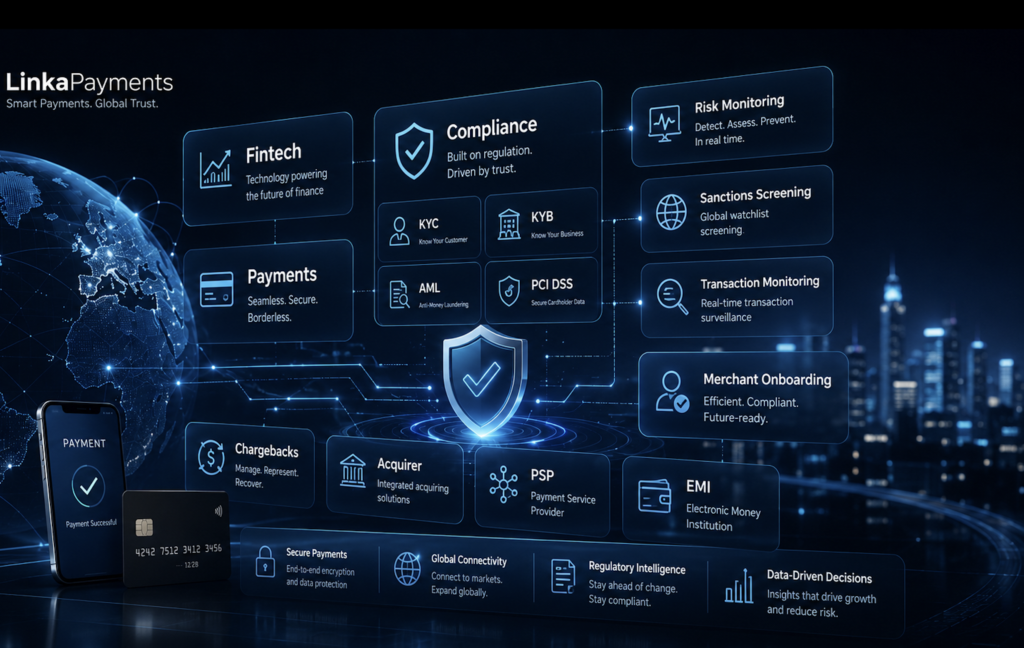
Fundamentals of acquiring and commercial risk
1. Acquiring Bank
Acquiring Bank is a central concept in payments, risk, and compliance. It's a financial institution that enables merchants to accept credit and debit card payments. It acts as a bridge between the merchant, the customer, and the card networks (Visa, Mastercard, etc.), facilitating the authorization, processing, and settlement of transactions. In high-risk markets, it assumes additional risks and applies strict controls. Operationally, it influences the merchant's acceptance, the contractual structure, the flow of funds, and the exposure assumed by the acquirer, the PSP, or the sponsoring bank in the event of subsequent issues. In high-risk verticals, it's analyzed along with the website, refund policy, fulfillment, traffic source, geography, MCC, and consistency between reported and actual processed activity. If it's poorly defined or documented, it can result in higher pricing, additional reservations, volume limits, extraordinary reviews, or even account termination due to misrepresentation. That's why it's typically reviewed during onboarding, underwriting, and portfolio monitoring, and its proper management improves processing stability, reduces friction with card schemes, and facilitates more sustainable relationships with payment providers. At linkapayments.com, we connect merchants with payment solution providers and banks.
2. High-Risk Merchant Account
A High-Risk Merchant Account is a core concept in payments, risk, and compliance. This merchant account is designed for businesses operating in sectors categorized as high-risk (e.g., gambling, forex, CBD, adult entertainment). These accounts have higher fees, reserves, and additional compliance requirements due to a greater likelihood of fraud and chargebacks. Operationally, it influences merchant acceptance, contractual structure, cash flow, and the exposure assumed by the acquirer, PSP, or sponsor bank in the event of subsequent incidents. In high-risk verticals, it is analyzed in conjunction with the website, refund policy, fulfillment process, traffic source, geography, MCC, and consistency between reported and actual processed activity. A poorly defined or documented account can result in higher pricing, additional reserves, volume limits, extraordinary reviews, or even account termination due to misrepresentation. Therefore, it is typically reviewed during onboarding, underwriting, and portfolio monitoring, and its proper management improves processing stability, reduces friction with card schemes, and facilitates more sustainable relationships with payment providers.
3. Chargeback
Chargeback is a core concept in payments, risk, and compliance that we at linkapayments.com understand perfectly. It's the reversal of a transaction requested by the customer's issuing bank when the customer is unaware of, disputes, or considers a charge fraudulent. In high-risk industries, chargebacks are frequent, impacting the merchant's reputation and their ability to maintain active accounts. Operationally, it affects the merchant's acceptance, the contractual structure, the flow of funds, and the exposure assumed by the acquirer, the PSP, or the sponsoring bank in the event of subsequent incidents. In high-risk verticals, it's analyzed along with the website, refund policy, fulfillment, traffic source, geography, MCC, and consistency between declared and actually processed activity. If it's poorly defined or documented, it can result in higher pricing, additional reservations, volume limits, extraordinary reviews, or even account termination due to misrepresentation. Therefore, it is typically reviewed during onboarding, underwriting, and portfolio monitoring, and its proper management improves processing stability, reduces friction with card schemes, and facilitates more sustainable relationships with payment providers. Its monitoring should be segmented by MID, country, BIN, product, and traffic source, because the root cause is rarely singular or uniform.
4. Rolling Reserve
Rolling Reserve is a core concept in payments, risk, and compliance. It involves the acquirer or PSP retaining a percentage of a merchant's sales for a defined period (e.g., 180 days). This is used to cover potential refunds, fraud, or chargebacks. In high-risk verticals, it is typically higher and longer. Operationally, it influences merchant acceptance, the contractual structure, cash flow, and the exposure assumed by the acquirer, PSP, or sponsoring bank in the event of subsequent incidents. In high-risk verticals, it is analyzed in conjunction with website, refund policy, fulfillment, traffic source, geography, MCC, and consistency between reported and actually processed activity. If it is poorly defined or documented, it can result in higher pricing, additional reserves, volume limits, extraordinary reviews, or even account termination due to misrepresentation. Therefore, it is usually reviewed during onboarding, underwriting, and portfolio monitoring, and its proper management improves processing stability, reduces friction with card schemes, and facilitates more sustainable relationships with payment providers. For the merchant, the key is to model its real impact on cash flow and growth, not just to accept the contractual condition out of immediate business necessity.
5. MATCH List (TMF)
The Match List (TMF) is a core concept in payments, risk, and compliance. This database, managed by Mastercard (and recognized by Visa), includes merchants blacklisted for fraud, regulatory non-compliance, or serious risks. Being on this list makes it difficult for a business to obtain new processing accounts. Operationally, it affects merchant acceptance, contractual structure, funds flow, and the exposure assumed by the acquirer, PSP, or sponsor bank in the event of subsequent incidents. In high-risk verticals, it is analyzed along with website, refund policy, fulfillment, traffic source, geography, MCC, and consistency between declared and actually processed activity. If it is poorly defined or documented, it can result in higher pricing, additional reservations, volume limits, extraordinary reviews, or even account termination due to misrepresentation. Therefore, it is typically reviewed during onboarding, underwriting, and portfolio monitoring, and its proper management improves processing stability, reduces friction with card schemes, and facilitates more sustainable relationships with payment providers.
6. Underwriting
Underwriting is a core concept in payments, risk, and compliance. It's a risk assessment process performed by an acquirer or PSP before approving a merchant. This includes analyzing the business model, industry, financial history, and projections. In the high-risk sector, underwriting is more detailed and rigorous. Operationally, it influences merchant acceptance, the contractual structure, cash flow, and the exposure assumed by the acquirer, PSP, or sponsoring bank in the event of future issues. In high-risk verticals, it's analyzed in conjunction with the website, refund policy, fulfillment process, traffic source, geography, MCC (Market Credit Card), and consistency between reported and actual processed activity. If it's poorly defined or documented, it can result in higher pricing, additional reservations, volume limits, extraordinary reviews, or even account termination due to misrepresentation. Therefore, it's typically reviewed during onboarding, underwriting, and portfolio monitoring, and its proper management improves processing stability, reduces friction with card schemes, and fosters more sustainable relationships with payment providers.
7. MCC (Merchant Category Code)
The Merchant Category Code (MCC) is a core concept in payments, risk, and compliance. It's a four-digit code assigned by card networks that classifies a business's activity. It determines applicable risk policies, fees, and terms. High-risk merchants are often associated with sensitive MCCs (e.g., 7995 for betting). Operationally, it influences merchant acceptance, contractual structure, fund flow, and the exposure assumed by the acquirer, PSP, or sponsor bank in the event of subsequent issues. In high-risk verticals, it's analyzed along with website, refund policy, fulfillment, traffic source, geography, MCC, and consistency between declared and actually processed activity. A poorly defined or documented MCC can result in higher pricing, additional reservations, volume limits, extraordinary reviews, or even account termination due to misrepresentation. Therefore, it's typically reviewed during onboarding, underwriting, and portfolio monitoring, and its proper management improves processing stability, reduces friction with card schemes, and facilitates more sustainable relationships with payment providers.
8. Descriptor
A transaction descriptor is a core concept in payments, risk, and compliance. It's the text that appears on a customer's bank statement to identify a transaction. In high-risk verticals, a clear and transparent descriptor reduces the likelihood of disputes and chargebacks, as the customer recognizes the charge. Operationally, it influences the merchant's acceptance, the contractual structure, the flow of funds, and the exposure assumed by the acquirer, the PSP, or the sponsoring bank in the event of subsequent issues. In high-risk verticals, it's analyzed along with the website, refund policy, fulfillment process, traffic source, geography, MCC, and consistency between reported and actually processed activity. If it's poorly defined or documented, it can result in higher pricing, additional reservations, volume limits, extraordinary reviews, or even account termination due to misrepresentation. Therefore, it's typically reviewed during onboarding, underwriting, and portfolio monitoring, and its proper management improves processing stability, reduces friction with card schemes, and facilitates more sustainable relationships with payment providers.
9. Nested Merchanting
Nested Merchant is a core concept in payments, risk, and compliance. It's a practice where a merchant processes payments on behalf of other, hidden businesses without acquirer approval. This is considered illegal and high-risk, as it conceals the true nature of transactions and can involve fraud or money laundering. Operationally, it affects merchant acceptance, contractual structure, fund flow, and the exposure assumed by the acquirer, PSP, or sponsor bank in the event of subsequent issues. In high-risk verticals, it's analyzed in conjunction with website, refund policy, fulfillment, traffic source, geography, MCC, and consistency between declared and actually processed activity. If poorly defined or documented, it can result in higher pricing, additional reservations, volume limits, extraordinary reviews, or even account termination due to misrepresentation. Therefore, it's typically reviewed during onboarding, underwriting, and portfolio monitoring, and its proper management improves processing stability, reduces friction with card schemes, and facilitates more sustainable relationships with payment providers.
10. Dormant Account
Dormant Accounts are a core concept in payments, risk, and compliance. A dormant account is a payment processing account that has been inactive for an extended period. For acquirers and PSPs, it represents a risk because it can be suddenly reactivated with suspiciously high volumes, a typical pattern in fraudulent schemes. Operationally, it affects merchant acceptance, contractual structure, fund flow, and the exposure assumed by the acquirer, PSP, or sponsoring bank in the event of subsequent incidents. In high-risk verticals, it is analyzed in conjunction with website, refund policy, fulfillment, traffic source, geography, MCC, and consistency between reported and actually processed activity. If it is poorly defined or documented, it can result in higher pricing, additional reservations, volume limits, extraordinary reviews, or even account termination due to misrepresentation. Therefore, it is typically reviewed during onboarding, underwriting, and portfolio monitoring, and its proper management improves processing stability, reduces friction with card schemes, and facilitates more sustainable relationships with payment providers.
Compliance, AML/CFT and risk governance
11. AML (Anti-Money Laundering)
AML (Anti-Money Laundering) is a core concept in payments, risk, and compliance. It comprises a set of laws, controls, and procedures designed to prevent financial systems from being used for money laundering. In high-risk payments, it requires policies, transaction monitoring, and reporting of suspicious transactions. This involves screening customers and transactions against restricted lists. Non-compliance can result in severe penalties and account closures. In practice, it forms part of the control framework used by banks, EMIs, PSPs, and fintechs to demonstrate that they know their customers, understand the risks, and apply measures proportionate to their actual exposure. It is not limited to an initial document review but requires methodology, evidence, risk matrices, screening, governance, decision traceability, and the ability to escalate controls when relevant alerts arise. In high-risk cases, it typically combines jurisdiction, shareholding structure, UBOs, product nature, sources of funds, transaction patterns, reputational risk, and potential implications of sanctions or AML/CFT. Its flawed implementation can lead to onboarding failures, acceptance of unsuitable clients, audit findings, or an inability to justify to regulators why a particular business relationship was allowed. Documentation typically relies on commercial records, external databases, screening providers, client declarations, and other evidence to defend the decision before an auditor or supervisor.
12. CFT (Counter Financing of Terrorism)
Counter-Terrorist Financing (CFT) is a core concept in payments, risk, and compliance. It's a regulatory and operational framework designed to prevent the financing of terrorist activities through payment channels or remittances. It complements Anti-Money Laundering (AML) with sanctions lists, monitoring by geography, and specific types of transactions. It requires enhanced due diligence (EDD) and blocking when there is a substantiated risk. It's key in verticals involving cross-border payments. In practice, it forms part of the control framework used by banks, EMIs, PSPs, and fintechs to demonstrate that they know their customers, understand the risk, and apply measures proportionate to their actual exposure. It's not limited to an initial document review but requires methodology, evidence, risk matrices, screening, governance, traceability of decisions, and the ability to escalate controls when relevant alerts arise. In high-risk situations, it typically combines jurisdiction, shareholding structure, UBOs, product nature, sources of funds, transaction patterns, reputational risk, and potential sanctions or AML/CFT implications. Its flawed implementation can lead to onboarding failures, acceptance of unsuitable clients, audit findings, or an inability to justify to regulators why a particular business relationship was allowed. Documentation typically relies on commercial records, external databases, screening providers, client declarations, and other evidence to defend the decision before an auditor or supervisor.
13. Risk Appetite
Risk Appetite is a core concept in payments, risk, and compliance that we at www.linkapayments.com understand well. It represents the level of risk that an entity (PSP, acquirer, bank) is willing to accept in its portfolio of merchants and transactions. It defines thresholds for fraud, chargebacks, and acceptable regulatory exposure. It is reflected in internal policies and underwriting guidelines. It informs approval, pricing, and reservation decisions. In practice, it forms part of the control framework used by banks, EMIs, PSPs, and fintechs to demonstrate that they know their customers, understand the risk, and apply measures proportionate to their actual exposure. It is not limited to an initial document review but requires methodology, evidence, risk matrices, screening, governance, decision traceability, and the ability to escalate controls when relevant alerts arise. In high-risk cases, it typically combines jurisdiction, shareholding structure, UBOs, product nature, funding sources, transaction patterns, reputational risk, and potential implications of sanctions or AML/CFT. Its poor implementation can lead to onboarding failures, acceptance of unsuitable clients, audit findings, or an inability to justify to the regulator why a certain business relationship was allowed.
14. Risk Scoring
Risk scoring is a core concept in payments, risk, and compliance. It's a quantitative methodology for assigning a risk score to merchants or transactions, combining variables such as industry, country, fraud history, and usage patterns. It facilitates automated decisions (approve, review, reject). In high-risk transactions, it leverages statistical models and behavioral signals. It allows for adjusting controls based on the profile. In practice, it forms part of the control framework used by banks, EMIs, PSPs, and fintechs to demonstrate that they know their customers, understand the risk, and apply measures proportionate to their actual exposure. It's not limited to an initial document review but requires methodology, evidence, risk matrices, screening, governance, decision traceability, and the ability to escalate controls when relevant alerts arise. In high-risk transactions, it typically combines jurisdiction, shareholding structure, UBOs, product nature, funding sources, transaction patterns, reputational risk, and potential implications of sanctions or AML/CFT. Poor implementation can lead to onboarding failures, acceptance of ineligible customers, audit findings, or an inability to justify to regulators why a particular business relationship was allowed. At linkapayments.com, we connect merchants with payment solution providers based on their business profile.
15. Reserve Account
Reserve Accounts are a core concept in payments, risk, and compliance. They represent an account or balance held by the acquirer/PSP to cover potential refunds, fraud, and disputes. Reserve Accounts can be rolling, fixed, or hybrid, with defined terms (e.g., 180 days). They impact the merchant's cash flow but protect the processor's operational continuity. Reserve Accounts are typically higher in sectors with higher loss rates. In practice, they form part of the control framework used by banks, EMIs, PSPs, and fintechs to demonstrate that they know their customers, understand the risk, and apply measures proportionate to their actual exposure. This goes beyond an initial document review and requires methodology, evidence, risk matrices, screening, governance, decision traceability, and the ability to escalate controls when relevant alerts arise. In high-risk sectors, Reserve Accounts often combine jurisdiction, shareholding structure, UBOs, product nature, funding sources, transaction patterns, reputational risk, and potential sanctions or AML/CFT implications. Poor implementation can lead to onboarding failures, acceptance of unsuitable customers, audit findings, or an inability to justify to regulators why a particular business relationship was allowed. For merchants, the key is to model its real impact on cash flow and growth, not just to accept the contractual condition out of immediate business necessity.
16. Early Warning System
An Early Warning System (EWS) is a core concept in payments, risk, and compliance. It's an early warning system that detects risk signals (increases in chargebacks, fraud binaries, volume spikes) before they escalate. It allows for the activation of preventative measures such as enhanced verification, limits, or pauses. It integrates rules, machine learning, and external feeds. It's critical for keeping chargeback rates under control. In practice, it forms part of the control framework used by banks, EMIs, PSPs, and fintechs to demonstrate that they know their customers, understand the risk, and apply measures proportionate to their actual exposure. It's not limited to an initial document review but requires methodology, evidence, risk matrices, screening, governance, decision traceability, and the ability to escalate controls when relevant alerts arise. In high-risk situations, it typically combines jurisdiction, shareholding structure, UBOs, product nature, funding sources, transaction patterns, reputational risk, and potential implications of sanctions or AML/CFT. Its poor implementation can lead to onboarding failures, acceptance of unsuitable clients, audit findings, or an inability to justify to the regulator why a certain business relationship was allowed.
17. Blacklist
Blacklisting is a core concept in payments, risk, and compliance. It's an internal or shared list of banned identifiers (cards, IPs, emails, devices, merchants) due to fraud, abuse, or non-compliance. It automatically blocks new transactions or account activations. It must be governed with clear criteria to avoid false positives. In high-risk cases, it's updated dynamically. In practice, it forms part of the control framework used by banks, EMIs, PSPs, and fintechs to demonstrate that they know their customers, understand the risk, and apply measures proportionate to their actual exposure. It's not limited to an initial document review but requires methodology, evidence, risk matrices, screening, governance, decision traceability, and the ability to escalate controls when relevant alerts arise. In high-risk cases, it typically combines jurisdiction, shareholding structure, UBOs, product nature, funding sources, transaction patterns, reputational risk, and potential implications of sanctions or AML/CFT. Its poor implementation can lead to onboarding failures, acceptance of unsuitable clients, audit findings, or an inability to justify to the regulator why a certain business relationship was allowed.
18. Whitelist
Whitelisting is a core concept in payments, risk, and compliance. It's a list of previously validated and trusted entities or attributes (customers, IPs, BINs, domains) that receive preferential treatment or less friction. It's used to improve conversion rates and user experience when risk is low. It requires periodic review to prevent degradation of control. It complements blacklisting. In practice, it forms part of the control framework used by banks, EMIs, PSPs, and fintechs to demonstrate that they know their customers, understand the risk, and apply measures proportionate to their actual exposure. It's not limited to an initial document review but requires methodology, evidence, risk matrices, screening, governance, decision traceability, and the ability to escalate controls when relevant alerts arise. In high-risk situations, it typically combines jurisdiction, shareholding structure, UBOs, product nature, funding sources, transaction patterns, reputational risk, and potential implications of sanctions or AML/CFT. Its poor implementation can lead to onboarding failures, acceptance of unsuitable clients, audit findings, or an inability to justify to the regulator why a certain business relationship was allowed.
19. Greylist
Greylisting is a core concept in payments, risk, and compliance. It's an intermediate category for questionable items that don't warrant immediate blocking but require further verification or a delay. It helps reduce false negatives without penalizing conversion. It typically triggers MFA, additional documentation, or manual review. It's useful when the risk context is incomplete. In practice, it forms part of the control framework used by banks, EMIs, PSPs, and fintechs to demonstrate that they know their customers, understand the risk, and apply measures proportionate to their actual exposure. It's not limited to an initial document review but requires methodology, evidence, risk matrices, screening, governance, decision traceability, and the ability to escalate controls when relevant alerts arise. In high-risk cases, it often combines jurisdiction, shareholding structure, UBOs, product nature, funding sources, transaction patterns, reputational risk, and potential sanctions or AML/CFT implications. Poor implementation can lead to onboarding failures, acceptance of unsuitable customers, audit findings, or an inability to justify to regulators why a particular business relationship was allowed.
20. Shell Company
Shell companies are a central concept in payments, risk, and compliance. A shell company with minimal operational activity is sometimes used to conceal beneficial owners or disguise financial flows. It represents a high risk in terms of AML/CFT and KYB. It requires thorough verification of ultimate beneficial owners (UBOs), sources of funds, and economic purpose. Misuse can lead to rejections and regulatory reports. In practice, it forms part of the control framework used by banks, EMIs, PSPs, and fintechs to demonstrate that they know their customers, understand the risk, and apply measures proportionate to their actual exposure. This goes beyond an initial document review and requires methodology, evidence, risk matrices, screening, governance, decision traceability, and the ability to escalate controls when relevant alerts arise. In high-risk cases, it typically combines jurisdiction, shareholding structure, UBOs, product nature, sources of funds, transaction patterns, reputational risk, and potential sanctions or AML/CFT implications. Its poor implementation can lead to onboarding failures, acceptance of unsuitable clients, audit findings, or an inability to justify to the regulator why a certain business relationship was allowed.
21. UBO (Ultimate Beneficial Owner)
Ultimate Beneficial Owner (UBO) is a central concept in payments, risk, and compliance. It refers to the individual(s) who, directly or indirectly, ultimately owns or controls a company. Identifying a UBO is mandatory in Know Your Business (KYB) procedures to prevent money laundering and penalties. This is verified through corporate documentation, records, and sworn statements. UBO identification is key to assessing a client's actual risk. In practice, it forms part of the control framework used by banks, IMBs, PSPs, and fintechs to demonstrate that they know their clients, understand the risk, and apply measures proportionate to their actual exposure. This assessment goes beyond an initial document review and requires methodology, evidence, risk matrices, screening, governance, decision traceability, and the ability to escalate controls when relevant alerts arise. In high-risk cases, it typically combines jurisdiction, shareholding structure, UBOs, product nature, sources of funds, transaction patterns, reputational risk, and potential implications of sanctions or AML/CFT. Its flawed implementation can lead to onboarding failures, acceptance of unsuitable clients, audit findings, or an inability to justify to regulators why a particular business relationship was allowed. Documentation typically relies on commercial records, external databases, screening providers, client declarations, and other evidence to defend the decision before an auditor or supervisor.
22. Sanctions List Screening
Sanctions List Screening is a core concept in payments, risk, and compliance. It's a systematic process of cross-referencing clients, counterparties, and payments against sanctions lists (OFAC, EU, UN, etc.). This involves both exact and fuzzy matches, with the resolution of false positives. In the event of a true match, funds must be blocked and the relevant authority notified. It's a continuous and mandatory control. In practice, it forms part of the control framework used by banks, EIs, PSPs, and fintechs to demonstrate that they know their customers, understand the risk, and apply measures proportionate to their actual exposure. It's not limited to an initial document review but requires methodology, evidence, risk matrices, screening, governance, decision traceability, and the ability to escalate controls when relevant alerts arise. In high-risk cases, it typically combines jurisdiction, shareholding structure, UBOs, product nature, funding sources, transaction patterns, reputational risk, and potential sanctions or AML/CFT implications. Its flawed implementation can lead to onboarding failures, acceptance of unsuitable clients, audit findings, or an inability to justify to regulators why a particular business relationship was allowed. Documentation typically relies on commercial records, external databases, screening providers, client declarations, and other evidence to defend the decision before an auditor or supervisor.
23. Politically Exposed Person (PEP)
Politically Exposed Person (PEP) is a central concept in payments, risk, and compliance. An individual with prominent public functions (or their associates) is subject to heightened scrutiny due to corruption risk. This requires evidence-based decision-making (EDD), enhanced monitoring, and senior approval. It does not imply automatic rejection, but it does entail stricter controls. It is a relevant risk factor in onboarding and monitoring. In practice, it forms part of the control framework used by banks, EMIs, PSPs, and fintechs to demonstrate that they know their customers, understand the risk, and apply measures proportionate to their actual exposure. It is not limited to an initial document review but requires methodology, evidence, risk matrices, screening, governance, decision traceability, and the ability to escalate controls when relevant alerts arise. In high-risk cases, it typically combines jurisdiction, shareholding structure, UBOs, product nature, sources of funds, transaction patterns, reputational risk, and potential implications of sanctions or AML/CFT. Its flawed implementation can lead to onboarding failures, acceptance of unsuitable clients, audit findings, or an inability to justify to regulators why a particular business relationship was allowed. Documentation typically relies on commercial records, external databases, screening providers, client declarations, and other evidence to defend the decision before an auditor or supervisor.
24. KYB (Know Your Business)
Know Your Business (KYB) is a core concept in payments, risk, and compliance, one that we at linkapayments.com understand very well. It involves due diligence on corporate entities to validate their legality, structure, activities, business units (UBOs), and jurisdictions. This includes articles of incorporation, registrations, licenses, proof of address, and domain. In high-risk cases, it expands to include business model and traffic analysis. It influences limits, pricing, and acceptance. In practice, it forms part of the control framework used by banks, EMIs, PSPs, and fintechs to demonstrate that they know their customers, understand the risk, and apply measures proportionate to their actual exposure. It is not limited to an initial document review but requires methodology, evidence, risk matrices, screening, governance, decision traceability, and the ability to escalate controls when relevant alerts arise. In high-risk cases, it typically combines jurisdiction, shareholding structure, UBOs, product nature, sources of funds, transaction patterns, reputational risk, and potential implications of sanctions or AML/CFT. Its flawed implementation can lead to onboarding failures, acceptance of unsuitable clients, audit findings, or an inability to justify to regulators why a particular business relationship was allowed. Documentation typically relies on commercial records, external databases, screening providers, client declarations, and other evidence to defend the decision before an auditor or supervisor.
25. KYCC (Know Your Customer's Customer)
KYCC (Know Your Customer's Customer) is a core concept in payments, risk, and compliance. It extends due diligence to intermediary models (e.g., platforms, marketplaces) where the end merchant is not the direct customer of the PSP. It aims to prevent nested merchanting and downstream illicit transactions. It requires policies and controls proportionate to the risk. In practice, it forms part of the control framework used by banks, EMIs, PSPs, and fintechs to demonstrate that they know their customers, understand the risk, and apply measures proportionate to their actual exposure. It is not limited to an initial document review but requires methodology, evidence, risk matrices, screening, governance, decision traceability, and the ability to escalate controls when relevant alerts arise. In high-risk cases, it typically combines jurisdiction, shareholding structure, UBOs, product nature, sources of funds, transaction patterns, reputational risk, and potential implications of sanctions or AML/CFT. Its flawed implementation can lead to onboarding failures, acceptance of unsuitable clients, audit findings, or an inability to justify to regulators why a particular business relationship was allowed. Documentation typically relies on commercial records, external databases, screening providers, client declarations, and other evidence to defend the decision before an auditor or supervisor.
26. EDD (Enhanced Due Diligence)
Enhanced Due Diligence (EDD) is a core concept in payments, risk, and compliance. It involves rigorous due diligence applied to high-risk clients (PEPs, sensitive jurisdictions, complex business models). It demands additional evidence, higher-level approvals, and intensive monitoring. It typically includes analysis of funding and revenue sources. It is standard practice in high-risk verticals. In practice, it forms part of the control framework used by banks, EMIs, PSPs, and fintechs to demonstrate that they know their clients, understand the risk, and apply measures proportionate to their actual exposure. It is not limited to an initial document review but requires methodology, evidence, risk matrices, screening, governance, decision traceability, and the ability to escalate controls when relevant alerts arise. In high-risk sectors, it often combines jurisdiction, shareholding structure, UBOs, product nature, funding sources, transaction patterns, reputational risk, and potential sanctions or AML/CFT implications. Its flawed implementation can lead to onboarding failures, acceptance of unsuitable clients, audit findings, or an inability to justify to regulators why a particular business relationship was allowed. Documentation typically relies on commercial records, external databases, screening providers, client declarations, and other evidence to defend the decision before an auditor or supervisor.
27. CDD (Customer Due Diligence)
Customer Due Diligence (CDD) is a core concept in payments, risk, and compliance. It's the fundamental due diligence process for identifying and verifying customers before and during a business relationship. This includes KYC/KYB, account purpose verification, and continuous monitoring. In case of risk indicators, it escalates to EDD (Enhanced Due Diligence). It's a pillar of AML/CFT (Anti-Money Laundering/Combating the Financing of Terrorism) and a cross-cutting regulatory requirement. In practice, it forms part of the control framework used by banks, EMIs (Emerging Market Publishers), PSPs (Payment Service Providers), and fintechs to demonstrate that they know their customers, understand the risks, and apply measures proportionate to their actual exposure. It's not limited to an initial document review but requires methodology, evidence, risk matrices, screening, governance, decision traceability, and the ability to escalate controls when relevant alerts arise. In high-risk cases, it typically combines jurisdiction, shareholding structure, UBOs (Unit Business Owners), product nature, sources of funds, transaction patterns, reputational risk, and potential sanctions or AML/CFT implications. Its flawed implementation can lead to onboarding failures, acceptance of unsuitable clients, audit findings, or an inability to justify to regulators why a particular business relationship was allowed. Documentation typically relies on commercial records, external databases, screening providers, client declarations, and other evidence to defend the decision before an auditor or supervisor.
28. Onboarding Risk Assessment
Onboarding Risk Assessment is a core concept in payments, risk, and compliance. It's a comprehensive risk assessment conducted before activating a merchant account, considering vertical, geography, experience, projections, refund policies, support, and compliance. It determines whether an account is approved, what limits apply, and what reserves to apply. This reduces subsequent rejections and exposure to sanctions. In practice, it forms part of the control framework used by banks, EMIs, PSPs, and fintechs to demonstrate that they know their customers, understand the risk, and apply measures proportionate to their actual exposure. It goes beyond an initial document review, requiring methodology, evidence, risk matrices, screening, governance, decision traceability, and the ability to escalate controls when relevant alerts arise. In high-risk applications, it typically combines jurisdiction, shareholding structure, UBOs, product nature, funding sources, transaction patterns, reputational risk, and potential sanctions or AML/CFT implications. Poor implementation can lead to onboarding failures, acceptance of unsuitable customers, audit findings, or an inability to justify to regulators why a particular business relationship was allowed.
29. Risk-Based Approach
Risk-Based Approach (RBA) is a core concept in payments, risk, and compliance. It's a compliance approach that allocates resources and controls based on the risk level of each client and transaction. It avoids one-size-fits-all solutions and improves operational efficiency. It requires methodology, documentation, and evidence of application. It's the standard required by regulators. In practice, it forms part of the control framework used by banks, EMIs, PSPs, and fintechs to demonstrate that they know their clients, understand the risk, and apply measures proportionate to their actual exposure. It's not limited to an initial document review but requires methodology, evidence, risk matrices, screening, governance, decision traceability, and the ability to escalate controls when relevant alerts arise. In high-risk transactions, it typically combines jurisdiction, shareholding structure, UBOs, product nature, sources of funds, transaction patterns, reputational risk, and potential implications of sanctions or AML/CFT. Its poor implementation can lead to onboarding failures, acceptance of unsuitable clients, audit findings, or an inability to justify to the regulator why a certain business relationship was allowed.
30. Compliance Officer
The Compliance Officer is a central figure in payments, risk, and compliance. They are responsible for designing, implementing, and overseeing the compliance program (AML/CFT, sanctions, privacy, PCI). They coordinate audits, training, and regulatory reporting. They act as a second line of defense and business advisor. Their independence and judgment are critical in high-risk environments. In practice, they form part of the control framework used by banks, EMIs, PSPs, and fintechs to demonstrate that they know their customers, understand the risks, and apply measures proportionate to their actual exposure. This goes beyond an initial document review; it requires methodology, evidence, risk matrices, screening, governance, decision traceability, and the ability to escalate controls when relevant alerts arise. In high-risk environments, this role typically combines jurisdiction, shareholding structure, UBOs, product nature, funding sources, transaction patterns, reputational risk, and potential sanctions or AML/CFT implications. Poor implementation can lead to onboarding failures, acceptance of unsuitable clients, audit findings, or an inability to justify to regulators why a particular business relationship was allowed.
Fraud, authentication, and transactional security
31. 3D Secure
3D Secure is a core concept in payments, risk, and compliance. It's a security protocol that adds an extra layer of authentication to online card transactions. It requires the customer to confirm the purchase using a key, token, or biometrics. It reduces Card Not Present (CNP) fraud and is mandatory in the EU under PSD2. In fraud prevention, it's evaluated along with signals such as IP address, BIN, device type, attempt speed, user behavior, data consistency, and the history of the payment method or account used. Its relevance increases in card-not-present and remote sales environments, where authentication must be supported by analytical layers and compensating controls to balance security and conversion. Risk teams typically combine rules, machine learning, trusted lists, block lists, and manual review because overly permissive controls allow fraud to pass through, while overly aggressive controls destroy legitimate approvals. When not properly controlled, the impact manifests as chargebacks, lost revenue, additional fees, false positives, portfolio deterioration, and increasing pressure from the acquirer. When acting as an authentication mechanism, its effectiveness depends on adding sufficient validation without introducing disproportionate friction that unnecessarily degrades the conversion.
32. Friendly Fraud
Friendly fraud is a core concept in payments, risk, and compliance. It occurs when a legitimate customer makes a purchase and subsequently requests a chargeback, claiming they didn't recognize the transaction. This generates significant losses for high-risk merchants in sectors like gaming and adult entertainment, where subsequent denials are common. In fraud prevention, it's assessed alongside signals such as IP address, BIN, device type, attempt speed, user behavior, data consistency, and the history of the payment method or account used. Its relevance increases in card-not-present and remote sales environments, where authentication must be supported by analytical layers and compensating controls to balance security and conversion. Risk teams typically combine rules, machine learning, trusted lists, block lists, and manual review because overly permissive controls allow fraud to pass through, while overly aggressive controls destroy legitimate authorizations. When not properly controlled, the impact manifests as chargebacks, lost revenue, additional fees, false positives, portfolio deterioration, and increasing pressure from the acquirer. Its tracking should be segmented by MID, country, BIN, product, and traffic source, because the root cause is rarely unique or uniform.
33. Synthetic Identity Fraud
Synthetic Identity Fraud (SID) is a core concept in payments, risk, and compliance. It involves creating fictitious identities by combining real and false data. These identities are used to open accounts or make payments, making detection difficult. This poses a growing challenge for PSPs and acquirers. In fraud prevention, SID is assessed alongside signals such as IP address, BIN, device type, attempt speed, user behavior, data consistency, and the history of the payment method or account used. Its relevance increases in card-not-present and remote sales environments, where authentication must be supported by analytical layers and compensating controls to balance security and conversion. Risk teams typically combine rules, machine learning, trusted lists, block lists, and manual review, because overly permissive controls allow fraud to pass through, while overly aggressive controls destroy legitimate approvals. When not properly controlled, the impact manifests as chargebacks, lost revenue, additional fees, false positives, portfolio deterioration, and increasing pressure from the acquirer.
34. Transaction Laundering
Transaction laundering is a core concept in payments, risk, and compliance. It's the practice of an authorized merchant processing payments from an undeclared entity. A form of nested merchanting, it conceals illegal activity under a legitimate facade and is grounds for immediate cancellation. In fraud prevention, it's assessed alongside signals such as IP address, BIN, device type, attempt speed, user behavior, data consistency, and the history of the payment method or account used. Its relevance increases in card-not-present and remote sales environments, where authentication must be supported by analytical layers and compensating controls to balance security and conversion. Risk teams typically combine rules, machine learning, trusted lists, block lists, and manual review, because overly permissive controls allow fraud to pass through, while overly aggressive controls destroy legitimate authorizations. When not properly controlled, the impact manifests as chargebacks, lost revenue, additional fees, false positives, portfolio deterioration, and increasing pressure from the acquirer.
35. Bust-Out Fraud
Bust-out fraud is a core concept in payments, risk, and compliance. It occurs when a customer builds a reliable payment history and then suddenly makes high-value transactions that they fail to pay for. It affects issuers and processors, is difficult to anticipate, and is common in high-risk markets. In fraud prevention, it is assessed along with signals such as IP address, BIN, device type, attempt speed, user behavior, data consistency, and the history of the payment method or account used. Its relevance increases in card-not-present and remote sales environments, where authentication must be supported by analytical layers and compensating controls to balance security and conversion. Risk teams typically combine rules, machine learning, trusted lists, block lists, and manual review because overly permissive controls allow fraud to go unchecked, while overly aggressive controls destroy legitimate approvals. When not properly controlled, the impact manifests as chargebacks, lost revenue, additional fees, false positives, portfolio deterioration, and increasing pressure from the acquirer.
36. Fraud Scoring
Fraud scoring is a core concept in payments, risk, and compliance. It's a fraud risk rating system based on algorithms, rules, and machine learning. Each transaction receives a score that determines whether it's approved, reviewed, or rejected. In fraud prevention, it's evaluated alongside signals such as IP address, BIN, device, attempt speed, user behavior, data consistency, and the history of the payment method or account used. Its relevance increases in card-not-present and remote sales environments, where authentication must be supported by analytical layers and compensating controls to balance security and conversion. Risk teams typically combine rules, machine learning, trusted lists, block lists, and manual review because overly permissive controls allow fraud to pass through, while overly aggressive controls destroy legitimate approvals. When not properly controlled, the impact manifests as chargebacks, lost revenue, additional fees, false positives, portfolio deterioration, and increasing pressure from the acquirer.
37. AVS (Address Verification System)
Address Verification System (AVS) is a core concept in payments, risk, and compliance. This system validates the cardholder's address against the one registered with the issuer. It's a widely used anti-fraud control in the US, especially for card-not-present (CNP) transactions. In fraud prevention, it's evaluated alongside signals such as IP address, BIN, device type, attempt speed, user behavior, data consistency, and the history of the payment method or account used. Its relevance increases in card-not-present and remote sales environments, where authentication must be supported by analytical layers and compensating controls to balance security and conversion. Risk teams typically combine rules, machine learning, trusted lists, block lists, and manual review because overly permissive controls allow fraud to pass through, while overly aggressive controls destroy legitimate approvals. When not properly controlled, the impact manifests as chargebacks, lost revenue, additional fees, false positives, portfolio deterioration, and increasing pressure from the acquirer.
38. Velocity Check
Velocity Check is a core concept in payments, risk, and compliance. It's a control that limits the number or amount of transactions allowed in a short period. It prevents automated attacks using compromised cards. In fraud prevention, it's evaluated along with signals such as IP address, BIN, device type, attempt speed, user behavior, data consistency, and the history of the payment method or account used. Its relevance increases in card-not-present and remote sales environments, where authentication must be supported by analytical layers and compensating controls to balance security and conversion. Risk teams often combine rules, machine learning, trusted lists, block lists, and manual review because overly permissive controls allow fraud to pass through, while overly aggressive controls destroy legitimate authorizations. When not properly controlled, the impact manifests as chargebacks, lost revenue, additional fees, false positives, portfolio deterioration, and increasing pressure from the acquirer.
39. BIN Blocking
BIN blocking is a core concept in payments, risk, and compliance. It involves blocking transactions originating from BINs (the first digits of a card) associated with high fraud or sanctioned regions. In fraud prevention, it is evaluated alongside signals such as IP address, BIN, device type, transaction attempt speed, user behavior, data consistency, and the history of the payment method or account used. Its relevance increases in card-not-present and remote sales environments, where authentication must be supported by analytical layers and compensating controls to balance security and conversion. Risk teams typically combine rules, machine learning, trusted lists, block lists, and manual review, because overly permissive controls allow fraud to pass through, while overly aggressive controls destroy legitimate authorizations. When not properly controlled, the impact manifests as chargebacks, lost revenue, additional fees, false positives, portfolio deterioration, and increasing pressure from the acquirer.
40. Device Fingerprinting
Device fingerprinting is a core concept in payments, risk, and compliance. This technique identifies unique characteristics of a customer's device (browser, operating system, IP address). It allows for the detection of suspicious patterns or fraud across multiple accounts. In fraud prevention, it is evaluated alongside signals such as IP address, BIN, device type, attempt speed, user behavior, data consistency, and the history of the payment method or account used. Its relevance increases in card-not-present and remote sales environments, where authentication must be supported by analytical layers and compensating controls to balance security and conversion. Risk teams typically combine rules, machine learning, trusted lists, block lists, and manual review, because overly permissive controls allow fraud to pass through, while overly aggressive controls destroy legitimate approvals. When not properly controlled, the impact manifests as chargebacks, lost revenue, additional fees, false positives, portfolio deterioration, and increasing pressure from the acquirer.
41. Geo-Blocking
Geo-blocking is a core concept in payments, risk, and compliance. It involves restricting transactions by country or region due to regulatory risks or high fraud rates. In fraud prevention, it's evaluated alongside signals such as IP address, BIN, device type, attempt speed, user behavior, data consistency, and the history of the payment method or account used. Its relevance increases in card-not-present and remote sales environments, where authentication must be supported by analytical layers and compensating controls to balance security and conversion. Risk teams typically combine rules, machine learning, trusted lists, block lists, and manual review because overly permissive controls allow fraud to pass through, while overly aggressive controls destroy legitimate approvals. When not properly controlled, the impact manifests as chargebacks, lost revenue, additional fees, false positives, portfolio deterioration, and increasing pressure from the acquirer.
42. Encryption
Encryption is a core concept in payments, risk, and compliance. It's a data protection method that converts sensitive information into encrypted text. It's essential for payment data transmission under PCI DSS. In fraud prevention, it's evaluated alongside signals such as IP address, BIN, device, attempt speed, user behavior, data consistency, and the history of the payment method or account used. Its relevance increases in card-not-present and remote sales environments, where authentication must be supported by analytical layers and compensating controls to balance security and conversion. Risk teams often combine rules, machine learning, trusted lists, block lists, and manual review because overly permissive controls allow fraud to pass through, while overly aggressive controls destroy legitimate approvals. When not properly controlled, the impact manifests as chargebacks, lost revenue, additional fees, false positives, portfolio deterioration, and increasing pressure from the acquirer.
43. End-to-End Encryption (E2EE)
End-to-End Encryption (E2EE) is a core concept in payments, risk, and compliance. It encrypts data from the point of origin to the final destination, ensuring that information such as card numbers cannot be read by intermediaries. In fraud prevention, it is evaluated alongside signals such as IP address, BIN, device type, attempt speed, user behavior, data consistency, and the history of the payment method or account used. Its relevance increases in card-not-present and remote sales environments, where authentication must be supported by analytical layers and compensating controls to balance security and conversion. Risk teams typically combine rules, machine learning, trusted lists, block lists, and manual review because overly permissive controls allow fraud to pass through, while overly aggressive controls destroy legitimate approvals. When not properly controlled, the impact manifests as chargebacks, lost revenue, additional fees, false positives, portfolio deterioration, and increasing pressure from the acquirer.
44. Fraud Detection AI
AI Fraud Detection is a core concept in payments, risk, and compliance. It uses artificial intelligence to identify fraud patterns in real time. This improves accuracy compared to static rules and adapts to new schemes. In fraud prevention, it is evaluated alongside signals such as IP address, BIN, device, attempt speed, user behavior, data consistency, and the history of the payment method or account used. Its relevance increases in card-not-present and remote sales environments, where authentication must be supported by analytical layers and compensating controls to balance security and conversion. Risk teams typically combine rules, machine learning, trusted lists, block lists, and manual review because overly permissive controls allow fraud to pass through, while overly aggressive controls destroy legitimate approvals. When not properly controlled, the impact manifests as chargebacks, lost revenue, additional fees, false positives, portfolio deterioration, and increasing pressure from the acquirer.
45. Bot Attacks
Bot attacks are a core concept in payments, risk, and compliance. They are automated fraud attempts, such as trying thousands of stolen card numbers in a matter of seconds. This requires specific defenses like CAPTCHAs and monitoring. In fraud prevention, bot attacks are evaluated alongside signals such as IP address, BIN, device type, attempt speed, user behavior, data consistency, and the history of the payment method or account used. Their relevance increases in card-not-present and remote sales environments, where authentication must be supported by analytical layers and compensating controls to balance security and conversion. Risk teams often combine rules, machine learning, trusted lists, block lists, and manual review because overly permissive controls allow fraud to pass through, while overly aggressive controls destroy legitimate approvals. When not properly controlled, the impact manifests as chargebacks, lost revenue, additional fees, false positives, portfolio deterioration, and increasing pressure from the acquirer.
46 Phishing
Phishing is a core concept in payments, risk, and compliance. It's a fraud technique that tricks users into handing over credentials or sensitive data. It's frequently carried out via email, SMS, or fake websites. In fraud prevention, it's assessed along with signals such as IP address, BIN, device type, attempt speed, user behavior, data consistency, and the history of the payment method or account used. Its relevance increases in card-not-present and remote sales environments, where authentication must be supported by analytical layers and compensating controls to balance security and conversion. Risk teams often combine rules, machine learning, trusted lists, block lists, and manual review because overly permissive controls allow fraud to pass through, while overly aggressive controls destroy legitimate approvals. When not properly controlled, the impact manifests as chargebacks, lost revenue, additional fees, false positives, portfolio deterioration, and increasing pressure from the acquirer.
47. Credential Stuffing
Credential stuffing is a core concept in payments, risk, and compliance. It's an attack where stolen credentials from one service are used to attempt to access multiple platforms. It threatens wallets and payment accounts. In fraud prevention, it's assessed alongside signals such as IP address, BIN, device, attempt speed, user behavior, data consistency, and the history of the payment method or account used. Its relevance increases in card-not-present and remote sales environments, where authentication must be supported by analytical layers and compensating controls to balance security and conversion. Risk teams typically combine rules, machine learning, trusted lists, block lists, and manual review because overly permissive controls allow fraud to pass through, while overly aggressive controls destroy legitimate approvals. When not properly controlled, the impact manifests as chargebacks, lost revenue, additional fees, false positives, portfolio deterioration, and increasing pressure from the acquirer.
48. Account Takeover Fraud
Account takeover fraud is a core concept in payments, risk, and compliance. It occurs when a malicious actor gains access to a legitimate customer account and performs illicit transactions. This can result from phishing or malware. In fraud prevention, it is assessed alongside signals such as IP address, BIN, device type, attempt speed, user behavior, data consistency, and the history of the payment method or account used. Its relevance increases in card-not-present and remote sales environments, where authentication must be supported by analytical layers and compensating controls to balance security and conversion. Risk teams typically combine rules, machine learning, trusted lists, block lists, and manual review, because overly permissive controls allow fraud to pass through, while overly aggressive controls destroy legitimate authorizations. When not properly controlled, the impact manifests as chargebacks, lost revenue, additional fees, false positives, portfolio deterioration, and increasing pressure from the acquirer.
49. Chargeback Mitigation Service
Chargeback Mitigation Service is a core concept in payments, risk, and compliance, which we at linkapayments.com understand. These are external services that help merchants reduce the impact of chargebacks. They include representations, early warnings, and refund management. In fraud prevention, it's evaluated alongside signals such as IP address, BIN, device, attempt speed, user behavior, data consistency, and the history of the payment method or account used. Its relevance increases in card-not-present and remote sales environments, where authentication must be supported by analytical layers and compensating controls to balance security and conversion. Risk teams often combine rules, machine learning, trusted lists, block lists, and manual review because overly permissive controls allow fraud to pass through, while overly aggressive controls destroy legitimate approvals. When not properly controlled, the impact appears in the form of chargebacks, lost revenue, additional fees, false positives, portfolio deterioration, and increasing pressure from the acquirer. Monitoring should be segmented by MID, country, BIN, product, and traffic source because the root cause is rarely singular or uniform.
50. Triangulation Fraud
Triangulation fraud is a core concept in payments, risk, and compliance. It's fraud where the perpetrator acts as an intermediary between buyer and seller, using stolen cards. This hinders traceability and commonly affects e-commerce. In fraud prevention, it's evaluated along with signals such as IP address, BIN, device type, attempt speed, user behavior, data consistency, and the history of the payment method or account used. Its relevance increases in card-not-present and remote sales environments, where authentication must be supported by analytical layers and compensating controls to balance security and conversion. Risk teams typically combine rules, machine learning, trusted lists, block lists, and manual review, because overly permissive controls allow fraud to pass through, while overly aggressive controls destroy legitimate approvals. When not properly controlled, the impact manifests as chargebacks, lost revenue, additional fees, false positives, portfolio deterioration, and increasing pressure from the acquirer.
51. Multi-Factor Authentication
Multi-factor authentication (MFA) is a core concept in payments, risk, and compliance. It's a security method that requires more than one form of verification to authorize a transaction or access. It can combine something the customer knows (password), something they have (token), and something they are (biometrics). Mandatory under PSD2, it reduces card-not-present (CNP) fraud. In fraud prevention, it's evaluated alongside signals such as IP address, BIN, device type, attempt speed, user behavior, data consistency, and the history of the payment method or account used. Its relevance increases in card-not-present and remote sales environments, where authentication must be supported by analytical layers and compensating controls to balance security and conversion. Risk teams typically combine rules, machine learning, trusted lists, block lists, and manual review, because overly permissive controls allow fraud to pass through, while overly aggressive controls destroy legitimate authorizations. When not properly controlled, the impact manifests as chargebacks, lost revenue, additional fees, false positives, portfolio deterioration, and increasing pressure from the acquirer. When acting as an authentication mechanism, its effectiveness depends on adding sufficient validation without introducing disproportionate friction that unnecessarily degrades the conversion.
52. Card Testing Fraud
Card testing fraud is a core concept in payments, risk, and compliance. It involves criminals testing multiple stolen cards with small transactions to verify their validity. Once confirmed, they use them for larger transactions. This affects e-commerce and generates costs through chargebacks. In fraud prevention, it is evaluated along with signals such as IP address, BIN, device type, attempt speed, user behavior, data consistency, and the history of the payment method or account used. Its relevance increases in card-not-present and remote sales environments, where authentication must be supported by analytical layers and compensating controls to balance security and conversion. Risk teams typically combine rules, machine learning, trusted lists, block lists, and manual review, because overly permissive controls allow fraud to pass through, while overly aggressive controls destroy legitimate authorizations. When not properly controlled, the impact manifests as chargebacks, lost revenue, additional fees, false positives, portfolio deterioration, and increasing pressure from the acquirer.
53. Deepfake Fraud
Deepfake fraud is a central concept in payments, risk, and compliance. It involves the use of artificial intelligence technologies to falsify voices or images in authentication processes. It represents a growing risk in remote identity validation and requires new biometric defenses. In fraud prevention, it is evaluated alongside signals such as IP address, BIN, device type, attempt speed, user behavior, data consistency, and the history of the payment method or account used. Its relevance increases in card-not-present and remote sales environments, where authentication must be supported by analytical layers and compensating controls to balance security and conversion. Risk teams typically combine rules, machine learning, trusted lists, block lists, and manual review because overly permissive controls allow fraud to pass through, while overly aggressive controls destroy legitimate approvals. When not properly controlled, the impact manifests as chargebacks, lost revenue, additional fees, false positives, portfolio deterioration, and increasing pressure from the acquirer.
54. Behavioral Biometrics
Behavioral biometrics is a core concept in payments, risk, and compliance. This technology analyzes human behavior patterns (typing speed, mouse movements, mobile usage) to detect fraud. It complements MFA and improves user experience by reducing false positives. In fraud prevention, it is evaluated alongside signals such as IP address, BIN, device, attempt speed, user behavior, data consistency, and the history of the payment method or account used. Its relevance increases in card-not-present and remote sales environments, where authentication must be supported by analytical layers and compensating controls to balance security and conversion. Risk teams typically combine rules, machine learning, trusted lists, block lists, and manual review because overly permissive controls allow fraud to pass through, while overly aggressive controls destroy legitimate approvals. When not properly controlled, the impact manifests as chargebacks, lost revenue, additional fees, false positives, portfolio deterioration, and increasing pressure from the acquirer. When acting as an authentication mechanism, its effectiveness depends on adding sufficient validation without introducing disproportionate friction that unnecessarily degrades the conversion.
55. Geo-IP Spoofing
Geo-IP spoofing is a core concept in payments, risk, and compliance. It involves manipulating IP addresses to conceal a user's true location. This is used in cross-border fraud or to circumvent geo-blocks. It requires geolocation controls and proxy detection. In fraud prevention, it is evaluated alongside signals such as IP address, BIN, device type, transaction attempt speed, user behavior, data consistency, and the history of the payment method or account used. Its relevance increases in card-not-present and remote sales environments, where authentication must be supported by analytical layers and compensating controls to balance security and conversion. Risk teams typically combine rules, machine learning, trusted lists, block lists, and manual review because overly permissive controls allow fraud to pass through, while overly aggressive controls destroy legitimate approvals. When not properly controlled, the impact manifests as chargebacks, lost revenue, additional fees, false positives, portfolio deterioration, and increasing pressure from the acquirer.
56. Voice Phishing (Vishing)
Voice phishing (vishing) is a core concept in payments, risk, and compliance. It's fraud based on phone calls in which callers impersonate legitimate entities to obtain credentials. In high-risk payments, it can be used to deceive merchants or customers regarding refunds or support. In fraud prevention, it's assessed alongside signals such as IP address, BIN, device type, attempt speed, user behavior, data consistency, and the history of the payment method or account used. Its relevance increases in card-not-present and remote sales environments, where authentication must be supported by analytical layers and compensating controls to balance security and conversion. Risk teams typically combine rules, machine learning, trusted lists, block lists, and manual review because overly permissive controls allow fraud to pass through, while overly aggressive controls destroy legitimate approvals. When not properly controlled, the impact manifests as chargebacks, lost revenue, additional fees, false positives, portfolio deterioration, and increasing pressure from the acquirer.
57. SIM Swap Fraud
SIM swap fraud is a core concept in payments, risk, and compliance. It involves criminals duplicating a customer's SIM card to intercept verification SMS messages and steal accounts. This poses a significant threat to mobile banking and digital wallets. It is combated with out-of-band authentication and carrier alerts. In fraud prevention, it is assessed alongside signals such as IP address, BIN, device type, attempt speed, user behavior, data consistency, and the history of the payment method or account used. Its relevance increases in card-not-present and remote sales environments, where authentication must be supported by analytical layers and compensating controls to balance security and conversion. Risk teams typically combine rules, machine learning, trusted lists, block lists, and manual review, because overly permissive controls allow fraud to pass through, while overly aggressive controls destroy legitimate authorizations. When not properly controlled, the impact manifests as chargebacks, lost revenue, additional fees, false positives, portfolio deterioration, and increasing pressure from the acquirer.
58. Synthetic BINs
Synthetic BINs are a central concept in payments, risk, and compliance. They involve creating or manipulating card BINs to generate fake numbers that appear valid. They are used in automated attacks and fraud testing. Payment Service Providers (PSPs) must monitor for suspicious patterns. In fraud prevention, they are evaluated alongside signals such as IP address, BIN, device type, attempt speed, user behavior, data consistency, and the history of the payment method or account used. Their relevance increases in card-not-present and remote sales environments, where authentication must be supported by analytical layers and compensating controls to balance security and conversion. Risk teams typically combine rules, machine learning, trusted lists, block lists, and manual review because overly permissive controls allow fraud to pass through, while overly aggressive controls destroy legitimate approvals. When not properly controlled, the impact manifests as chargebacks, lost revenue, additional fees, false positives, portfolio deterioration, and increasing pressure from the acquirer.
59. Card Not Present Fraud (CNP)
Card Not Present Fraud (CNP) is a core concept in payments, risk, and compliance. It refers to fraud in transactions where the card is not physically present, such as e-commerce or call centers. It is the most common type of fraud in high-risk environments and requires controls such as 3D Secure, AVS, and behavioral monitoring. In fraud prevention, it is assessed along with signals such as IP address, BIN, device type, attempt speed, user behavior, data consistency, and the history of the payment method or account used. Its relevance increases in card-not-present and remote sales environments, where authentication must be supported by analytical layers and compensating controls to balance security and conversion. Risk teams typically combine rules, machine learning, trusted lists, block lists, and manual review because overly permissive controls allow fraud to pass through, while overly aggressive controls destroy legitimate approvals. When not properly controlled, the impact manifests as chargebacks, lost revenue, additional fees, false positives, portfolio deterioration, and increasing pressure from the acquirer.
60. Man-in-the-Middle Attack
Man-in-the-Middle (Man-in-the-Middle) attacks are a core concept in payments, risk, and compliance. This type of attack occurs when an attacker intercepts communication between a customer and a PSP/acquirer. It allows for the theft of credentials or manipulation of transactions. It is mitigated with TLS encryption and active monitoring. In fraud prevention, it is evaluated along with signals such as IP address, BIN, device type, attempt speed, user behavior, data consistency, and the history of the payment method or account used. Its relevance increases in card-not-present and remote sales environments, where authentication must be supported by analytical layers and compensating controls to balance security and conversion. Risk teams typically combine rules, machine learning, trusted lists, block lists, and manual review, because overly permissive controls allow fraud to pass through, while overly aggressive controls destroy legitimate approvals. When not properly controlled, the impact manifests as chargebacks, lost revenue, additional fees, false positives, portfolio deterioration, and increasing pressure from the acquirer.
Technical infrastructure and payment architecture
61.Gateway
A gateway is a central concept in payments, risk, and compliance. It's a technology platform that transmits payment data between the merchant and the acquirer. It manages authorization, settlement, and connection with multiple payment methods. It's a critical component of the payments infrastructure. From a technical standpoint, it affects availability, security, latency, resilience, and the ability to scale transactions without losing traceability, data integrity, or coordination between connected systems. Its proper design requires compatibility between the merchant, gateway, PSP, acquirer, and internal systems for fraud prevention, reconciliation, support, reporting, and secure handling of sensitive information. Failures in this component not only generate technical errors but also cause abandoned purchases, duplicate transactions, lost events, incorrect reconciliations, and a poor user experience at critical moments. Therefore, it must be implemented with a sandbox, auditable logs, monitoring, alerts, error control, idempotence (where appropriate), and fallback or failover mechanisms to ensure operational continuity. At the implementation level, it's advisable to validate versioning, logs, retries, monitoring, and stress testing to prevent silent failures in production. At linkapayments.com, we connect merchants with payment solution providers for any industry.
62. API Integration
API integration is a core concept in payments, risk, and compliance. It involves connecting merchants directly with payment service providers (PSPs) via programming interfaces. This facilitates automation, control, and customization in payment processing. From a technical perspective, it impacts availability, security, latency, resilience, and the ability to scale transactions without losing traceability, data integrity, or coordination between connected systems. Proper design requires compatibility between the merchant, gateway, PSP, acquirer, and internal systems for fraud prevention, reconciliation, support, reporting, and secure handling of sensitive information. Failures in this component not only generate technical errors but also lead to abandoned purchases, duplicate transactions, lost events, incorrect reconciliations, and a poor user experience at critical moments. Therefore, it must be implemented with a sandbox, auditable logs, monitoring, alerts, error control, idempotence (where appropriate), and fallback or failover mechanisms to ensure operational continuity. At the implementation level, it is advisable to validate versioning, logs, retries, monitoring, and stress testing to prevent silent failures in production.
63. SDK (Software Development Kit)
The SDK (Software Development Kit) is a core concept in payments, risk, and compliance. It's a package of libraries and tools that makes it easy for developers to integrate payments into apps and websites. This saves time and ensures compliance with security standards. From a technical standpoint, it impacts availability, security, latency, resilience, and the ability to scale transactions without losing traceability, data integrity, or coordination between connected systems. Its proper design requires compatibility between the merchant, gateway, PSP, acquirer, and internal systems for fraud prevention, reconciliation, support, reporting, and secure handling of sensitive information. Failures in this component not only generate technical errors but also cause abandoned purchases, duplicate transactions, lost events, incorrect reconciliations, and a poor user experience at critical moments. Therefore, it must be implemented with a sandbox, auditable logs, monitoring, alerts, error control, idempotence (where appropriate), and fallback or failover mechanisms to maintain operational continuity. At the implementation level, it's advisable to validate versioning, logs, retries, monitoring, and stress testing to prevent silent failures in production.
64. Webhook
Webhooks are a core concept in payments, risk, and compliance. They are notifications automatically sent from a Payment Service Provider (PSP) to a merchant's system to provide real-time updates on events (such as approved payments). They are essential for automated processes like service activation. From a technical perspective, they impact availability, security, latency, resilience, and the ability to scale transactions without compromising traceability, data integrity, or coordination between connected systems. Proper design requires compatibility between the merchant, gateway, PSP, acquirer, and internal systems for fraud prevention, reconciliation, support, reporting, and secure handling of sensitive information. Failures in this component not only generate technical errors but also lead to abandoned purchases, duplicate transactions, lost events, incorrect reconciliations, and a poor user experience at critical moments. Therefore, they must be implemented with sandboxing, auditable logs, monitoring, alerts, error control, idempotence (where appropriate), and fallback or failover mechanisms to ensure operational continuity. At the implementation level, it is advisable to validate versioning, logs, retries, monitoring, and stress tests to avoid silent failures in production.
65. Latency
Latency is a core concept in payments, risk, and compliance. It's the time it takes to process a transaction from when the customer initiates it until they receive a response. In high-risk environments, it directly impacts conversion rates and user experience. From a technical standpoint, it affects availability, security, latency, resilience, and the ability to scale transactions without losing traceability, data integrity, or coordination between connected systems. Proper design requires compatibility between the merchant, gateway, PSP, acquirer, and internal systems for fraud prevention, reconciliation, support, reporting, and secure handling of sensitive information. Failures in this component not only generate technical errors but also lead to abandoned purchases, duplicate transactions, lost events, incorrect reconciliations, and a poor user experience at critical moments. Therefore, it must be implemented with a sandbox, auditable logs, monitoring, alerts, error control, idempotence (where appropriate), and fallback or failover mechanisms to ensure operational continuity. At the implementation level, it's advisable to validate versioning, logs, retries, monitoring, and stress testing to prevent silent failures in production.
66. Uptime SLA
Uptime SLA is a core concept in payments, risk, and compliance. It's a service level agreement that guarantees a minimum percentage of payment system availability. In critical environments, an SLA of 99,9% or higher is required. From a technical perspective, it affects availability, security, latency, resilience, and the ability to scale transactions without losing traceability, data integrity, or coordination between connected systems. Its proper design requires compatibility between the merchant, gateway, PSP, acquirer, and internal systems for fraud prevention, reconciliation, support, reporting, and secure handling of sensitive information. Failures in this component not only generate technical errors but also cause abandoned purchases, duplicate transactions, lost events, incorrect reconciliations, and a poor user experience at critical moments. Therefore, it must be implemented with a sandbox, auditable logs, monitoring, alerts, error control, idempotence where appropriate, and fallback or failover mechanisms to ensure operational continuity.
67. Fallback Routing
Fallback routing is a core concept in payments, risk, and compliance. It's a mechanism that redirects failed transactions to alternative routes or payment service providers (PSPs). This increases approval rates and operational continuity for high-risk merchants. From a technical perspective, it impacts availability, security, latency, resilience, and the ability to scale transactions without losing traceability, data integrity, or coordination between connected systems. Its proper design requires compatibility between the merchant, gateway, PSP, acquirer, and internal systems for fraud prevention, reconciliation, support, reporting, and secure handling of sensitive information. Failures in this component not only generate technical errors but also cause abandoned purchases, duplicate transactions, lost events, incorrect reconciliations, and a poor user experience at critical moments. Therefore, it must be implemented with a sandbox, auditable logs, monitoring, alerts, error control, idempotence (where appropriate), and fallback or failover mechanisms to maintain operational continuity.
68. Load Balancing
Load balancing is a core concept in payments, risk, and compliance. It involves the automatic distribution of payment requests across multiple servers, ensuring the availability, speed, and resilience of the infrastructure. From a technical perspective, it impacts availability, security, latency, resilience, and the ability to scale transactions without compromising traceability, data integrity, or coordination between connected systems. Proper design requires compatibility between the merchant, gateway, PSP, acquirer, and internal systems for fraud prevention, reconciliation, support, reporting, and secure handling of sensitive information. Failures in this component not only generate technical errors but also lead to abandoned purchases, duplicate transactions, lost events, incorrect reconciliations, and a poor user experience at critical moments. Therefore, it must be implemented with a sandbox, auditable logs, monitoring, alerts, error control, idempotence (where appropriate), and fallback or failover mechanisms to maintain operational continuity. At the implementation level, it is advisable to validate versioning, logs, retries, monitoring, and stress testing to prevent silent failures in production.
69. Cloud Hosting
Cloud hosting is a core concept in payments, risk, and compliance. It's a cloud-based infrastructure that allows PSPs and merchants to scale processing capacity. It provides flexibility, redundancy, and enhanced security. From a technical perspective, it impacts availability, security, latency, resilience, and the ability to scale transactions without losing traceability, data integrity, or coordination between connected systems. Its proper design requires compatibility between the merchant, gateway, PSP, acquirer, and internal systems for fraud prevention, reconciliation, support, reporting, and secure handling of sensitive information. Failures in this component not only generate technical errors but also lead to abandoned purchases, duplicate transactions, lost events, incorrect reconciliations, and a poor user experience at critical moments. Therefore, it must be implemented with a sandbox, auditable logs, monitoring, alerts, error control, idempotence where appropriate, and fallback or failover mechanisms to ensure operational continuity.
70. Sandbox Environment
A sandbox environment is a core concept in payments, risk, and compliance. It's a testing environment provided by Payment Service Providers (PSPs) for merchants and developers to test payment integrations. It allows for the simulation of transactions without real financial risk. From a technical perspective, it impacts availability, security, latency, resilience, and the ability to scale transactions without losing traceability, data integrity, or coordination between connected systems. Its proper design requires compatibility between the merchant, gateway, PSP, acquirer, and internal systems for fraud prevention, reconciliation, support, reporting, and secure handling of sensitive information. Failures in this component not only generate technical errors but also cause abandoned purchases, duplicate transactions, lost events, incorrect reconciliations, and a poor user experience at critical moments. Therefore, it must be implemented with a sandbox, auditable logs, monitoring, alerts, error control, idempotence (where appropriate), and fallback or failover mechanisms to ensure operational continuity.
71. Tokenization
Tokenization is a core concept in payments, risk, and compliance. It's a process that replaces sensitive card data with unique identifiers (tokens). This protects information and reduces the scope of PCI DSS compliance. From a technical standpoint, it impacts availability, security, latency, resilience, and the ability to scale transactions without losing traceability, data integrity, or coordination between connected systems. Proper design requires compatibility between merchants, gateways, PSPs, acquirers, and internal systems for fraud prevention, reconciliation, support, reporting, and secure handling of sensitive information. Failures in this component not only generate technical errors but also cause abandoned purchases, duplicate transactions, lost events, incorrect reconciliations, and a poor user experience at critical moments. Therefore, it must be implemented with a sandbox, auditable logs, monitoring, alerts, error control, idempotence (where appropriate), and fallback or failover mechanisms to ensure operational continuity. At the implementation level, it's advisable to validate versioning, logs, retries, monitoring, and stress testing to prevent silent failures in production.
72. Smart Routing
Smart Routing is a core concept in payments, risk, and compliance, which we at www.linkapayments.com frequently use. This technology intelligently selects the best route for a transaction based on cost, geography, and probability of success. It optimizes approvals in high-risk environments. From a technical standpoint, it impacts availability, security, latency, resilience, and the ability to scale transactions without losing traceability, data integrity, or coordination between connected systems. Its proper design requires compatibility between the merchant, gateway, PSP, acquirer, and internal systems for fraud prevention, reconciliation, support, reporting, and secure handling of sensitive information. Failures in this component not only generate technical errors but also cause abandoned purchases, duplicate transactions, lost events, incorrect reconciliations, and a poor user experience at critical moments. Therefore, it must be implemented with a sandbox, auditable logs, monitoring, alerts, error control, idempotence where appropriate, and fallback or failover mechanisms to ensure operational continuity.
73. Payment Orchestration
Payment Orchestration is a core concept in payments, risk, and compliance. It's a platform that centralizes multiple payment integrations in a single point. It facilitates management, routing, and reporting for international merchants. From a technical perspective, it impacts availability, security, latency, resilience, and the ability to scale transactions without losing traceability, data integrity, or coordination between connected systems. Its proper design requires compatibility between the merchant, gateway, PSP, acquirer, and internal systems for fraud prevention, reconciliation, support, reporting, and secure handling of sensitive information. Failures in this component not only generate technical errors but also cause abandoned purchases, duplicate transactions, lost events, incorrect reconciliations, and a poor user experience at critical moments. Therefore, it must be implemented with a sandbox, auditable logs, monitoring, alerts, error control, idempotence where appropriate, and fallback or failover mechanisms to ensure operational continuity.
74. Alternative Payments
Alternative Payments (APPs) is a core concept in payments, risk, and compliance. These are payment methods other than traditional cards, such as digital wallets, instant transfers, cryptocurrencies, and eChecks. They are key in markets where card penetration is low. From a technical standpoint, they affect availability, security, latency, resilience, and the ability to scale transactions without losing traceability, data integrity, or coordination between connected systems. Proper design requires compatibility between merchants, gateways, payment service providers (PSPs), acquirers, and internal systems for fraud prevention, reconciliation, support, reporting, and secure handling of sensitive information. Failures in this component not only generate technical errors but also cause abandoned purchases, duplicate transactions, lost events, incorrect reconciliations, and a poor user experience at critical moments. Therefore, they must be implemented with a sandbox, auditable logs, monitoring, alerts, error control, idempotence (where appropriate), and fallback or failover mechanisms to ensure operational continuity.
75. Open Banking API
Open Banking APIs are a core concept in payments, risk, and compliance. This interface allows third parties to access banking data and execute payments with customer authorization. Promoted by PSD2 in Europe, it fosters innovation and competition in fintech. From a technical standpoint, it impacts availability, security, latency, resilience, and the ability to scale transactions without losing traceability, data integrity, or coordination between connected systems. Its proper design requires compatibility between merchants, gateways, PSPs, acquirers, and internal systems for fraud prevention, reconciliation, support, reporting, and secure handling of sensitive information. Failures in this component not only generate technical errors but also cause abandoned purchases, duplicate transactions, lost events, incorrect reconciliations, and a poor user experience at critical moments. Therefore, it must be implemented with a sandbox, auditable logs, monitoring, alerts, error control, idempotence where appropriate, and fallback or failover mechanisms to ensure operational continuity. At the implementation level, it is advisable to validate versioning, logs, retries, monitoring, and stress testing to prevent silent failures in production.
76. Payment Switch
Payment Switch is a core concept in payments, risk, and compliance. It's an infrastructure that routes transactions between different acquirers and issuers. Payment networks and banks use it to manage high volumes of transactions. From a technical standpoint, it impacts availability, security, latency, resilience, and the ability to scale transactions without losing traceability, data integrity, or coordination between connected systems. Its proper design requires compatibility between merchants, gateways, PSPs, acquirers, and internal systems for fraud prevention, reconciliation, support, reporting, and secure handling of sensitive information. Failures in this component not only generate technical errors but also cause abandoned purchases, duplicate transactions, lost events, incorrect reconciliations, and a poor user experience at critical moments. Therefore, it must be implemented with a sandbox, auditable logs, monitoring, alerts, error control, idempotence (where appropriate), and fallback or failover mechanisms to ensure operational continuity.
77. ISO 8583
ISO 8583 is a core concept in payments, risk, and compliance. It's a financial messaging standard used in card transactions. It defines the structure of authorization, reversal, and settlement messages. From a technical perspective, it affects availability, security, latency, resilience, and the ability to scale transactions without losing traceability, data integrity, or coordination between connected systems. Its proper design requires compatibility between merchants, gateways, PSPs, acquirers, and internal systems for fraud prevention, reconciliation, support, reporting, and secure handling of sensitive information. Failures in this component not only generate technical errors but also cause abandoned purchases, duplicate transactions, lost events, incorrect reconciliations, and a poor user experience at critical moments. Therefore, it must be implemented with a sandbox, auditable logs, monitoring, alerts, error control, idempotence where appropriate, and fallback or failover mechanisms to ensure operational continuity.
78. Settlement File
Settlement Files are a core concept in payments, risk, and compliance. An electronic file containing transactions processed during a specific period, sent between PSPs and acquirers for settlement, it is crucial for financial reconciliations. From a technical standpoint, it impacts availability, security, latency, resilience, and the ability to scale transactions without losing traceability, data integrity, or coordination between connected systems. Proper design requires compatibility between merchants, gateways, PSPs, acquirers, and internal systems for fraud prevention, reconciliation, support, reporting, and secure handling of sensitive information. Failures in this component not only generate technical errors but also lead to abandoned purchases, duplicate transactions, lost events, incorrect reconciliations, and a poor user experience at critical moments. Therefore, it must be implemented with sandboxing, auditable logs, monitoring, alerts, error control, idempotence where appropriate, and fallback or failover mechanisms to ensure operational continuity. For merchants, the key lies in modeling the real impact on cash flow and growth, not simply accepting the contractual condition out of immediate business necessity.
79. Batch Processing
Batch processing is a core concept in payments, risk, and compliance. It involves processing multiple transactions in blocks instead of one by one, optimizing time and costs in bulk settlements. From a technical standpoint, it impacts availability, security, latency, resilience, and the ability to scale transactions without losing traceability, data integrity, or coordination between connected systems. Proper design requires compatibility between merchants, gateways, PSPs, acquirers, and internal systems for fraud prevention, reconciliation, support, reporting, and secure handling of sensitive information. Failures in this component not only generate technical errors but also lead to abandoned purchases, duplicate transactions, lost events, incorrect reconciliations, and a poor user experience at critical moments. Therefore, it must be implemented with a sandbox, auditable logs, monitoring, alerts, error control, idempotence (where appropriate), and fallback or failover mechanisms to ensure operational continuity.
80. Data Token
Data tokens are a core concept in payments, risk, and compliance. They are unique identifiers generated to replace sensitive data. They are used in tokenization and in privacy and security mechanisms. From a technical standpoint, they affect availability, security, latency, resilience, and the ability to scale transactions without losing traceability, data integrity, or coordination between connected systems. Their proper design requires compatibility between merchants, gateways, PSPs, acquirers, and internal systems for fraud prevention, reconciliation, support, reporting, and secure handling of sensitive information. Failures in this component not only generate technical errors but also cause abandoned purchases, duplicate transactions, lost events, incorrect reconciliations, and a poor user experience at critical moments. Therefore, they must be implemented with sandboxing, auditable logs, monitoring, alerts, error control, idempotence where appropriate, and fallback or failover mechanisms to ensure operational continuity.
81. Latency Monitoring
Latency monitoring is a core concept in payments, risk, and compliance. It involves the constant monitoring of response times in payment processing. This allows for the detection of performance issues and ensures a good user experience. From a technical perspective, it affects availability, security, latency, resilience, and the ability to scale transactions without losing traceability, data integrity, or coordination between connected systems. Its proper design requires compatibility between the merchant, gateway, PSP, acquirer, and internal systems for fraud prevention, reconciliation, support, reporting, and secure handling of sensitive information. Failures in this component not only generate technical errors but also cause abandoned purchases, duplicate transactions, lost events, incorrect reconciliations, and a poor user experience at critical moments. Therefore, it must be implemented with a sandbox, auditable logs, monitoring, alerts, error control, idempotence where appropriate, and fallback or failover mechanisms to maintain operational continuity. At the implementation level, it is advisable to validate versioning, logs, retries, monitoring, and stress testing to prevent silent failures in production.
82. Server Redundancy
Server redundancy is a core concept in payments, risk, and compliance. It involves implementing duplicate servers to ensure service continuity in case of failures. It is standard practice in mission-critical PSPs. From a technical perspective, it impacts availability, security, latency, resilience, and the ability to scale transactions without losing traceability, data integrity, or coordination between connected systems. Its proper design requires compatibility between the merchant, gateway, PSP, acquirer, and internal systems for fraud prevention, reconciliation, support, reporting, and secure handling of sensitive information. Failures in this component not only generate technical errors but also cause abandoned purchases, duplicate transactions, lost events, incorrect reconciliations, and a poor user experience at critical moments. Therefore, it must be implemented with a sandbox, auditable logs, monitoring, alerts, error control, idempotence where appropriate, and fallback or failover mechanisms to maintain operational continuity.
83. Failover System
A failover system is a core concept in payments, risk, and compliance. It's an automated mechanism that transfers operations to an alternative server when the primary server fails. This ensures resilience in the payments infrastructure. From a technical standpoint, it impacts availability, security, latency, resilience, and the ability to scale transactions without losing traceability, data integrity, or coordination between connected systems. Its proper design requires compatibility between the merchant, gateway, PSP, acquirer, and internal systems for fraud prevention, reconciliation, support, reporting, and secure handling of sensitive information. Failures in this component not only generate technical errors but also cause abandoned purchases, duplicate transactions, lost events, incorrect reconciliations, and a poor user experience at critical moments. Therefore, it must be implemented with a sandbox, auditable logs, monitoring, alerts, error control, idempotence (where appropriate), and fallback or failover mechanisms to maintain operational continuity.
84. System Uptime
System uptime is a core concept in payments, risk, and compliance. It measures the amount of time a payment system remains active and available. It's a key indicator in Service Level Agreements (SLAs). From a technical perspective, it affects availability, security, latency, resilience, and the ability to scale transactions without losing traceability, data integrity, or coordination between connected systems. Proper design requires compatibility between merchants, gateways, payment service providers (PSPs), acquirers, and internal systems for fraud prevention, reconciliation, support, reporting, and secure handling of sensitive information. Failures in this component not only generate technical errors but also lead to abandoned purchases, duplicate transactions, lost events, incorrect reconciliations, and a poor user experience at critical moments. Therefore, it must be implemented with a sandbox, auditable logs, monitoring, alerts, error control, idempotence (where appropriate), and fallback or failover mechanisms to ensure operational continuity.
85. TLS (Transport Layer Security)
TLS (Transport Layer Security) is a core concept in payments, risk, and compliance. It's a cryptographic protocol that secures internet communications and is mandatory for the secure transmission of payment data. From a technical standpoint, it affects availability, security, latency, resilience, and the ability to scale transactions without losing traceability, data integrity, or coordination between connected systems. Its proper design requires compatibility between merchants, gateways, PSPs, acquirers, and internal systems for fraud prevention, reconciliation, support, reporting, and secure handling of sensitive information. Failures in this component not only generate technical errors but also cause abandoned purchases, duplicate transactions, lost events, incorrect reconciliations, and a poor user experience at critical moments. Therefore, it must be implemented with a sandbox, auditable logs, monitoring, alerts, error control, idempotence (where appropriate), and fallback or failover mechanisms to ensure operational continuity. At the implementation level, it's advisable to validate versioning, logs, retries, monitoring, and stress testing to prevent silent failures in production.
86. HSM (Hardware Security Module)
A Hardware Security Module (HSM) is a core concept in payments, risk, and compliance. It's a physical device that protects and manages cryptographic keys. Payment Service Providers (PSPs) use it to encrypt data and comply with PCI DSS. From a technical standpoint, it impacts availability, security, latency, resilience, and the ability to scale transactions without losing traceability, data integrity, or coordination between connected systems. Its proper design requires compatibility between the merchant, gateway, PSP, acquirer, and internal systems for fraud prevention, reconciliation, support, reporting, and secure handling of sensitive information. Failures in this component not only generate technical errors but also cause abandoned purchases, duplicate transactions, lost events, incorrect reconciliations, and a poor user experience at critical moments. Therefore, it must be implemented with a sandbox, auditable logs, monitoring, alerts, error control, idempotence (where appropriate), and fallback or failover mechanisms to ensure operational continuity. At the implementation level, it's advisable to validate versioning, logs, retries, monitoring, and stress testing to prevent silent failures in production.
87. Message Queueing
Message queuing is a core concept in payments, risk, and compliance. It's a mechanism that organizes the flow of messages in payment systems to prevent losses or congestion. It's crucial in high-volume environments. From a technical standpoint, it affects availability, security, latency, resilience, and the ability to scale transactions without losing traceability, data integrity, or coordination between connected systems. Its proper design requires compatibility between merchants, gateways, PSPs, acquirers, and internal systems for fraud prevention, reconciliation, support, reporting, and secure handling of sensitive information. Failures in this component not only generate technical errors but also cause abandoned purchases, duplicate transactions, lost events, incorrect reconciliations, and a poor user experience at critical moments. Therefore, it must be implemented with a sandbox, auditable logs, monitoring, alerts, error control, idempotence where appropriate, and fallback or failover mechanisms to ensure operational continuity. At the implementation level, it's advisable to validate versioning, logs, retries, monitoring, and stress testing to prevent silent failures in production.
88. Fraud Rule Engine
A Fraud Rule Engine is a core concept in payments, risk, and compliance. This rules engine evaluates transactions in real time based on predefined parameters, allowing for the blocking, approval, or flagging of suspicious transactions. From a technical perspective, it impacts availability, security, latency, resilience, and the ability to scale transactions without compromising traceability, data integrity, or coordination between connected systems. Its proper design requires compatibility between merchants, gateways, PSPs, acquirers, and internal systems for fraud prevention, reconciliation, support, reporting, and secure handling of sensitive information. Failures in this component not only generate technical errors but also lead to abandoned purchases, duplicate transactions, lost events, incorrect reconciliations, and a poor user experience at critical moments. Therefore, it must be implemented with a sandbox, auditable logs, monitoring, alerts, error control, idempotence (where appropriate), and fallback or failover mechanisms to ensure operational continuity.
89. Webhook Retry Logic
Webhook Retry Logic is a core concept in payments, risk, and compliance. It's a mechanism that retries failed notifications sent to the merchant's system, ensuring reliable communication of critical events. From a technical standpoint, it impacts availability, security, latency, resilience, and the ability to scale transactions without losing traceability, data integrity, or coordination between connected systems. Its proper design requires compatibility between the merchant, gateway, PSP, acquirer, and internal systems for fraud prevention, reconciliation, support, reporting, and secure handling of sensitive information. Failures in this component not only generate technical errors but also cause abandoned purchases, duplicate transactions, lost events, incorrect reconciliations, and a poor user experience at critical moments. Therefore, it must be implemented with a sandbox, auditable logs, monitoring, alerts, error control, idempotence (where appropriate), and fallback or failover mechanisms to maintain operational continuity. At the implementation level, it's advisable to validate versioning, logs, retries, monitoring, and stress testing to prevent silent failures in production.
90. Crypto Gateway
Crypto Gateway is a core concept in payments, risk, and compliance. It's a payment gateway that enables the processing of cryptocurrency transactions. This includes fiat currency conversion and volatility risk management. From a technical perspective, it impacts availability, security, latency, resilience, and the ability to scale transactions without losing traceability, data integrity, or coordination between connected systems. Its proper design requires compatibility between the merchant, gateway, PSP, acquirer, and internal systems for fraud prevention, reconciliation, support, reporting, and secure handling of sensitive information. Failures in this component not only generate technical errors but also cause abandoned purchases, duplicate transactions, lost events, incorrect reconciliations, and a poor user experience at critical moments. Therefore, it must be implemented with a sandbox, auditable logs, monitoring, alerts, error control, idempotence where appropriate, and fallback or failover mechanisms to ensure operational continuity. At the implementation level, it's advisable to validate versioning, logs, retries, monitoring, and stress testing to prevent silent failures in production. At linkapayments.com we connect merchants with international fiat and crypto payment solution providers.
91. Stablecoin Gateway
Stablecoin Gateways are a core concept in payments, risk, and compliance. This infrastructure facilitates payments with stablecoins, offering lower volatility than other cryptocurrencies. They are used in international trade and high-risk verticals. From a technical standpoint, they impact availability, security, latency, resilience, and the ability to scale transactions without losing traceability, data integrity, or coordination between connected systems. Proper design requires compatibility between merchants, gateways, PSPs, acquirers, and internal systems for fraud prevention, reconciliation, support, reporting, and secure handling of sensitive information. Failures in this component not only generate technical errors but also cause abandoned purchases, duplicate transactions, lost events, incorrect reconciliations, and a poor user experience at critical moments. Therefore, they must be implemented with a sandbox, auditable logs, monitoring, alerts, error control, idempotence (where appropriate), and fallback or failover mechanisms to ensure operational continuity. At the implementation level, it is advisable to validate versioning, logs, retries, monitoring, and stress testing to prevent silent failures in production.
92. Latency Monitoring
Latency monitoring is a core concept in payments, risk, and compliance. It involves the constant monitoring of response times in payment processing. This allows for the detection of performance issues and ensures a good user experience. From a technical perspective, it affects availability, security, latency, resilience, and the ability to scale transactions without losing traceability, data integrity, or coordination between connected systems. Its proper design requires compatibility between the merchant, gateway, PSP, acquirer, and internal systems for fraud prevention, reconciliation, support, reporting, and secure handling of sensitive information. Failures in this component not only generate technical errors but also cause abandoned purchases, duplicate transactions, lost events, incorrect reconciliations, and a poor user experience at critical moments. Therefore, it must be implemented with a sandbox, auditable logs, monitoring, alerts, error control, idempotence where appropriate, and fallback or failover mechanisms to maintain operational continuity. At the implementation level, it is advisable to validate versioning, logs, retries, monitoring, and stress testing to prevent silent failures in production.
93. Server Redundancy
Server redundancy is a core concept in payments, risk, and compliance. It involves implementing duplicate servers to ensure service continuity in case of failures. It is standard practice in mission-critical PSPs. From a technical perspective, it impacts availability, security, latency, resilience, and the ability to scale transactions without losing traceability, data integrity, or coordination between connected systems. Its proper design requires compatibility between the merchant, gateway, PSP, acquirer, and internal systems for fraud prevention, reconciliation, support, reporting, and secure handling of sensitive information. Failures in this component not only generate technical errors but also cause abandoned purchases, duplicate transactions, lost events, incorrect reconciliations, and a poor user experience at critical moments. Therefore, it must be implemented with a sandbox, auditable logs, monitoring, alerts, error control, idempotence where appropriate, and fallback or failover mechanisms to maintain operational continuity.
94. Failover System
A failover system is a core concept in payments, risk, and compliance. It's an automated mechanism that transfers operations to an alternative server when the primary server fails. This ensures resilience in the payments infrastructure. From a technical standpoint, it impacts availability, security, latency, resilience, and the ability to scale transactions without losing traceability, data integrity, or coordination between connected systems. Its proper design requires compatibility between the merchant, gateway, PSP, acquirer, and internal systems for fraud prevention, reconciliation, support, reporting, and secure handling of sensitive information. Failures in this component not only generate technical errors but also cause abandoned purchases, duplicate transactions, lost events, incorrect reconciliations, and a poor user experience at critical moments. Therefore, it must be implemented with a sandbox, auditable logs, monitoring, alerts, error control, idempotence (where appropriate), and fallback or failover mechanisms to maintain operational continuity.
95. System Uptime
System uptime is a core concept in payments, risk, and compliance. It measures the amount of time a payment system remains active and available. It's a key indicator in Service Level Agreements (SLAs). From a technical perspective, it affects availability, security, latency, resilience, and the ability to scale transactions without losing traceability, data integrity, or coordination between connected systems. Proper design requires compatibility between merchants, gateways, payment service providers (PSPs), acquirers, and internal systems for fraud prevention, reconciliation, support, reporting, and secure handling of sensitive information. Failures in this component not only generate technical errors but also lead to abandoned purchases, duplicate transactions, lost events, incorrect reconciliations, and a poor user experience at critical moments. Therefore, it must be implemented with a sandbox, auditable logs, monitoring, alerts, error control, idempotence (where appropriate), and fallback or failover mechanisms to ensure operational continuity.
96. TLS (Transport Layer Security)
TLS (Transport Layer Security) is a core concept in payments, risk, and compliance. It's a cryptographic protocol that secures internet communications and is mandatory for the secure transmission of payment data. From a technical standpoint, it affects availability, security, latency, resilience, and the ability to scale transactions without losing traceability, data integrity, or coordination between connected systems. Its proper design requires compatibility between merchants, gateways, PSPs, acquirers, and internal systems for fraud prevention, reconciliation, support, reporting, and secure handling of sensitive information. Failures in this component not only generate technical errors but also cause abandoned purchases, duplicate transactions, lost events, incorrect reconciliations, and a poor user experience at critical moments. Therefore, it must be implemented with a sandbox, auditable logs, monitoring, alerts, error control, idempotence (where appropriate), and fallback or failover mechanisms to ensure operational continuity. At the implementation level, it's advisable to validate versioning, logs, retries, monitoring, and stress testing to prevent silent failures in production.
97. HSM (Hardware Security Module)
A Hardware Security Module (HSM) is a core concept in payments, risk, and compliance. It's a physical device that protects and manages cryptographic keys. Payment Service Providers (PSPs) use it to encrypt data and comply with PCI DSS. From a technical standpoint, it impacts availability, security, latency, resilience, and the ability to scale transactions without losing traceability, data integrity, or coordination between connected systems. Its proper design requires compatibility between the merchant, gateway, PSP, acquirer, and internal systems for fraud prevention, reconciliation, support, reporting, and secure handling of sensitive information. Failures in this component not only generate technical errors but also cause abandoned purchases, duplicate transactions, lost events, incorrect reconciliations, and a poor user experience at critical moments. Therefore, it must be implemented with a sandbox, auditable logs, monitoring, alerts, error control, idempotence (where appropriate), and fallback or failover mechanisms to ensure operational continuity. At the implementation level, it's advisable to validate versioning, logs, retries, monitoring, and stress testing to prevent silent failures in production.
98. Message Queueing
Message queuing is a core concept in payments, risk, and compliance. It's a mechanism that organizes the flow of messages in payment systems to prevent losses or congestion. It's crucial in high-volume environments. From a technical standpoint, it affects availability, security, latency, resilience, and the ability to scale transactions without losing traceability, data integrity, or coordination between connected systems. Its proper design requires compatibility between merchants, gateways, PSPs, acquirers, and internal systems for fraud prevention, reconciliation, support, reporting, and secure handling of sensitive information. Failures in this component not only generate technical errors but also cause abandoned purchases, duplicate transactions, lost events, incorrect reconciliations, and a poor user experience at critical moments. Therefore, it must be implemented with a sandbox, auditable logs, monitoring, alerts, error control, idempotence where appropriate, and fallback or failover mechanisms to ensure operational continuity. At the implementation level, it's advisable to validate versioning, logs, retries, monitoring, and stress testing to prevent silent failures in production.
99. Fraud Rule Engine
A Fraud Rule Engine is a core concept in payments, risk, and compliance. This rules engine evaluates transactions in real time based on predefined parameters, allowing for the blocking, approval, or flagging of suspicious transactions. From a technical perspective, it impacts availability, security, latency, resilience, and the ability to scale transactions without compromising traceability, data integrity, or coordination between connected systems. Its proper design requires compatibility between merchants, gateways, PSPs, acquirers, and internal systems for fraud prevention, reconciliation, support, reporting, and secure handling of sensitive information. Failures in this component not only generate technical errors but also lead to abandoned purchases, duplicate transactions, lost events, incorrect reconciliations, and a poor user experience at critical moments. Therefore, it must be implemented with a sandbox, auditable logs, monitoring, alerts, error control, idempotence (where appropriate), and fallback or failover mechanisms to ensure operational continuity.
100. Webhook Retry Logic
Webhook Retry Logic is a core concept in payments, risk, and compliance. It's a mechanism that retries failed notifications sent to the merchant's system, ensuring reliable communication of critical events. From a technical standpoint, it impacts availability, security, latency, resilience, and the ability to scale transactions without losing traceability, data integrity, or coordination between connected systems. Its proper design requires compatibility between the merchant, gateway, PSP, acquirer, and internal systems for fraud prevention, reconciliation, support, reporting, and secure handling of sensitive information. Failures in this component not only generate technical errors but also cause abandoned purchases, duplicate transactions, lost events, incorrect reconciliations, and a poor user experience at critical moments. Therefore, it must be implemented with a sandbox, auditable logs, monitoring, alerts, error control, idempotence (where appropriate), and fallback or failover mechanisms to maintain operational continuity. At the implementation level, it's advisable to validate versioning, logs, retries, monitoring, and stress testing to prevent silent failures in production.
101. Crypto Gateway
Crypto Gateway is a core concept in payments, risk, and compliance. It's a payment gateway that enables the processing of cryptocurrency transactions. This includes fiat currency conversion and volatility risk management. From a technical perspective, it impacts availability, security, latency, resilience, and the ability to scale transactions without losing traceability, data integrity, or coordination between connected systems. Its proper design requires compatibility between the merchant, gateway, PSP, acquirer, and internal systems for fraud prevention, reconciliation, support, reporting, and secure handling of sensitive information. Failures in this component not only generate technical errors but also cause abandoned purchases, duplicate transactions, lost events, incorrect reconciliations, and a poor user experience at critical moments. Therefore, it must be implemented with a sandbox, auditable logs, monitoring, alerts, error control, idempotence where appropriate, and fallback or failover mechanisms to ensure operational continuity. At the implementation level, it's advisable to validate versioning, logs, retries, monitoring, and stress testing to prevent silent failures in production. At linkapayments.com we connect merchants with providers of fiat and crypto payment solutions.
Settlement, pricing, treasury, and financial metrics
102. Settlement
Settlement is a core concept in payments, risk, and compliance, one that we at linkapayments.com understand extensively. It's the process by which transaction funds are settled between acquirers, issuers, PSPs, and merchants. It's essential for financial reconciliation and the stability of high-risk businesses. Financially, it influences the merchant's cash flow, the processor's exposure, and the ability to absorb refunds, chargebacks, operational delays, or currency fluctuations. Its treatment is typically defined in the contract through settlement windows, netting of adjustments, reserves, release conditions, payout currencies, fees, and extraordinary retention assumptions. In high-risk transactions, it must be analyzed in conjunction with the delivery cycle, refund profile, working capital, and forecasting, because a seemingly acceptable structure can erode margin or liquidity when volume increases. The treasury, risk, and operations teams continuously monitor it to prevent revenue leakage, cash flow problems, and deviations that could affect relationships with acquirers, correspondent banks, or payment partners. For the merchant, the key is to model its real impact on cash flow and growth, not just to accept the contractual condition out of immediate business necessity.
103. Payout Schedule
Payout schedule is a core concept in payments, risk, and compliance. It's the timeline established by a PSP or acquirer for transferring funds to the merchant. In high-risk transactions, it's typically longer to cover the risks of refunds and fraud. Financially, it impacts the merchant's cash flow, the processor's exposure, and the ability to absorb refunds, chargebacks, operational delays, or currency fluctuations. Its treatment is usually defined in the contract through settlement windows, netting of adjustments, reserves, release conditions, payout currencies, fees, and extraordinary retention assumptions. In high-risk transactions, it must be analyzed in conjunction with the delivery cycle, refund profile, working capital, and forecasting, because a seemingly acceptable structure can erode margin or liquidity when volume increases. Treasury, risk, and operations teams continuously monitor it to prevent revenue leakage, cash flow problems, and deviations that could affect relationships with acquirers, correspondent banks, or payment partners. For the merchant, the key is to model its real impact on cash flow and growth, not just to accept the contractual condition out of immediate business necessity.
104. Wire Transfer
Wire transfer is a core concept in payments, risk, and compliance. International bank transfers are common in high-value payments. While they can involve high fees and lengthy processing times, they are essential in B2B transactions. Financially, they impact the merchant's cash flow, the processor's exposure, and their ability to absorb refunds, chargebacks, operational delays, or currency fluctuations. Their handling is typically defined in the contract through settlement windows, netting of adjustments, reserves, release conditions, payout currencies, fees, and extraordinary retention assumptions. In high-risk transactions, wire transfers must be analyzed in conjunction with the delivery cycle, refund profile, working capital, and forecasting, because a seemingly acceptable structure can erode margin or liquidity when volume increases. Treasury, risk, and operations teams continuously monitor wire transfers to prevent revenue leakage, cash flow problems, and deviations that could affect relationships with acquirers, correspondent banks, or payment partners.
105. eChecks
eChecks are a central concept in payments, risk, and compliance. An electronic version of traditional checks, they are primarily used in the US. They are an alternative in high-risk verticals where cards have high rejection rates. Financially, they influence the merchant's cash flow, the processor's exposure, and the ability to absorb returns, chargebacks, operational delays, or currency fluctuations. Their handling is usually defined in the contract through settlement windows, netting of adjustments, reserves, release conditions, payout currencies, fees, and extraordinary retention assumptions. In high-risk markets, they must be analyzed in conjunction with the delivery cycle, refund profile, working capital, and forecasting, because a seemingly acceptable structure can erode margin or liquidity when volume increases. Treasury, risk, and operations teams continuously monitor them to prevent revenue leakage, cash flow problems, and deviations that could affect relationships with acquirers, correspondent banks, or payment partners.
106. ACH Payments
ACH Payments is a central concept in payments, risk, and compliance. Electronic payments processed through the Automated Clearing House in the US allow for low-cost, bulk transfers, although they are less immediate than cards. Financially, ACH impacts the merchant's cash flow, the processor's exposure, and the ability to absorb refunds, chargebacks, operational delays, or currency fluctuations. Its handling is typically defined in the contract through settlement windows, netting of adjustments, reserves, release conditions, payout currencies, fees, and extraordinary retention assumptions. In high-risk transactions, it must be analyzed in conjunction with the delivery cycle, refund profile, working capital, and forecasting, because a seemingly acceptable structure can erode margin or liquidity when volume increases. Treasury, risk, and operations teams continuously monitor ACH to prevent revenue leakage, cash flow problems, and deviations that could affect relationships with acquirers, correspondent banks, or payment partners.
107. Reserve Withholding
Reserve withholding is a core concept in payments, risk, and compliance. It involves the retention of funds by the Payment Service Provider (PSP) to mitigate the risk of refunds. It is more common in high-risk verticals and impacts merchants' cash flow. Financially, it influences the merchant's cash flow, the processor's exposure, and its ability to absorb refunds, chargebacks, operational delays, or currency fluctuations. Its treatment is typically defined in the contract through settlement windows, netting of adjustments, reserves, release conditions, payout currencies, fees, and assumptions for extraordinary withholding. In high-risk verticals, it must be analyzed in conjunction with the delivery cycle, refund profile, working capital, and forecasting, because a seemingly acceptable structure can erode margin or liquidity when volume increases. Treasury, risk, and operations teams continuously monitor it to prevent revenue leakage, cash flow pressures, and deviations that could affect relationships with acquirers, correspondent banks, or payment partners. For the merchant, the key is to model its real impact on cash flow and growth, not just to accept the contractual condition out of immediate business necessity.
108. Blended Pricing
Blended pricing is a core concept in payments, risk, and compliance. It's a pricing model where all transaction types are grouped into an average fee. While it offers simplicity, it can mask higher actual costs. Financially, it impacts the merchant's cash flow, the processor's exposure, and its ability to absorb refunds, chargebacks, operational delays, or currency fluctuations. Its application is typically defined in the contract through settlement windows, netting of adjustments, reserves, release conditions, payout currencies, fees, and extraordinary retention assumptions. In high-risk transactions, it must be analyzed in conjunction with the delivery cycle, refund profile, working capital, and forecasting, because a seemingly acceptable structure can erode margin or liquidity when volume increases. Treasury, risk, and operations teams continuously monitor it to prevent revenue leakage, cash flow problems, and deviations that could negatively affect relationships with acquirers, correspondent banks, or payment partners.
109. Interchange Fee
Interchange fees are a core concept in payments, risk, and compliance. This fee is charged by issuing banks to acquirers for each card transaction. It's a key cost in the payments ecosystem. Financially, it impacts the merchant's cash flow, the processor's exposure, and their ability to absorb refunds, chargebacks, operational delays, or currency fluctuations. Its treatment is typically defined in the contract through settlement windows, netting of adjustments, reserves, release conditions, payout currencies, fees, and extraordinary retention assumptions. In high-risk transactions, it must be analyzed in conjunction with the delivery cycle, refund profile, working capital, and forecasting, because a seemingly acceptable structure can erode margin or liquidity when volume increases. Treasury, risk, and operations teams continuously monitor it to prevent revenue leakage, cash flow problems, and deviations that could affect relationships with acquirers, correspondent banks, or payment partners.
110. Markup
Markup is a core concept in payments, risk, and compliance. It's the additional margin a Payment Service Provider (PSP) adds on top of interchange and acquiring fees. It represents the provider's direct profit on each transaction. Financially, it impacts the merchant's cash flow, the processor's exposure, and its ability to absorb refunds, chargebacks, operational delays, or currency fluctuations. Its treatment is typically defined in the contract through settlement windows, netting of adjustments, reserves, release conditions, payout currencies, fees, and extraordinary retention assumptions. In high-risk environments, it must be analyzed in conjunction with the delivery cycle, refund profile, working capital, and forecasting, because a seemingly acceptable structure can erode margin or liquidity when volume increases. Treasury, risk, and operations teams continuously monitor it to prevent revenue leakage, cash flow problems, and deviations that could affect relationships with acquirers, correspondent banks, or payment partners. At linkapayments.com, we connect merchants with payment solution providers offering the best market conditions.
111. FX Fee
FX Fees are a core concept in payments, risk, and compliance. They are commissions applied for currency conversion in international payments. They directly impact merchants processing cross-border payments. Financially, they influence the merchant's cash flow, the processor's exposure, and their ability to absorb refunds, chargebacks, operational delays, or currency fluctuations. Their treatment is typically defined in the contract through settlement windows, netting of adjustments, reserves, release conditions, payout currencies, fees, and extraordinary retention assumptions. In high-risk transactions, FX Fees must be analyzed in conjunction with the delivery cycle, refund profile, working capital, and forecasting, because a seemingly acceptable structure can erode margin or liquidity when volume increases. Treasury, risk, and operations teams continuously monitor FX Fees to prevent revenue leakage, cash flow problems, and deviations that could affect relationships with acquirers, correspondent banks, or payment partners.
112. Dynamic Currency Conversion
Dynamic Currency Conversion (DCC) is a core concept in payments, risk, and compliance. It's a service that allows customers to pay in their local currency. It generates additional revenue for the Payment Service Provider (PSP), although it typically involves higher costs for the end user. Financially, it impacts the merchant's cash flow, the processor's exposure, and its ability to absorb refunds, chargebacks, operational delays, or currency fluctuations. Its management is usually defined in the contract through settlement windows, netting of adjustments, reserves, release conditions, payout currencies, fees, and extraordinary retention assumptions. In high-risk transactions, it must be analyzed in conjunction with the delivery cycle, refund profile, working capital, and forecasting, because a seemingly acceptable structure can erode margin or liquidity when volume increases. Treasury, risk, and operations teams continuously monitor it to prevent revenue leakage, cash flow problems, and deviations that could affect relationships with acquirers, correspondent banks, or payment partners. From an acquiring perspective, funnel transparency and the actual quality of consent are just as important as the conversion rate achieved.
113. Tiered Pricing
Tiered pricing is a core concept in payments, risk, and compliance. It's a stepped fee structure that varies depending on the transaction type. While it allows for price differentiation, it can complicate transparency for the merchant. Financially, it impacts the merchant's cash flow, the processor's exposure, and its ability to absorb refunds, chargebacks, operational delays, or currency fluctuations. Its implementation is typically defined in the contract through settlement windows, netting of adjustments, reserves, release conditions, payout currencies, fees, and extraordinary retention assumptions. In high-risk transactions, it must be analyzed in conjunction with the delivery cycle, refund profile, working capital, and forecasting, because a seemingly acceptable structure can erode margin or liquidity when volume increases. Treasury, risk, and operations teams continuously monitor it to prevent revenue leakage, cash flow problems, and deviations that could affect relationships with acquirers, correspondent banks, or payment partners.
114. Flat Fee
Flat fees are a core concept in payments, risk, and compliance. This billing model is based on a fixed fee per transaction. It's simple to understand, but can be more expensive at high volumes. Financially, it impacts the merchant's cash flow, the processor's exposure, and its ability to absorb refunds, chargebacks, operational delays, or currency fluctuations. Its treatment is typically defined in the contract through settlement windows, netting of adjustments, reserves, release conditions, payout currencies, fees, and assumptions for extraordinary retention. In high-risk transactions, it must be analyzed in conjunction with the delivery cycle, refund profile, working capital, and forecasting, because a seemingly acceptable structure can erode margin or liquidity when volume increases. Treasury, risk, and operations teams continuously monitor it to prevent revenue leakage, cash flow problems, and deviations that could affect relationships with acquirers, correspondent banks, or payment partners.
115. Volume Discount
Volume Discount is a core concept in payments, risk, and compliance. It's a fee reduction applied to merchants who process large volumes. It's a commercial incentive used in negotiations with high-risk clients. Financially, it influences the merchant's cash flow, the processor's exposure, and its ability to absorb refunds, chargebacks, operational delays, or currency fluctuations. Its treatment is usually defined in the contract through settlement windows, netting of adjustments, reserves, release conditions, payout currencies, fees, and extraordinary retention assumptions. In high-risk transactions, it must be analyzed in conjunction with the delivery cycle, refund profile, working capital, and forecasting, because a seemingly acceptable structure can erode margin or liquidity when volume increases. Treasury, risk, and operations teams continuously monitor it to prevent revenue leakage, cash flow problems, and deviations that could affect relationships with acquirers, correspondent banks, or payment partners.
116. Reserve Release
Reserve Release is a core concept in payments, risk, and compliance. It involves releasing funds held in reserve after the security period has expired. This is key to restoring liquidity in high-risk transactions. Financially, it impacts the merchant's cash flow, the processor's exposure, and the ability to absorb refunds, chargebacks, operational delays, or currency fluctuations. Its treatment is typically defined in the contract through settlement windows, netting of adjustments, reserves, release conditions, payout currencies, fees, and extraordinary retention scenarios. In high-risk transactions, it must be analyzed in conjunction with the delivery cycle, refund profile, working capital, and forecasting, because a seemingly acceptable structure can erode margin or liquidity when volume increases. Treasury, risk, and operations teams continuously monitor it to prevent revenue leakage, cash flow problems, and deviations that could affect relationships with acquirers, correspondent banks, or payment partners. For the merchant, the key is to model its real impact on cash flow and growth, not just accept the contractual condition out of immediate business necessity.
117. Processing Volume Cap
Processing Volume Cap is a core concept in payments, risk, and compliance. It's the maximum processing volume limit imposed on a merchant. It serves to control risk and prevent excessive exposure for a Payment Service Provider (PSP). Financially, it influences the merchant's cash flow, the processor's exposure, and the ability to absorb refunds, chargebacks, operational delays, or currency fluctuations. Its management is typically defined in the contract through settlement windows, netting of adjustments, reserves, release conditions, payout currencies, fees, and extraordinary retention assumptions. In high-risk environments, it must be analyzed in conjunction with the delivery cycle, refund profile, working capital, and forecasting, because a seemingly acceptable structure can erode margin or liquidity when volume increases. Treasury, risk, and operations teams continuously monitor it to prevent revenue leakage, cash flow problems, and deviations that could affect relationships with acquirers, correspondent banks, or payment partners.
118. Payout Currency
Payout Currency is a core concept in payments, risk, and compliance. It's the currency in which a merchant receives settlements. This can differ from the original sales currency, creating exposure to FX risks. Financially, it impacts the merchant's cash flow, the processor's exposure, and the ability to absorb refunds, chargebacks, operational delays, or currency fluctuations. Its treatment is typically defined in the contract through settlement windows, netting of adjustments, reserves, release conditions, payout currencies, fees, and extraordinary retention assumptions. In high-risk transactions, it must be analyzed in conjunction with the delivery cycle, refund profile, working capital, and forecasting, because a seemingly acceptable structure can erode margin or liquidity when volume increases. Treasury, risk, and operations teams continuously monitor it to prevent revenue leakage, cash flow pressures, and deviations that could affect relationships with acquirers, correspondent banks, or payment partners. For the merchant, the key is to model its real impact on cash flow and growth, not just accept the contractual condition out of immediate business necessity.
119. Rolling Settlement
Rolling Settlement is a core concept in payments, risk, and compliance. It's a continuous settlement scheme where payments are transferred periodically (e.g., daily or weekly). This reduces the risk of accumulating funds and improves liquidity. Financially, it impacts the merchant's cash flow, the processor's exposure, and the ability to absorb refunds, chargebacks, operational delays, or currency fluctuations. Its treatment is typically defined in the contract through settlement windows, netting of adjustments, reserves, release conditions, payout currencies, fees, and extraordinary retention assumptions. In high-risk transactions, it must be analyzed in conjunction with the delivery cycle, refund profile, working capital, and forecasting, because a seemingly acceptable structure can erode margin or liquidity when volume increases. Treasury, risk, and operations teams continuously monitor it to prevent revenue leakage, cash flow problems, and deviations that could affect relationships with acquirers, correspondent banks, or payment partners. For the merchant, the key is to model its real impact on cash flow and growth, not just to accept the contractual condition out of immediate business necessity.
120. Split Payments
Split payments are a core concept in payments, risk, and compliance. They involve the automatic division of a single payment among multiple payees. This is used in marketplaces and platform models. Financially, it impacts the merchant's cash flow, the processor's exposure, and the ability to absorb refunds, chargebacks, operational delays, or currency fluctuations. Its handling is typically defined in the contract through settlement windows, netting of adjustments, reserves, release conditions, payout currencies, fees, and extraordinary retention assumptions. In high-risk transactions, it must be analyzed in conjunction with the delivery cycle, refund profile, working capital, and forecasting, because a seemingly acceptable structure can erode margin or liquidity when volume increases. Treasury, risk, and operations teams continuously monitor it to prevent revenue leakage, cash flow problems, and deviations that could affect relationships with acquirers, correspondent banks, or payment partners.
121. Cross-Border Fee
Cross-border fees are a core concept in payments, risk, and compliance. They represent an extra fee applied to international transactions. In high-risk transactions, this cost can be significant due to the additional risk assumed. Financially, it impacts the merchant's cash flow, the processor's exposure, and the ability to absorb refunds, chargebacks, operational delays, or currency fluctuations. Its treatment is typically defined in the contract through settlement windows, netting of adjustments, reserves, release conditions, payout currencies, fees, and extraordinary retention assumptions. In high-risk transactions, it must be analyzed in conjunction with the delivery cycle, refund profile, working capital, and forecasting, because a seemingly acceptable structure can erode margin or liquidity when volume increases. Treasury, risk, and operations teams continuously monitor it to prevent revenue leakage, cash flow problems, and deviations that could affect relationships with acquirers, correspondent banks, or payment partners.
122. Chargeback Ratio
Chargeback Ratio is a core concept in payments, risk, and compliance. It represents the percentage of transactions that result in forced refunds. It's a key KPI for classifying merchants as high-risk. Financially, it impacts the merchant's cash flow, the processor's exposure, and the ability to absorb refunds, chargebacks, operational delays, or currency fluctuations. Its treatment is typically defined in the contract through settlement windows, netting of adjustments, reserves, release conditions, payout currencies, fees, and extraordinary retention assumptions. In high-risk markets, it should be analyzed in conjunction with delivery cycle, refund profile, working capital, and forecasting, because a seemingly acceptable structure can erode margin or liquidity when volume increases. Treasury, risk, and operations teams continuously monitor it to prevent revenue leakage, cash flow problems, and deviations that could affect relationships with acquirers, correspondent banks, or payment partners. Its tracking should be segmented by MID, country, BIN, product, and traffic source, because the root cause is rarely unique or uniform.
123. Revenue Leakage
Revenue leakage is a core concept in payments, risk, and compliance. It represents lost revenue due to billing errors, fraud, or disputes. In high-risk payments, monitoring this indicator is crucial. Financially, it impacts the merchant's cash flow, the processor's exposure, and the ability to absorb refunds, chargebacks, operational delays, or currency fluctuations. Its treatment is typically defined in the contract through settlement windows, netting of adjustments, reserves, release conditions, payout currencies, fees, and extraordinary retention assumptions. In high-risk transactions, it must be analyzed in conjunction with the delivery cycle, refund profile, working capital, and forecasting, because a seemingly acceptable structure can erode margin or liquidity when volume increases. Treasury, risk, and operations teams continuously monitor it to prevent revenue leakage, cash flow problems, and deviations that could negatively affect relationships with acquirers, correspondent banks, or payment partners.
124. Operational Risk
Operational risk is a core concept in payments, risk, and compliance. It represents the risk of losses stemming from inadequate processes, technological failures, or human error. At PSPs and acquirers, it is managed through audits and internal controls. Financially, it impacts the merchant's cash flow, the processor's exposure, and the ability to absorb refunds, chargebacks, operational delays, or currency fluctuations. Its treatment is typically defined in the contract through settlement windows, netting of adjustments, reserves, release conditions, payout currencies, fees, and extraordinary retention assumptions. In high-risk transactions, it must be analyzed in conjunction with the delivery cycle, refund profile, working capital, and forecasting, because a seemingly acceptable structure can erode margin or liquidity when volume increases. Treasury, risk, and operations teams continuously monitor it to prevent revenue leakage, cash flow problems, and deviations that could affect relationships with acquirers, correspondent banks, or payment partners. At linkapayments.com we connect merchants from any vertical with payment solution providers specially selected based on the merchant's business profile.
125. Liquidity Risk
Liquidity risk is a core concept in payments, risk, and compliance. It represents the risk of not having sufficient funds to cover immediate obligations. In high-risk PSPs, it is mitigated with reserves and credit lines. Financially, it influences the merchant's cash flow, the processor's exposure, and the ability to absorb refunds, chargebacks, operational delays, or currency fluctuations. Its treatment is usually defined in the contract through settlement windows, netting of adjustments, reserves, release conditions, payout currencies, fees, and extraordinary retention assumptions. In high-risk PSPs, it must be analyzed in conjunction with the delivery cycle, refund profile, working capital, and forecasting, because a seemingly acceptable structure can erode margin or liquidity when volume increases. Treasury, risk, and operations teams continuously monitor it to prevent revenue leakage, cash flow pressures, and deviations that affect relationships with acquirers, correspondent banks, or payment partners. For the merchant, the key is to model its real impact on cash flow and growth, not just accept the contractual condition due to immediate business necessity.
126. Working Capital
Working capital is a core concept in payments, risk, and compliance. It represents the available working capital to cover short-term operations. In high-risk transactions, it can be affected by reserves and long settlement cycles. Financially, it influences the merchant's cash flow, the processor's exposure, and the ability to absorb refunds, chargebacks, operational delays, or currency fluctuations. Its treatment is typically defined in the contract through settlement windows, netting of adjustments, reserves, release conditions, payout currencies, fees, and extraordinary retention assumptions. In high-risk transactions, it must be analyzed in conjunction with the delivery cycle, refund profile, working capital, and forecasting, because a seemingly acceptable structure can erode margin or liquidity when volume increases. Treasury, risk, and operations teams continuously monitor it to prevent revenue leakage, cash flow problems, and deviations that could affect relationships with acquirers, correspondent banks, or payment partners. For the merchant, the key is to model its real impact on cash flow and growth, not just accept the contractual condition out of immediate business necessity.
127. Treasury Management
Treasury management is a core concept in payments, risk, and compliance. It involves managing an entity's liquidity, investments, and financial risks. It is critical for PSPs and acquirers handling large transaction volumes. Financially, it influences the merchant's cash flow, the processor's exposure, and the ability to absorb refunds, chargebacks, operational delays, or currency fluctuations. Its treatment is typically defined in the contract through settlement windows, netting of adjustments, reserves, release conditions, payout currencies, fees, and extraordinary retention assumptions. In high-risk transactions, it must be analyzed in conjunction with the delivery cycle, refund profile, working capital, and forecasting, because a seemingly acceptable structure can erode margin or liquidity when volume increases. Treasury, risk, and operations teams continuously monitor it to prevent revenue leakage, cash flow problems, and deviations that could affect relationships with acquirers, correspondent banks, or payment partners. For the merchant, the key is to model its real impact on cash flow and growth, not just accept the contractual condition out of immediate business necessity.
128. Cash Flow Forecasting
Cash flow forecasting is a core concept in payments, risk, and compliance. It projects cash inflows and outflows, allowing merchants with high-risk models to anticipate liquidity needs. Financially, it influences the merchant's cash flow, the processor's exposure, and the ability to absorb refunds, chargebacks, operational delays, or currency fluctuations. Its treatment is typically defined in the contract through settlement windows, netting of adjustments, reserves, release conditions, payout currencies, fees, and extraordinary retention assumptions. In high-risk markets, it must be analyzed in conjunction with delivery cycle, refund profile, working capital, and forecasting, because a seemingly acceptable structure can erode margin or liquidity when volume increases. Treasury, risk, and operations teams continuously monitor it to prevent revenue leakage, cash flow pressures, and deviations that could affect relationships with acquirers, correspondent banks, or payment partners. For the merchant, the key is to model its real impact on cash and growth, not just accept the contractual condition due to immediate business needs.
129. FX Hedging
FX hedging is a core concept in payments, risk, and compliance. It involves using financial instruments to mitigate the risks of currency fluctuations. It's common among PSPs and merchants processing cross-border payments. Financially, it impacts the merchant's cash flow, the processor's exposure, and their ability to absorb refunds, chargebacks, operational delays, or currency fluctuations. Its management is typically defined in the contract through settlement windows, netting of adjustments, reserves, release conditions, payout currencies, fees, and extraordinary retention assumptions. In high-risk transactions, it must be analyzed in conjunction with the delivery cycle, refund profile, working capital, and forecasting, because a seemingly acceptable structure can erode margin or liquidity when volume increases. Treasury, risk, and operations teams continuously monitor it to prevent revenue leakage, cash flow problems, and deviations that could affect relationships with acquirers, correspondent banks, or payment partners.
130. Reconciliation
Reconciliation is a core concept in payments, risk, and compliance. It's the process of reconciling processed transactions with settled funds. It's vital for the accounting and internal control of Payment Service Providers (PSPs). Financially, it influences the merchant's cash flow, the processor's exposure, and its ability to absorb refunds, chargebacks, operational delays, or currency fluctuations. Its treatment is typically defined in the contract through settlement windows, netting of adjustments, reserves, release conditions, payout currencies, fees, and extraordinary retention assumptions. In high-risk transactions, it must be analyzed in conjunction with the delivery cycle, refund profile, working capital, and forecasting, because a seemingly acceptable structure can erode margin or liquidity when volume increases. Treasury, risk, and operations teams continuously monitor it to prevent revenue leakage, cash flow problems, and deviations that could affect relationships with acquirers, correspondent banks, or payment partners.
131. Deferred Settlement
Deferred settlement is a core concept in payments, risk, and compliance. It involves delaying the transfer of funds to the merchant. It's used as a control measure in high-risk verticals. Financially, it impacts the merchant's cash flow, the processor's exposure, and the ability to absorb refunds, chargebacks, operational delays, or currency fluctuations. Its treatment is typically defined in the contract through settlement windows, netting of adjustments, reserves, release conditions, payout currencies, fees, and extraordinary retention assumptions. In high-risk sectors, it must be analyzed in conjunction with the delivery cycle, refund profile, working capital, and forecasting, because a seemingly acceptable structure can erode margin or liquidity when volume increases. Treasury, risk, and operations teams continuously monitor it to prevent revenue leakage, cash flow problems, and deviations that could affect relationships with acquirers, correspondent banks, or payment partners. For the merchant, the key is to model its real impact on cash flow and growth, not just accept the contractual condition out of immediate business necessity.
132. Dispute Management
Dispute Management is a core concept in payments, risk, and compliance. It involves managing disputes between customers and merchants. In high-risk transactions, a sound resolution process reduces chargebacks and protects reputation. Financially, it impacts the merchant's cash flow, the processor's exposure, and its ability to absorb refunds, chargebacks, operational delays, or currency fluctuations. Its handling is typically defined in the contract through settlement windows, netting of adjustments, reserves, release conditions, payout currencies, fees, and extraordinary retention assumptions. In high-risk transactions, it must be analyzed in conjunction with the delivery cycle, refund profile, working capital, and forecasting, because a seemingly acceptable structure can erode margin or liquidity when volume increases. Treasury, risk, and operations teams continuously monitor it to prevent revenue leakage, cash flow problems, and deviations that could affect relationships with acquirers, correspondent banks, or payment partners. Monitoring should be segmented by MID, country, BIN, product, and traffic source, because the root cause is rarely singular or uniform.
FinTech, crypto and international regulation
133. Neobank
Neobanks are a central concept in payments, risk, and compliance. A 100% digital bank with no physical branches, offering financial services through apps. In the high-risk sector, some neobanks provide access to merchants rejected by traditional banks. Their importance lies in defining the legal and operational framework within which banks, EMIs, PSPs, wallets, fintech platforms, and other intermediaries in the financial ecosystem can operate. Depending on the jurisdiction, this can generate licensing obligations, reporting requirements, corporate governance standards, fund protection, customer transparency, technological controls, or specific activity limitations. In cross-border or high-risk businesses, this concept should not be analyzed in the abstract, as the same entity can be treated very differently depending on the country, regulator, contractual chain, and actual cash flow. An incorrect interpretation can block bankability, increase compliance costs, generate supervisory observations, or leave the business exposed to significant legal, reputational, and operational risks. At linkapayments.com, we connect merchants from any vertical with payment solution providers and banks specially selected based on the merchant's business profile.
134. Embedded Finance
Embedded finance is a core concept in payments, risk, and compliance. It involves integrating financial services into non-financial platforms (such as marketplaces). It facilitates payments and access to credit, including for high-risk verticals. Its importance lies in defining the legal and operational framework within which banks, EMIs, PSPs, wallets, fintech platforms, and other intermediaries in the financial ecosystem can operate. Depending on the jurisdiction, it can generate licensing obligations, reporting requirements, corporate governance standards, fund protection, customer transparency, technological controls, or specific activity limitations. In cross-border or high-risk businesses, it should not be analyzed in the abstract, as the same concept can be treated very differently depending on the country, regulator, contractual chain, and actual cash flow. An incorrect interpretation can block bankability, increase compliance costs, generate supervisory observations, or leave the business exposed to significant legal, reputational, and operational risks. Documentation typically relies on commercial registries, external databases, screening providers, customer declarations, and evidence that allows the decision to be defended before an auditor or regulator.
135. RegTech
RegTech is a core concept in payments, risk, and compliance. It's technology that facilitates regulatory compliance through automation and advanced analytics. It's used by PSPs and acquirers to comply with AML, KYC, and regulatory reporting requirements. Its importance lies in defining the legal and operational framework within which banks, EMIs, PSPs, wallets, fintech platforms, and other intermediaries in the financial ecosystem can operate. Depending on the jurisdiction, it can generate licensing obligations, reporting requirements, corporate governance standards, fund protection requirements, customer transparency requirements, technological controls, or specific activity limitations. In cross-border or high-risk businesses, it shouldn't be analyzed in the abstract, because the same concept can be treated very differently depending on the country, regulator, contractual chain, and actual flow of funds. An incorrect interpretation can block bankability, increase compliance costs, generate supervisory observations, or leave the business exposed to significant legal, reputational, and operational risks.
136. SupTech
SupTech is a core concept in payments, risk, and compliance, which we at linkapayments.com understand. Supervisory Technology refers to the tools regulators use to oversee the financial sector. These include big data, AI, and real-time monitoring. Its importance lies in defining the legal and operational framework within which banks, EMIs, PSPs, wallets, fintech platforms, and other intermediaries in the financial ecosystem can operate. Depending on the jurisdiction, it can generate licensing obligations, reporting requirements, corporate governance standards, fund protection, customer transparency, technological controls, or specific activity limitations. In cross-border or high-risk businesses, it shouldn't be analyzed in the abstract, because the same concept can be treated very differently depending on the country, regulator, contractual chain, and actual cash flow. An incorrect interpretation can block bankability, increase compliance costs, generate supervisory observations, or leave the business exposed to significant legal, reputational, and operational risks.
137. Robo-Advisory
Robo-advisory is a core concept in payments, risk, and compliance. It involves automated financial advisory services using algorithms. In high-risk situations, these services may include additional regulatory warnings. Its importance lies in defining the legal and operational framework within which banks, EMIs, PSPs, wallets, fintech platforms, and other intermediaries in the financial ecosystem can operate. Depending on the jurisdiction, it can generate licensing obligations, reporting requirements, corporate governance standards, fund protection, customer transparency, technological controls, or specific activity limitations. In cross-border or high-risk businesses, it should not be analyzed in the abstract, as the same concept can be treated very differently depending on the country, regulator, contractual chain, and actual cash flow. An incorrect interpretation can hinder bankability, increase compliance costs, generate supervisory observations, or leave the business exposed to significant legal, reputational, and operational risks.
138. Digital Wallet
Digital wallets are a central concept in payments, risk, and compliance. They are applications that allow users to store and use digital payment methods. Examples include Apple Pay and Google Wallet. In high-risk sectors, they represent an alternative acceptance channel. Their importance lies in defining the legal and operational framework within which banks, EMIs, PSPs, wallets, fintech platforms, and other intermediaries in the financial ecosystem can operate. Depending on the jurisdiction, they can generate licensing obligations, reporting requirements, corporate governance standards, fund protection requirements, customer transparency requirements, technological controls, or specific activity limitations. In cross-border or high-risk businesses, they should not be analyzed in the abstract, as the same concept can be treated very differently depending on the country, regulator, contractual chain, and actual cash flow. An incorrect interpretation can hinder bankability, increase compliance costs, generate supervisory observations, or leave the business exposed to significant legal, reputational, and operational risks.
139. Mobile Payments
Mobile payments are a central concept in payments, risk, and compliance. Payments made through mobile devices represent a key channel in emerging markets and high-risk verticals. Their importance lies in defining the legal and operational framework within which banks, EMIs, PSPs, wallets, fintech platforms, and other intermediaries in the financial ecosystem can operate. Depending on the jurisdiction, they can generate licensing obligations, reporting requirements, corporate governance standards, fund protection, customer transparency requirements, technological controls, or specific activity limitations. In cross-border or high-risk businesses, this concept should not be analyzed in the abstract, as the same concept can be treated very differently depending on the country, regulator, contractual chain, and actual cash flow. An incorrect interpretation can hinder bankability, increase compliance costs, generate supervisory observations, or leave the business exposed to significant legal, reputational, and operational risks.
140. Contactless Payments
Contactless payments are a central concept in payments, risk, and compliance. They involve payments without physical contact of the card, using NFC or other methods. They improve the customer experience and reduce processing times. Their importance lies in defining the legal and operational framework within which banks, EMIs, PSPs, wallets, fintech platforms, and other intermediaries in the financial ecosystem can operate. Depending on the jurisdiction, they can generate licensing obligations, reporting requirements, corporate governance standards, fund protection, customer transparency requirements, technological controls, or specific activity limitations. In cross-border or high-risk businesses, they should not be analyzed in the abstract, because the same concept can be treated very differently depending on the country, regulator, contractual chain, and actual flow of money. An incorrect interpretation can hinder bankability, increase compliance costs, generate supervisory observations, or leave the business exposed to significant legal, reputational, and operational risks.
141. BNPL (Buy Now Pay Later)
BNPL (Buy Now Pay Later) is a central concept in payments, risk, and compliance. It's a financing model that allows customers to pay in installments. While a fintech trend, it carries credit and fraud risks. Its importance lies in defining the legal and operational framework within which banks, EMIs, PSPs, wallets, fintech platforms, and other intermediaries in the financial ecosystem can operate. Depending on the jurisdiction, it can generate licensing obligations, reporting requirements, corporate governance standards, fund protection, customer transparency requirements, technological controls, or specific activity limitations. In cross-border or high-risk businesses, it shouldn't be analyzed in the abstract, as the same concept can be treated very differently depending on the country, regulator, contractual chain, and actual cash flow. An incorrect interpretation can hinder bankability, increase compliance costs, generate supervisory observations, or leave the business exposed to significant legal, reputational, and operational risks.
142. DeFi (Decentralized Finance)
DeFi (Decentralized Finance) is a central concept in payments, risk, and compliance. It's a blockchain-based financial ecosystem without intermediaries. In high-risk environments, it represents innovation but also presents regulatory challenges. Its importance lies in defining the legal and operational framework within which banks, EMIs, PSPs, wallets, fintech platforms, and other intermediaries in the financial ecosystem can operate. Depending on the jurisdiction, it can generate licensing obligations, reporting requirements, corporate governance standards, fund protection, customer transparency, technological controls, or specific activity limitations. In cross-border or high-risk businesses, it shouldn't be analyzed in the abstract, because the same concept can be treated very differently depending on the country, regulator, contractual chain, and actual money flow. An incorrect interpretation can block bankability, increase compliance costs, generate supervisory observations, or leave the business exposed to significant legal, reputational, and operational risks. In crypto environments, on-chain traceability, custody, fiat conversion, and the constant evolution of the applicable regulatory framework must also be considered.
143. CBDC (Central Bank Digital Currency)
CBDC (Central Bank Digital Currency) is a central concept in payments, risk, and compliance. It is a digital currency issued by central banks. It aims to combine fiat stability with digital benefits. It can impact PSPs (Payment Service Providers). Its importance lies in defining the legal and operational framework within which banks, EMIs (Emerging Market Distributors), PSPs, wallets, fintech platforms, and other intermediaries in the financial ecosystem can operate. Depending on the jurisdiction, it can generate licensing obligations, reporting requirements, corporate governance standards, fund protection requirements, customer transparency requirements, technological controls, or specific activity limitations. In cross-border or high-risk businesses, it should not be analyzed in the abstract, because the same concept can be treated very differently depending on the country, regulator, contractual chain, and actual flow of money. An incorrect interpretation can hinder bankability, increase compliance costs, generate supervisory observations, or leave the business exposed to significant legal, reputational, and operational risks.
144. Stablecoins
Stablecoins are a central concept in payments, risk, and compliance. Cryptocurrencies backed by stable assets like the dollar are attractive for international payments, although regulators closely monitor them. Their importance lies in defining the legal and operational framework within which banks, EMIs, PSPs, wallets, fintech platforms, and other intermediaries in the financial ecosystem can operate. Depending on the jurisdiction, they can generate licensing obligations, reporting requirements, corporate governance standards, fund protection, customer transparency, technological controls, or specific activity limitations. In cross-border or high-risk businesses, they should not be analyzed in the abstract, because the same concept can be treated very differently depending on the country, regulator, contractual chain, and actual flow of funds. An incorrect interpretation can block bankability, increase compliance costs, generate supervisory observations, or leave the business exposed to significant legal, reputational, and operational risks. In crypto environments, on-chain traceability, custody, fiat conversion, and the constant evolution of the applicable regulatory framework must also be considered. At linkapayments.com we connect merchants from any vertical with payment solution providers using fiat or crypto money, specially selected based on the merchant's business profile.
145. Altcoins
Altcoins are a central concept in payments, risk, and compliance. These cryptocurrencies, distinct from Bitcoin, carry greater volatility and a higher risk of fraud, which is why many payment service providers (PSPs) are restrictive. Their importance lies in defining the legal and operational framework within which banks, electronic commerce entities (EMIs), PSPs, wallets, fintech platforms, and other intermediaries in the financial ecosystem can operate. Depending on the jurisdiction, this can generate licensing obligations, reporting requirements, corporate governance standards, fund protection requirements, customer transparency requirements, technological controls, or specific activity limitations. In cross-border or high-risk businesses, this concept should not be analyzed in the abstract, as the same entity can be treated very differently depending on the country, regulator, contractual chain, and actual flow of funds. An incorrect interpretation can block bankability, increase compliance costs, generate supervisory observations, or leave the business exposed to significant legal, reputational, and operational risks.
146. Crypto Payments
Crypto payments are a core concept in payments, risk, and compliance, which we at linkapayments.com frequently address. They involve the acceptance of cryptocurrencies as a means of payment. In high-risk sectors, they are common due to banking restrictions in sensitive areas. Their importance lies in defining the legal and operational framework within which banks, EMIs, PSPs, wallets, fintech platforms, and other intermediaries in the financial ecosystem can operate. Depending on the jurisdiction, this can generate licensing obligations, reporting requirements, corporate governance standards, fund protection, customer transparency, technological controls, or specific activity limitations. In cross-border or high-risk businesses, crypto payments should not be analyzed in the abstract, as the same concept can be treated very differently depending on the country, regulator, contractual chain, and actual flow of funds. An incorrect interpretation can hinder bankability, increase compliance costs, generate supervisory observations, or leave the business exposed to significant legal, reputational, and operational risks. In crypto environments, on-chain traceability, custody, fiat conversion, and the constant evolution of the applicable regulatory framework must also be considered.
147. Token Economy
The Token Economy is a central concept in payments, risk, and compliance. It's an economic model based on the use of digital tokens. It drives new fintech business models, albeit with regulatory risks. Its importance lies in defining the legal and operational framework within which banks, EMIs, PSPs, wallets, fintech platforms, and other intermediaries in the financial ecosystem can operate. Depending on the jurisdiction, it can generate licensing obligations, reporting requirements, corporate governance standards, fund protection, customer transparency, technological controls, or specific activity limitations. In cross-border or high-risk businesses, it shouldn't be analyzed in the abstract, because the same concept can be treated very differently depending on the country, regulator, contractual chain, and actual cash flow. An incorrect interpretation can block bankability, increase compliance costs, generate supervisory observations, or leave the business exposed to significant legal, reputational, and operational risks.
148. Open Banking
Open Banking is a central concept in payments, risk, and compliance. It's a regulation that requires banks to share customer data with authorized third parties. In Europe, it's driven by PSD2, fostering innovation and competition. Its importance lies in defining the legal and operational framework within which banks, EMIs, PSPs, wallets, fintech platforms, and other intermediaries in the financial ecosystem can operate. Depending on the jurisdiction, it can generate licensing obligations, reporting requirements, corporate governance standards, fund protection, customer transparency, technological controls, or specific activity limitations. In cross-border or high-risk businesses, it shouldn't be analyzed in the abstract, because the same concept can be treated very differently depending on the country, regulator, contractual chain, and actual flow of money. An incorrect interpretation can block bankability, increase compliance costs, generate supervisory observations, or leave the business exposed to significant legal, reputational, and operational risks.
149. API Economy
The API Economy is a core concept in payments, risk, and compliance. It's an ecosystem of financial services connected through APIs. It allows fintechs and PSPs to quickly integrate functionalities. Its importance lies in defining the legal and operational framework within which banks, EMIs, PSPs, wallets, fintech platforms, and other intermediaries in the financial ecosystem can operate. Depending on the jurisdiction, it can generate licensing obligations, reporting requirements, corporate governance guidelines, fund protection, customer transparency, technological controls, or specific activity limitations. In cross-border or high-risk businesses, it shouldn't be analyzed in the abstract, because the same concept can be treated very differently depending on the country, regulator, contractual chain, and actual money flow. An incorrect interpretation can block bankability, increase compliance costs, generate supervisory observations, or leave the business exposed to significant legal, reputational, and operational risks. At the implementation level, it's advisable to validate versioning, logs, retries, monitoring, and stress testing to avoid silent failures in production.
150. Financial Inclusion
Financial inclusion is a core concept in payments, risk, and compliance. It encompasses strategies for providing access to financial services for unbanked populations. This includes mobile payments and digital wallets, applicable even in high-risk markets. Its importance lies in defining the legal and operational framework within which banks, EMIs, PSPs, digital wallets, fintech platforms, and other intermediaries in the financial ecosystem can operate. Depending on the jurisdiction, it can generate licensing obligations, reporting requirements, corporate governance standards, fund protection, customer transparency requirements, technological controls, or specific activity limitations. In cross-border or high-risk businesses, it should not be analyzed in the abstract, as the same concept can be treated very differently depending on the country, regulator, contractual chain, and actual flow of funds. An incorrect interpretation can hinder bankability, increase compliance costs, generate supervisory observations, or leave the business exposed to significant legal, reputational, and operational risks.
151. AI Fraud Detection
AI Fraud Detection is a core concept in payments, risk, and compliance. It uses artificial intelligence to detect fraudulent patterns, improving real-time prevention for PSPs and acquirers. Its importance lies in defining the legal and operational framework within which banks, EMIs, PSPs, wallets, fintech platforms, and other intermediaries in the financial ecosystem can operate. Depending on the jurisdiction, it can generate licensing obligations, reporting requirements, corporate governance standards, fund protection, customer transparency, technological controls, or specific activity limitations. In cross-border or high-risk businesses, it should not be analyzed in the abstract, as the same concept can be treated very differently depending on the country, regulator, contractual chain, and actual cash flow. An incorrect interpretation can hinder bankability, increase compliance costs, generate supervisory observations, or leave the business exposed to significant legal, reputational, and operational risks.
152. Machine Learning in Payments
Machine Learning in Payments is a core concept in payments, risk, and compliance. It involves applying machine learning algorithms to scoring, fraud detection, and payment optimization. It is a key differentiator in fintech. Its importance lies in defining the legal and operational framework within which banks, EMIs, PSPs, wallets, fintech platforms, and other intermediaries in the financial ecosystem can operate. Depending on the jurisdiction, it can generate licensing obligations, reporting requirements, corporate governance standards, fund protection, customer transparency, technological controls, or specific activity limitations. In cross-border or high-risk businesses, it should not be analyzed in the abstract, because the same concept can be treated very differently depending on the country, regulator, contractual chain, and actual cash flow. An incorrect interpretation can hinder bankability, increase compliance costs, generate supervisory observations, or leave the business exposed to significant legal, reputational, and operational risks.
153. Big Data Analytics
Big Data Analytics is a core concept in payments, risk, and compliance. It uses large volumes of data to improve decision-making. In payments, it helps detect anomalies and improve conversion rates. Its importance lies in defining the legal and operational framework within which banks, EMIs, PSPs, wallets, fintech platforms, and other intermediaries in the financial ecosystem can operate. Depending on the jurisdiction, it can generate licensing obligations, reporting requirements, corporate governance standards, fund protection, customer transparency, technological controls, or specific activity limitations. In cross-border or high-risk businesses, it should not be analyzed in the abstract, because the same concept can be treated very differently depending on the country, regulator, contractual chain, and actual cash flow. An incorrect interpretation can block bankability, increase compliance costs, generate supervisory observations, or leave the business exposed to significant legal, reputational, and operational risks.
154. Predictive Modelling
Predictive modeling is a core concept in payments, risk, and compliance. It involves mathematical models that anticipate future behaviors, such as default risk. In high-risk businesses, these models are applied to manage exposure. Their importance lies in defining the legal and operational framework within which banks, EMIs, PSPs, wallets, fintech platforms, and other intermediaries in the financial ecosystem can operate. Depending on the jurisdiction, this can generate licensing obligations, reporting requirements, corporate governance standards, fund protection requirements, customer transparency, technological controls, or specific activity limitations. In cross-border or high-risk businesses, it should not be analyzed in the abstract, as the same concept can be treated very differently depending on the country, regulator, contractual chain, and actual cash flow. An incorrect interpretation can hinder bankability, increase compliance costs, generate supervisory observations, or leave the business exposed to significant legal, reputational, and operational risks.
155 Blockchain
Blockchain is a central concept in payments, risk, and compliance. It's a distributed ledger technology used in cryptocurrencies and smart contracts. In payments, it provides transparency and security. Its importance lies in defining the legal and operational framework within which banks, EMIs, PSPs, wallets, fintech platforms, and other intermediaries in the financial ecosystem can operate. Depending on the jurisdiction, it can generate licensing obligations, reporting requirements, corporate governance standards, fund protection, customer transparency, technological controls, or specific activity limitations. In cross-border or high-risk businesses, it shouldn't be analyzed in the abstract, because the same concept can be treated very differently depending on the country, regulator, contractual chain, and actual flow of money. An incorrect interpretation can block bankability, increase compliance costs, generate supervisory observations, or leave the business exposed to significant legal, reputational, and operational risks. In crypto environments, on-chain traceability, custody, fiat conversion, and the constant evolution of the applicable regulatory framework must also be considered.
156. Smart Contracts
Smart contracts are a central concept in payments, risk, and compliance. They are self-executing contracts on the blockchain. In fintech, they enable the automation of financial agreements without intermediaries. Their importance lies in defining the legal and operational framework within which banks, EMIs, PSPs, wallets, fintech platforms, and other intermediaries in the financial ecosystem can operate. Depending on the jurisdiction, they can generate licensing obligations, reporting requirements, corporate governance standards, fund protection, customer transparency, technological controls, or specific activity limitations. In cross-border or high-risk businesses, they should not be analyzed in the abstract, because the same concept can be treated very differently depending on the country, regulator, contractual chain, and actual cash flow. An incorrect interpretation can block bankability, increase compliance costs, generate supervisory observations, or leave the business exposed to significant legal, reputational, and operational risks.
157. Micropayments
Micropayments are a central concept in payments, risk, and compliance. They are very low-value payments used in online gaming, digital media, and high-risk sectors. Their importance lies in defining the legal and operational framework within which banks, EMIs, PSPs, wallets, fintech platforms, and other intermediaries in the financial ecosystem can operate. Depending on the jurisdiction, they can generate licensing obligations, reporting requirements, corporate governance standards, fund protection, customer transparency, technological controls, or specific activity limitations. In cross-border or high-risk businesses, they should not be analyzed in the abstract, because the same concept can be treated very differently depending on the country, regulator, contractual chain, and actual cash flow. An incorrect interpretation can hinder bankability, increase compliance costs, generate supervisory observations, or leave the business exposed to significant legal, reputational, and operational risks. At linkapayments.com, we connect merchants in any sector with payment solution providers specially selected based on the merchant's business profile.
158. Digital Identity
Digital Identity is a core concept in payments, risk, and compliance. It's a validated electronic identity that enables secure authentication in financial services and reduces fraud during digital onboarding. Its importance lies in defining the legal and operational framework within which banks, EMIs, PSPs, wallets, fintech platforms, and other intermediaries in the financial ecosystem can operate. Depending on the jurisdiction, it can generate licensing obligations, reporting requirements, corporate governance guidelines, fund protection, customer transparency requirements, technological controls, or specific activity limitations. In cross-border or high-risk businesses, it shouldn't be analyzed in the abstract, as the same concept can be treated very differently depending on the country, regulator, contractual chain, and actual cash flow. An incorrect interpretation can block bankability, increase compliance costs, generate supervisory observations, or leave the business exposed to significant legal, reputational, and operational risks.
159. Biometric Authentication
Biometric authentication is a core concept in payments, risk, and compliance. It involves verifying identity through fingerprints, face, or voice. It strengthens security in mobile payments and digital wallets. Its importance lies in defining the legal and operational framework within which banks, EMIs, PSPs, wallets, fintech platforms, and other intermediaries in the financial ecosystem can operate. Depending on the jurisdiction, it can generate licensing obligations, reporting requirements, corporate governance guidelines, fund protection, customer transparency, technological controls, or specific activity limitations. In cross-border or high-risk businesses, it should not be analyzed in the abstract, because the same concept can be treated very differently depending on the country, regulator, contractual chain, and actual flow of funds. An incorrect interpretation can block bankability, increase compliance costs, generate supervisory observations, or leave the business exposed to significant legal, reputational, and operational risks. When acting as an authentication mechanism, its effectiveness depends on adding sufficient validation without introducing disproportionate friction that unnecessarily degrades the conversion process.
160. Self-Sovereign Identity
Self-Sovereign Identity (SSI) is a central concept in payments, risk, and compliance. It's a digital identity model where users control their credentials. It promotes privacy, although its adoption is still in its early stages. Its importance lies in defining the legal and operational framework within which banks, EMIs, PSPs, wallets, fintech platforms, and other intermediaries in the financial ecosystem can operate. Depending on the jurisdiction, it can generate licensing obligations, reporting requirements, corporate governance guidelines, fund protection, customer transparency, technological controls, or specific activity limitations. In cross-border or high-risk businesses, it shouldn't be analyzed in the abstract, because the same concept can be treated very differently depending on the country, regulator, contractual chain, and actual flow of funds. An incorrect interpretation can block bankability, increase compliance costs, generate supervisory observations, or leave the business exposed to significant legal, reputational, and operational risks.
161. Quantum-Safe Encryption
Quantum-Safe Encryption is a core concept in payments, risk, and compliance. It encompasses cryptographic techniques resistant to quantum computing, preparing the payments industry for future security risks. Its importance lies in defining the legal and operational framework within which banks, EMIs, PSPs, wallets, fintech platforms, and other intermediaries in the financial ecosystem can operate. Depending on the jurisdiction, it can generate licensing obligations, reporting requirements, corporate governance standards, fund protection, customer transparency, technological controls, or specific activity limitations. In cross-border or high-risk businesses, it should not be analyzed in the abstract, as the same concept can be treated very differently depending on the country, regulator, contractual chain, and actual flow of funds. An incorrect interpretation can hinder bankability, increase compliance costs, generate supervisory observations, or leave the business exposed to significant legal, reputational, and operational risks.
162. IoT Payments
IoT Payments is a central concept in payments, risk, and compliance. Payments made from devices connected to the Internet of Things (e.g., cars, wearables) offer convenience but expand the risk surface. Its importance lies in defining the legal and operational framework within which banks, EMIs, PSPs, wallets, fintech platforms, and other intermediaries in the financial ecosystem can operate. Depending on the jurisdiction, it can generate licensing obligations, reporting requirements, corporate governance standards, fund protection, customer transparency, technological controls, or specific activity limitations. In cross-border or high-risk businesses, it should not be analyzed in the abstract, because the same concept can be treated very differently depending on the country, regulator, contractual chain, and actual cash flow. An incorrect interpretation can hinder bankability, increase compliance costs, generate supervisory observations, or leave the business exposed to significant legal, reputational, and operational risks.
163. GDPR
GDPR is a central concept in payments, risk, and compliance. The European Union's General Data Protection Regulation imposes privacy and data protection obligations applicable to PSPs and high-risk merchants. Its importance lies in defining the legal and operational framework within which banks, EMIs, PSPs, wallets, fintech platforms, and other intermediaries in the financial ecosystem can operate. Depending on the jurisdiction, it can generate obligations regarding licensing, reporting, corporate governance, fund protection, customer transparency, technological controls, or specific activity limitations. In cross-border or high-risk businesses, it should not be analyzed in the abstract, because the same entity can be treated very differently depending on the country, regulator, contractual chain, and actual flow of funds. An incorrect interpretation can hinder bankability, increase compliance costs, generate supervisory observations, or leave the business exposed to significant legal, reputational, and operational risks. Its practical interpretation is usually based on supervisory guidelines, enforcement actions, expert advisory opinions, and internal policies adapted to each relevant jurisdiction.
164. CCPA
The California Consumer Privacy Act (CCPA) is a central concept in payments, risk, and compliance. It grants control rights over personal data, affecting companies that process payments in the U.S. Its importance lies in defining the legal and operational framework within which banks, EMIs, PSPs, wallets, fintech platforms, and other intermediaries in the financial ecosystem can operate. Depending on the jurisdiction, it can generate licensing obligations, reporting requirements, corporate governance standards, fund protection, customer transparency, technological controls, or specific activity limitations. In cross-border or high-risk businesses, it should not be analyzed in the abstract, because the same concept can be treated very differently depending on the country, regulator, contractual chain, and actual flow of money. An incorrect interpretation can hinder bankability, increase compliance costs, generate supervisory observations, or leave the business exposed to significant legal, reputational, and operational risks. Its practical interpretation is usually based on supervisory guidelines, enforcement actions, expert advisor opinions, and internal policies adapted to each relevant jurisdiction.
165. PSD2
PSD2 is a central concept in payments, risk, and compliance. The European Payment Services Directive (PSD2) introduces Strong Customer Authentication (SCA) and fosters competition through open banking. Its importance lies in defining the legal and operational framework within which banks, EMIs, PSPs, wallets, fintech platforms, and other intermediaries in the financial ecosystem can operate. Depending on the jurisdiction, it can generate licensing obligations, reporting requirements, corporate governance standards, fund protection, customer transparency, technological controls, or specific activity limitations. In cross-border or high-risk businesses, it should not be analyzed in the abstract, as the same concept can be treated very differently depending on the country, regulator, contractual chain, and actual flow of funds. An incorrect interpretation can hinder bankability, increase compliance costs, generate supervisory observations, or leave the business exposed to significant legal, reputational, and operational risks. Its practical interpretation is usually based on supervisory guidelines, enforcement actions, expert advisory opinions, and internal policies adapted to each relevant jurisdiction.
166. AML Directive (AMLD5)
The AML Directive (AMLD5) is a central concept in payments, risk, and compliance. It is the fifth European directive against money laundering. It extends obligations to cryptocurrencies and e-wallets. Its importance lies in defining the legal and operational framework within which banks, EMIs, PSPs, wallets, fintech platforms, and other intermediaries in the financial ecosystem can operate. Depending on the jurisdiction, it can generate obligations regarding licensing, reporting, corporate governance, fund protection, customer transparency, technological controls, or specific activity limitations. In cross-border or high-risk businesses, it should not be analyzed in the abstract, because the same concept can be treated very differently depending on the country, regulator, contractual chain, and actual flow of funds. An incorrect interpretation can hinder bankability, increase compliance costs, generate supervisory observations, or leave the business exposed to significant legal, reputational, and operational risks. Documentation typically relies on commercial registries, external databases, screening providers, customer declarations, and evidence that allows the decision to be defended before an auditor or supervisor.
167. AMLD6
AMLD6 is a core concept in payments, risk, and compliance. The sixth European AML Directive expands the definitions of predicate offenses and increases penalties. It impacts PSPs and high-risk merchants. Its importance lies in defining the legal and operational framework within which banks, EMIs, PSPs, wallets, fintech platforms, and other intermediaries in the financial ecosystem can operate. Depending on the jurisdiction, it can generate licensing obligations, reporting requirements, corporate governance standards, fund protection, customer transparency, technological controls, or specific activity limitations. In cross-border or high-risk businesses, it should not be analyzed in the abstract, as the same concept can be treated very differently depending on the country, regulator, contractual chain, and actual flow of funds. An incorrect interpretation can block bankability, increase compliance costs, generate supervisory observations, or leave the business exposed to significant legal, reputational, and operational risks. Documentation typically relies on commercial registers, external databases, screening providers, customer declarations, and evidence that allows the decision to be defended before an auditor or supervisor.
168. MiCA (Markets in Crypto-Assets)
MiCA (Markets in Crypto-Assets) is a central concept in payments, risk, and compliance. It is a European Union regulation on crypto-assets that aims to standardize rules for issuers and service providers of crypto assets. Its importance lies in defining the legal and operational framework within which banks, issuers, payment service providers (PSPs), wallets, fintech platforms, and other intermediaries in the financial ecosystem can operate. Depending on the jurisdiction, it can generate licensing obligations, reporting requirements, corporate governance standards, fund protection, customer transparency, technological controls, or specific activity limitations. In cross-border or high-risk businesses, it should not be analyzed in the abstract, because the same concept can be treated very differently depending on the country, regulator, contractual chain, and actual flow of funds. An incorrect interpretation can hinder bankability, increase compliance costs, generate supervisory observations, or leave the business exposed to significant legal, reputational, and operational risks. In crypto environments, on-chain traceability, custody, fiat conversion, and the constant evolution of the applicable regulatory framework must also be considered.
169. FATF
The Financial Action Task Force (FATF) is a central concept in payments, risk, and compliance. This international body defines global standards against money laundering. Its guidelines influence national regulations. Its importance lies in defining the legal and operational framework within which banks, EMIs, PSPs, wallets, fintech platforms, and other intermediaries in the financial ecosystem can operate. Depending on the jurisdiction, it can generate obligations regarding licensing, reporting, corporate governance, fund protection, customer transparency, technological controls, or specific activity limitations. In cross-border or high-risk businesses, it should not be analyzed in the abstract, because the same concept can be treated very differently depending on the country, regulator, contractual chain, and actual flow of money. An incorrect interpretation can hinder bankability, increase compliance costs, generate supervisory observations, or leave the business exposed to significant legal, reputational, and operational risks. Its practical interpretation is usually based on supervisory guidelines, enforcement actions, expert advisory opinions, and internal policies adapted to each relevant jurisdiction.
170. FinCEN
FinCEN is a central concept in payments, risk, and compliance. The U.S. Financial Crimes Enforcement Network oversees AML/CFT and imposes reporting requirements on PSPs and financial institutions. Its importance lies in defining the legal and operational framework within which banks, EMIs, PSPs, wallets, fintech platforms, and other intermediaries in the financial ecosystem can operate. Depending on the jurisdiction, it can generate licensing obligations, reporting requirements, corporate governance standards, fund protection requirements, customer transparency requirements, technological controls, or specific activity limitations. In cross-border or high-risk businesses, it should not be analyzed in the abstract, because the same concept can be treated very differently depending on the country, regulator, contractual chain, and actual flow of funds. An incorrect interpretation can hinder bankability, increase compliance costs, generate supervisory observations, or leave the business exposed to significant legal, reputational, and operational risks. Its practical interpretation is usually based on supervisory guidelines, enforcement actions, expert advisor opinions, and internal policies adapted to each relevant jurisdiction.
171. OFAC
OFAC is a central concept in payments, risk, and compliance. The U.S. Office of Foreign Assets Control manages sanctions lists applicable to individuals, entities, and countries. Its importance lies in defining the legal and operational framework within which banks, EMIs, PSPs, wallets, fintech platforms, and other intermediaries in the financial ecosystem can operate. Depending on the jurisdiction, it can generate licensing obligations, reporting requirements, corporate governance standards, fund protection, customer transparency, technological controls, or specific activity limitations. In cross-border or high-risk businesses, it should not be analyzed in the abstract, because the same concept can be treated very differently depending on the country, regulator, contractual chain, and actual flow of funds. An incorrect interpretation can block bankability, increase compliance costs, generate supervisory observations, or leave the business exposed to significant legal, reputational, and operational risks. Its practical interpretation is usually based on supervisory guidelines, enforcement actions, expert advisory opinions, and internal policies adapted to each relevant jurisdiction.
172. eIDAS
eIDAS is a central concept in payments, risk, and compliance. It is a European regulation on digital identification and trust services, encompassing electronic signatures and digital seals. Its importance lies in defining the legal and operational framework within which banks, EMIs, PSPs, wallets, fintech platforms, and other intermediaries in the financial ecosystem can operate. Depending on the jurisdiction, it can generate licensing obligations, reporting requirements, corporate governance standards, fund protection, customer transparency, technological controls, or specific activity limitations. In cross-border or high-risk businesses, it should not be analyzed in the abstract, as the same concept can be treated very differently depending on the country, regulator, contractual chain, and actual flow of funds. An incorrect interpretation can hinder bankability, increase compliance costs, generate supervisory observations, or leave the business exposed to significant legal, reputational, and operational risks.
173. SOX (Sarbanes-Oxley)
SOX (Sarbanes-Oxley) is a central concept in payments, risk, and compliance. This US law establishes transparency and internal control requirements. Although geared toward publicly traded companies, it also impacts fintechs. Its importance lies in defining the legal and operational framework within which banks, EMIs, PSPs, wallets, fintech platforms, and other intermediaries in the financial ecosystem can operate. Depending on the jurisdiction, it can generate licensing obligations, reporting requirements, corporate governance standards, fund protection, customer transparency requirements, technological controls, or specific activity limitations. In cross-border or high-risk businesses, it should not be analyzed in the abstract, as the same legal concept can be treated very differently depending on the country, regulator, contractual chain, and actual flow of funds. An incorrect interpretation can hinder bankability, increase compliance costs, generate supervisory observations, or leave the business exposed to significant legal, reputational, and operational risks.
174. Dodd-Frank Act
The Dodd-Frank Act is a central concept in payments, risk, and compliance. This US law regulates financial transparency and consumer protection. It created the CFPB and regulates derivatives. Its importance lies in defining the legal and operational framework within which banks, EMIs, PSPs, wallets, fintech platforms, and other intermediaries in the financial ecosystem can operate. Depending on the jurisdiction, it can generate licensing obligations, reporting requirements, corporate governance standards, fund protection, customer transparency requirements, technological controls, or specific activity limitations. In cross-border or high-risk businesses, it should not be analyzed in the abstract, because the same legal concept can be treated very differently depending on the country, regulator, contractual chain, and actual flow of funds. An incorrect interpretation can hinder bankability, increase compliance costs, generate supervisory observations, or leave the business exposed to significant legal, reputational, and operational risks.
175. Bank Secrecy Act
The Bank Secrecy Act is a central concept in payments, risk, and compliance. This U.S. law establishes AML reporting and registration requirements for financial institutions. Its importance lies in defining the legal and operational framework within which banks, EMIs, PSPs, wallets, fintech platforms, and other intermediaries in the financial ecosystem can operate. Depending on the jurisdiction, it can generate licensing obligations, reporting requirements, corporate governance standards, fund protection requirements, customer transparency requirements, technological controls, or specific activity limitations. In cross-border or high-risk businesses, it should not be analyzed in the abstract, as the same concept can be treated very differently depending on the country, regulator, contractual chain, and actual flow of funds. An incorrect interpretation can hinder bankability, increase compliance costs, generate supervisory observations, or leave the business exposed to significant legal, reputational, and operational risks. Its practical interpretation is usually based on supervisory guidelines, enforcement actions, expert advisor opinions, and internal policies adapted to each relevant jurisdiction.
176. Consumer Credit Directive
The Consumer Credit Directive (CCD) is a central concept in payments, risk, and compliance. This EU regulation governs consumer credit agreements and affects lending fintechs and BNPLs. Its importance lies in defining the legal and operational framework within which banks, EMIs, PSPs, wallets, fintech platforms, and other intermediaries in the financial ecosystem can operate. Depending on the jurisdiction, it can generate licensing obligations, reporting requirements, corporate governance standards, fund protection, customer transparency requirements, technological controls, or specific activity limitations. In cross-border or high-risk businesses, it should not be analyzed in the abstract, as the same concept can be treated very differently depending on the country, regulator, contractual chain, and actual flow of funds. An incorrect interpretation can hinder bankability, increase compliance costs, generate supervisory observations, or leave the business exposed to significant legal, reputational, and operational risks.
177. E-Money Directive
The E-Money Directive is a central concept in payments, risk, and compliance. This European directive regulates the issuance of electronic money and applies to EMIs and wallets. Its importance lies in defining the legal and operational framework within which banks, EMIs, PSPs, wallets, fintech platforms, and other intermediaries in the financial ecosystem can operate. Depending on the jurisdiction, it may generate licensing obligations, reporting requirements, corporate governance standards, fund protection, customer transparency requirements, technological controls, or specific activity limitations. In cross-border or high-risk businesses, it should not be analyzed in the abstract, as the same entity can be treated very differently depending on the country, regulator, contractual chain, and actual flow of funds. An incorrect interpretation can hinder bankability, increase compliance costs, generate supervisory observations, or leave the business exposed to significant legal, reputational, and operational risks.
178. SEPA Regulation
SEPA Regulation is a central concept in payments, risk, and compliance. It governs euro transfers within the European Economic Area, facilitating cross-border payments. Its importance lies in defining the legal and operational framework within which banks, EMIs, PSPs, wallets, fintech platforms, and other intermediaries in the financial ecosystem can operate. Depending on the jurisdiction, it can generate licensing obligations, reporting requirements, corporate governance standards, fund protection, customer transparency requirements, technological controls, or specific activity limitations. In cross-border or high-risk businesses, it should not be analyzed in the abstract, as the same concept can be treated very differently depending on the country, regulator, contractual chain, and actual flow of funds. An incorrect interpretation can hinder bankability, increase compliance costs, generate supervisory observations, or leave the business exposed to significant legal, reputational, and operational risks.
179. Basel III
Basel III is a central concept in payments, risk, and compliance. It comprises a set of international standards for bank capital and liquidity. It impacts banks and acquirers. Its importance lies in defining the legal and operational framework within which banks, EMIs, PSPs, wallets, fintech platforms, and other intermediaries in the financial ecosystem can operate. Depending on the jurisdiction, it can generate licensing obligations, reporting requirements, corporate governance standards, fund protection requirements, customer transparency requirements, technological controls, or specific activity limitations. In cross-border or high-risk businesses, it should not be analyzed in the abstract, because the same concept can be treated very differently depending on the country, regulator, contractual chain, and actual flow of funds. An incorrect interpretation can hinder bankability, increase compliance costs, generate supervisory observations, or leave the business exposed to significant legal, reputational, and operational risks. Its practical interpretation is usually based on supervisory guidelines, enforcement actions, expert advisory opinions, and internal policies adapted to each relevant jurisdiction.
180. Basel IV
Basel IV is a central concept in payments, risk, and compliance. A revision of Basel III, it introduces adjustments to credit and operational risk. Its importance lies in defining the legal and operational framework within which banks, EMIs, PSPs, wallets, fintech platforms, and other intermediaries in the financial ecosystem can operate. Depending on the jurisdiction, it can generate licensing obligations, reporting requirements, corporate governance standards, fund protection, customer transparency, technological controls, or specific activity limitations. In cross-border or high-risk businesses, it should not be analyzed in the abstract, as the same concept can be treated very differently depending on the country, regulator, contractual chain, and actual flow of funds. An incorrect interpretation can hinder bankability, increase compliance costs, generate supervisory observations, or leave the business exposed to significant legal, reputational, and operational risks. Its practical interpretation is usually based on supervisory guidelines, enforcement actions, expert advisory opinions, and internal policies adapted to each relevant jurisdiction.
181. IFRS 9
IFRS 9 is a core concept in payments, risk, and compliance. It is an international accounting standard on financial instruments that defines provisions for expected credit losses. Its importance lies in defining the legal and operational framework within which banks, EMIs, PSPs, wallets, fintech platforms, and other intermediaries in the financial ecosystem can operate. Depending on the jurisdiction, it can generate obligations regarding licensing, reporting, corporate governance, protection of funds, transparency towards the client, technological controls, or specific limitations on activity. In cross-border or high-risk businesses, it should not be analyzed solely in the abstract, because the same concept can be treated very differently depending on the country, regulator, contractual chain, and actual flow of funds. An incorrect interpretation can hinder bankability, increase compliance costs, generate supervisory observations, or leave the business exposed to significant legal, reputational, and operational risks. Its practical interpretation is usually supported by supervisory guidelines, enforcement actions, expert advisor opinions, and internal policies adapted to each relevant jurisdiction.
182. IFRS 17
IFRS 17 is a core concept in payments, risk, and compliance. It is an international accounting standard for insurance contracts. It affects fintechs that offer insurance products. Its importance lies in defining the legal and operational framework within which banks, EMIs, PSPs, wallets, fintech platforms, and other intermediaries in the financial ecosystem can operate. Depending on the jurisdiction, it can generate licensing obligations, reporting requirements, corporate governance standards, fund protection requirements, customer transparency requirements, technological controls, or specific activity limitations. In cross-border or high-risk businesses, it should not be analyzed in the abstract, because the same concept can be treated very differently depending on the country, regulator, contractual chain, and actual flow of funds. An incorrect interpretation can hinder bankability, increase compliance costs, generate supervisory observations, or leave the business exposed to significant legal, reputational, and operational risks. Its practical interpretation is usually based on supervisory guidelines, enforcement actions, expert advisor opinions, and internal policies adapted to each relevant jurisdiction.
183. CFTC (Commodity Futures Trading Commission)
The CFTC (Commodity Futures Trading Commission) is a central concept in payments, risk, and compliance. This US regulatory agency oversees futures and derivatives markets. Its importance lies in defining the legal and operational framework within which banks, EMIs, PSPs, wallets, fintech platforms, and other intermediaries in the financial ecosystem can operate. Depending on the jurisdiction, it can generate licensing obligations, reporting requirements, corporate governance standards, fund protection, customer transparency, technological controls, or specific activity limitations. In cross-border or high-risk businesses, it should not be analyzed in the abstract, because the same entity can be treated very differently depending on the country, regulator, contractual chain, and actual flow of funds. An incorrect interpretation can hinder bankability, increase compliance costs, generate supervisory observations, or leave the business exposed to significant legal, reputational, and operational risks. Documentation typically relies on commercial registries, external databases, screening providers, customer declarations, and evidence that allows the decision to be defended before an auditor or regulator.
184. SEC (Securities and Exchange Commission)
The SEC (Securities and Exchange Commission) is a central concept in payments, risk, and compliance. This U.S. agency regulates securities markets and protects investors. Its importance lies in defining the legal and operational framework within which banks, EMIs, PSPs, wallets, fintech platforms, and other intermediaries in the financial ecosystem can operate. Depending on the jurisdiction, it can generate licensing obligations, reporting requirements, corporate governance standards, fund protection, customer transparency requirements, technological controls, or specific activity limitations. In cross-border or high-risk businesses, it should not be analyzed in the abstract, because the same entity can be treated very differently depending on the country, regulator, contractual chain, and actual flow of funds. An incorrect interpretation can hinder bankability, increase compliance costs, generate supervisory observations, or leave the business exposed to significant legal, reputational, and operational risks. Its practical interpretation is usually based on supervisory guidelines, enforcement actions, expert advisor opinions, and internal policies adapted to each relevant jurisdiction.
185. FCA (Financial Conduct Authority)
The Financial Conduct Authority (FCA) is a central concept in payments, risk, and compliance. It is the UK's financial regulator, supervising banks, payment service providers (PSPs), and fintechs. Its importance lies in defining the legal and operational framework within which banks, electronic specifiers (EMIs), PSPs, wallets, fintech platforms, and other intermediaries in the financial ecosystem can operate. Depending on the jurisdiction, it may impose licensing obligations, reporting requirements, corporate governance standards, fund protection requirements, customer transparency requirements, technological controls, or specific activity limitations. In cross-border or high-risk businesses, it should not be analyzed in the abstract, as the same entity can be treated very differently depending on the country, regulator, contractual chain, and actual flow of funds. An incorrect interpretation can hinder bankability, increase compliance costs, generate supervisory observations, or leave the business exposed to significant legal, reputational, and operational risks. Its practical interpretation is usually based on supervisory guidelines, enforcement actions, expert advisor opinions, and internal policies adapted to each relevant jurisdiction.
186. EBA (European Banking Authority)
The European Banking Authority (EBA) is a central concept in payments, risk, and compliance. It issues guidelines and oversees the application of banking regulations in the EU. Its importance lies in defining the legal and operational framework within which banks, EMIs, PSPs, wallets, fintech platforms, and other intermediaries in the financial ecosystem can operate. Depending on the jurisdiction, it may generate obligations regarding licensing, reporting, corporate governance, fund protection, customer transparency, technological controls, or specific activity limitations. In cross-border or high-risk businesses, it should not be analyzed in the abstract, because the same entity can be treated very differently depending on the country, regulator, contractual chain, and actual flow of funds. An incorrect interpretation can block bankability, increase compliance costs, generate supervisory observations, or leave the business exposed to significant legal, reputational, and operational risks. Its practical interpretation is usually based on supervisory guidelines, enforcement actions, expert advisory opinions, and internal policies adapted to each relevant jurisdiction.
187. MAS (Monetary Authority of Singapore)
The Monetary Authority of Singapore (MAS) is a central concept in payments, risk, and compliance. Singapore's central bank and financial regulator, it is recognized for its pro-fintech approach. Its importance lies in defining the legal and operational framework within which banks, EMIs, PSPs, wallets, fintech platforms, and other intermediaries in the financial ecosystem can operate. Depending on the jurisdiction, it can generate licensing obligations, reporting requirements, corporate governance standards, fund protection requirements, customer transparency requirements, technological controls, or specific activity limitations. In cross-border or high-risk businesses, it should not be analyzed in the abstract, as the same entity can be treated very differently depending on the country, regulator, contractual chain, and actual flow of funds. An incorrect interpretation can hinder bankability, increase compliance costs, generate supervisory observations, or leave the business exposed to significant legal, reputational, and operational risks. Its practical interpretation is usually based on supervisory guidelines, enforcement actions, expert advisor opinions, and internal policies adapted to each relevant jurisdiction.
188. HKMA (Hong Kong Monetary Authority)
The Hong Kong Monetary Authority (HKMA) is a central concept in payments, risk, and compliance. It regulates banking, payments, and fintechs in the region. Its importance lies in defining the legal and operational framework within which banks, EMIs, PSPs, wallets, fintech platforms, and other intermediaries in the financial ecosystem can operate. Depending on the jurisdiction, it may impose licensing obligations, reporting requirements, corporate governance standards, fund protection requirements, customer transparency requirements, technological controls, or specific activity limitations. In cross-border or high-risk businesses, it should not be analyzed in the abstract, as the same entity can be treated very differently depending on the country, regulator, contractual chain, and actual flow of funds. An incorrect interpretation can hinder bankability, increase compliance costs, generate supervisory observations, or leave the business exposed to significant legal, reputational, and operational risks. Its practical interpretation is usually based on supervisory guidelines, enforcement actions, expert advisor opinions, and internal policies adapted to each relevant jurisdiction.
189. APRA (Australian Prudential Regulation Authority)
The Australian Prudential Regulation Authority (APRA) is a central concept in payments, risk, and compliance. It is Australia's financial supervisor, overseeing banks, insurers, and payment service providers (PSPs). Its importance lies in defining the legal and operational framework within which banks, electronic specifiers (EMIs), PSPs, wallets, fintech platforms, and other intermediaries in the financial ecosystem can operate. Depending on the jurisdiction, it can generate licensing obligations, reporting requirements, corporate governance standards, fund protection requirements, customer transparency requirements, technological controls, or specific activity limitations. In cross-border or high-risk businesses, it should not be analyzed in the abstract, as the same entity can be treated very differently depending on the country, regulator, contractual chain, and actual flow of funds. An incorrect interpretation can hinder bankability, increase compliance costs, generate supervisory observations, or leave the business exposed to significant legal, reputational, and operational risks. Its practical interpretation is usually based on supervisory guidelines, enforcement actions, expert advisor opinions, and internal policies adapted to each relevant jurisdiction.
190. BoJ Regulation
Bank of Japan (BoJ) Regulation is a central concept in payments, risk, and compliance. It comprises the Bank of Japan's regulations applicable to payments and fintechs in the country. Its importance lies in defining the legal and operational framework within which banks, EMIs, PSPs, wallets, fintech platforms, and other intermediaries in the financial ecosystem can operate. Depending on the jurisdiction, it can generate licensing obligations, reporting requirements, corporate governance standards, fund protection, customer transparency requirements, technological controls, or specific activity limitations. In cross-border or high-risk businesses, it should not be analyzed in the abstract, as the same concept can be treated very differently depending on the country, regulator, contractual chain, and actual flow of funds. An incorrect interpretation can hinder bankability, increase compliance costs, generate supervisory observations, or leave the business exposed to significant legal, reputational, and operational risks. Its practical interpretation is usually supported by supervisory guidelines, enforcement actions, expert advisory opinions, and internal policies adapted to each relevant jurisdiction.
191. Swiss FINMA
Swiss FINMA is a central concept in payments, risk, and compliance. The Financial Markets Supervisory Authority of Switzerland regulates banks, fintechs, and crypto providers. Its importance lies in defining the legal and operational framework within which banks, EMIs, PSPs, wallets, fintech platforms, and other intermediaries in the financial ecosystem can operate. Depending on the jurisdiction, it may generate licensing obligations, reporting requirements, corporate governance standards, fund protection requirements, customer transparency requirements, technological controls, or specific activity limitations. In cross-border or high-risk businesses, it should not be analyzed in the abstract, because the same entity can be treated very differently depending on the country, regulator, contractual chain, and actual flow of funds. An incorrect interpretation can hinder bankability, increase compliance costs, generate supervisory observations, or leave the business exposed to significant legal, reputational, and operational risks. Its practical interpretation is usually based on supervisory guidelines, enforcement actions, expert advisory opinions, and internal policies adapted to each relevant jurisdiction.
192. Canadian FINTRAC
Canadian FINTRAC is a central concept in payments, risk, and compliance. It is Canada's Financial Transaction Analysis and Reporting Centre. It applies AML/CFT regulations to financial institutions. Its importance lies in defining the legal and operational framework within which banks, EMIs, PSPs, wallets, fintech platforms, and other intermediaries in the financial ecosystem can operate. Depending on the jurisdiction, it can generate licensing obligations, reporting requirements, corporate governance standards, fund protection requirements, customer transparency requirements, technological controls, or specific activity limitations. In cross-border or high-risk businesses, it should not be analyzed in the abstract, because the same concept can be treated very differently depending on the country, regulator, contractual chain, and actual flow of funds. An incorrect interpretation can hinder bankability, increase compliance costs, generate supervisory observations, or leave the business exposed to significant legal, reputational, and operational risks.
High-risk verticals
193. Lottery Payments
Lottery Payments is a core concept in payments, risk, and compliance. It involves processing payments for online and land-based lotteries, considered high-risk due to their gambling nature. It requires specialized acquirers, strict regulatory compliance, and robust anti-fraud controls. In acquiring, this vertical is often classified as sensitive due to its combination of reputational risk, regulatory pressure, market volatility, exposure to fraud, and a high history of disputes and refunds. Its acceptance depends not only on the product itself but also on the jurisdiction, the marketing method, applicable licenses, website clarity, fulfillment, and expected transaction behavior. Many banks and generalist PSPs reject it as a matter of internal policy, while specialized operators accept it with reinforced underwriting, reserves, longer payouts, and initial volume limits. To process it reliably, the merchant must thoroughly document their model, support, policies, internal controls, traffic sources, and specific risk mitigation measures. At linkapayments.com we connect merchants from any vertical with payment solution providers specially selected based on the merchant's business profile.
194. Sweepstakes
Sweepstakes are a central concept in payments, risk, and compliance. They are promotional contests or sweepstakes that involve payments or entries. They are frequently regulated and carry risks due to fraud, refunds, and legal ambiguity in some jurisdictions. In acquiring, this vertical is often classified as sensitive due to its combination of reputational risk, regulatory pressure, market volatility, exposure to fraud, and a high history of disputes and refunds. Its acceptance depends not only on the product but also on the jurisdiction, the marketing method, applicable licenses, website clarity, fulfillment, and expected transaction behavior. Many banks and generalist PSPs reject it as a matter of internal policy, while specialized operators accept it with reinforced underwriting, reserves, longer payouts, and initial volume limits. To process it reliably, the merchant must thoroughly document its model, support, policies, internal controls, traffic sources, and specific risk mitigation measures.
195. Fortune Telling
Fortune telling is a core concept in payments, risk, and compliance. Fortune telling and tarot services are generally classified as high-risk because they are considered unverifiable and subject to complaints or returns. Many PSPs reject them, requiring specialized processors. In acquiring, this vertical is often classified as sensitive due to its combination of reputational risk, regulatory pressure, market volatility, exposure to fraud, and a high history of disputes and returns. Its acceptance depends not only on the product but also on the jurisdiction, the marketing method, applicable licenses, website clarity, fulfillment, and expected transaction behavior. Many banks and generalist PSPs reject it as a matter of internal policy, while specialized operators accept it with reinforced underwriting, reserves, longer payouts, and initial volume limits. To process it reliably, the merchant must thoroughly document its model, support, policies, internal controls, traffic sources, and specific risk mitigation measures.
196. Coaching & Consulting
Coaching and consulting is a core concept in payments, risk, and compliance. It encompasses advisory and training services, especially in unregulated sectors. These services are classified as high-risk when they include promises of investment, trading, or guaranteed results. In merchant acquiring, this vertical is often classified as sensitive due to its combination of reputational risk, regulatory pressure, market volatility, exposure to fraud, and a high history of disputes and refunds. Its acceptance depends not only on the product itself but also on the jurisdiction, the marketing method, applicable licenses, website clarity, fulfillment, and expected transaction behavior. Many banks and generalist PSPs reject it as a matter of internal policy, while specialized operators accept it with reinforced underwriting, reserves, longer payouts, and initial volume limits. To process it reliably, the merchant must thoroughly document its model, support, policies, internal controls, traffic sources, and specific risk mitigation measures.
197. Debt Collection
Debt collection is a core concept in payments, risk, and compliance. Companies that manage debt collection are considered high-risk due to disputes, regulatory complaints, and aggressive practices in some markets. In acquiring, this vertical is often classified as sensitive due to its combination of reputational risk, regulatory pressure, market volatility, exposure to fraud, and a high history of disputes and returns. Its acceptance depends not only on the product but also on the jurisdiction, the marketing method, applicable licenses, website clarity, fulfillment, and expected transaction behavior. Many banks and generalist PSPs reject it as a matter of internal policy, while specialized operators accept it with reinforced underwriting, reserves, longer payouts, and initial volume limits. To process it reliably, the merchant must thoroughly document its model, support, policies, internal controls, traffic sources, and specific risk mitigation measures.
198. Timeshare Resales
Timeshare resales is a core concept in payments, risk, and compliance. It involves reselling vacation timeshare rights. It is considered high-risk due to historical fraud, high chargebacks, and constantly evolving regulations. In acquiring, this vertical is often classified as sensitive due to its combination of reputational risk, regulatory pressure, market volatility, exposure to fraud, and a high history of disputes and refunds. Its acceptance depends not only on the product itself but also on the jurisdiction, the marketing approach, applicable licenses, website clarity, fulfillment, and expected transaction behavior. Many banks and generalist PSPs reject it as a matter of internal policy, while specialized operators accept it with enhanced underwriting, reservations, longer payouts, and initial volume limits. To process it reliably, the merchant must thoroughly document their model, support, policies, internal controls, traffic sources, and specific risk mitigation measures.
199. Travel & Airlines
Travel & Airlines is a core concept in payments, risk, and compliance. It encompasses payments related to travel, agencies, and airlines. It's considered high-risk due to frequent cancellations, company bankruptcies, and international exposure. In acquiring, this vertical is often classified as sensitive due to its combination of reputational risk, regulatory pressure, market volatility, exposure to fraud, and a high history of disputes and refunds. Its acceptance depends not only on the product itself but also on the jurisdiction, marketing approach, applicable licenses, website clarity, fulfillment, and expected transaction behavior. Many banks and generalist PSPs reject it as a matter of internal policy, while specialized operators accept it with enhanced underwriting, reservations, longer payouts, and initial volume limits. To process it reliably, merchants must thoroughly document their model, support, policies, internal controls, traffic sources, and specific risk mitigation measures. At www.linkapayments.com, we connect merchants in any vertical with payment solution providers specially selected based on the merchant's business profile.
200. Cryptocurrency Exchanges
Cryptocurrency exchanges are a central concept in payments, risk, and compliance. These cryptocurrency exchange platforms are high-risk due to volatility, money laundering, and strict regulations. In acquiring, this vertical is often classified as sensitive due to its combination of reputational risk, regulatory pressure, trading volatility, exposure to fraud, and a high history of disputes and refunds. Acceptance depends not only on the product itself but also on the jurisdiction, the marketing approach, applicable licenses, website clarity, fulfillment, and expected transaction behavior. Many banks and generalist PSPs reject cryptocurrencies as a matter of internal policy, while specialized operators accept them with reinforced underwriting, reserves, longer payouts, and initial volume limits. To process cryptocurrencies reliably, merchants must thoroughly document their business model, support, policies, internal controls, traffic sources, and specific risk mitigation measures. In crypto environments, on-chain traceability, custody, fiat conversion, and the constantly evolving applicable regulatory framework must also be considered.
201. NFT Marketplaces
NFT marketplaces are a central concept in payments, risk, and compliance. These markets for non-fungible tokens carry risks associated with speculation, fraud, and a lack of clear regulation. They are often considered high-risk by PSPs (Payment Service Providers). In acquiring, this vertical is often classified as sensitive due to its combination of reputational risk, regulatory pressure, market volatility, exposure to fraud, and a high history of disputes and refunds. Acceptance depends not only on the product itself but also on the jurisdiction, the marketing method, applicable licenses, website clarity, fulfillment, and expected transaction behavior. Many banks and generalist PSPs reject NFTs as a matter of internal policy, while specialized operators accept them with reinforced underwriting, reserves, longer payouts, and initial volume limits. To process NFTs reliably, merchants must thoroughly document their model, support, policies, internal controls, traffic sources, and specific risk mitigation measures. In crypto environments, on-chain traceability, custody, fiat conversion, and the constant evolution of the applicable regulatory framework must also be considered.
202 Dropshipping
Dropshipping is a central concept in payments, risk, and compliance. It's an e-commerce model where the seller doesn't hold their own inventory. It's high-risk due to high return rates, customer complaints, and a lack of control over shipments. In acquiring, this vertical is often classified as sensitive due to its combination of reputational risk, regulatory pressure, market volatility, exposure to fraud, and a high history of disputes and returns. Its acceptance depends not only on the product but also on the jurisdiction, the marketing method, applicable licenses, website clarity, fulfillment, and expected transaction behavior. Many banks and generalist PSPs reject it as a matter of internal policy, while specialized operators accept it with reinforced underwriting, reserves, longer payouts, and initial volume limits. To process it reliably, the merchant must thoroughly document their model, support, policies, internal controls, traffic sources, and specific risk mitigation measures.
203. Replica Goods
Replica goods are a central concept in payments, risk, and compliance. They refer to the sale of counterfeit or imitation items. Generally prohibited by Payment Service Providers (PSPs), they are considered fraudulent and extremely high-risk. In acquiring, this vertical is often classified as sensitive due to its combination of reputational risk, regulatory pressure, market volatility, exposure to fraud, and a high history of disputes and returns. Acceptance depends not only on the product itself but also on the jurisdiction, the marketing method, applicable licenses, website clarity, fulfillment, and expected transaction behavior. Many banks and generalist PSPs reject them as a matter of internal policy, while specialized operators accept them with reinforced underwriting, reserves, longer payouts, and initial volume limits. To process them reliably, merchants must thoroughly document their model, support, policies, internal controls, traffic sources, and specific risk mitigation measures.
204. Counterfeit Products
Counterfeit products are a core concept in payments, risk, and compliance. These are counterfeit products that infringe on trademarks. Processing them is illegal and grounds for inclusion on acquirer blacklists. In acquiring, this vertical is often classified as sensitive due to its combination of reputational risk, regulatory pressure, market volatility, exposure to fraud, and a high history of disputes and refunds. Acceptance depends not only on the product itself but also on the jurisdiction, the marketing method, applicable licenses, website clarity, fulfillment, and expected transaction behavior. Many banks and generalist PSPs reject counterfeit products as a matter of internal policy, while specialized operators accept them with enhanced underwriting, reserves, longer payouts, and initial volume limits. To process counterfeit products reliably, merchants must thoroughly document their business model, support, policies, internal controls, traffic sources, and specific risk mitigation measures.
205. Weapons Sales Online
Online weapons sales are a central concept in payments, risk, and compliance. In most jurisdictions, this is illegal or highly restricted, so PSPs block it. In acquiring, this vertical is often classified as sensitive due to its combination of reputational risk, regulatory pressure, market volatility, exposure to fraud, and a high history of disputes and returns. Its acceptance depends not only on the product but also on the jurisdiction, the marketing method, applicable licenses, website clarity, fulfillment, and expected transaction behavior. Many banks and generalist PSPs reject it as a matter of internal policy, while specialized operators accept it with reinforced underwriting, reserves, longer payouts, and initial volume limits. To process it reliably, the merchant must thoroughly document their model, support, policies, internal controls, traffic sources, and specific risk mitigation measures.
206. Esports Betting
Esports betting is a core concept in payments, risk, and compliance, which we at linkapayments.com handle with due diligence. It involves betting on professional video game competitions. Classified as gambling and high-risk, it is subject to specific regulations. In acquiring, this vertical is often classified as sensitive due to its combination of reputational risk, regulatory pressure, market volatility, exposure to fraud, and a high history of disputes and refunds. Its acceptance depends not only on the product but also on the jurisdiction, the marketing method, applicable licenses, website clarity, fulfillment, and expected transaction behavior. Many banks and generalist PSPs reject it as a matter of internal policy, while specialized operators accept it with reinforced underwriting, reserves, longer payouts, and initial volume limits. To process it reliably, the merchant must thoroughly document their model, support, policies, internal controls, traffic sources, and specific risk mitigation measures. At www.linkapayments.com we connect merchants from any vertical with payment solution providers specially selected based on the merchant's business profile.
207. Social Casino
Social Casino is a central concept in payments, risk, and compliance. These are simulated online games of chance, sometimes without real payouts but with the risk of falling under gambling regulations. They are considered high-risk due to their similarity to real-world gambling. In acquiring, this vertical is often classified as sensitive due to its combination of reputational risk, regulatory pressure, market volatility, exposure to fraud, and a high history of disputes and refunds. Its acceptance depends not only on the product itself but also on the jurisdiction, the marketing approach, applicable licenses, website clarity, fulfillment, and expected transaction behavior. Many banks and generalist PSPs reject it as a matter of internal policy, while specialized operators accept it with reinforced underwriting, reserves, longer payouts, and initial volume limits. To process it reliably, the merchant must thoroughly document its model, support, policies, internal controls, traffic sources, and specific risk mitigation measures.
208. Pharma Online
Pharma Online is a central concept in payments, risk, and compliance. It involves the online sale of pharmaceutical products. This sector is highly regulated and carries risks related to counterfeit goods, unauthorized medications, and returns. In acquiring, this vertical is often classified as sensitive due to its combination of reputational risk, regulatory pressure, market volatility, exposure to fraud, and a high history of disputes and returns. Its acceptance depends not only on the product itself but also on the jurisdiction, the marketing method, applicable licenses, website clarity, fulfillment, and expected transaction behavior. Many banks and generalist PSPs reject it as a matter of internal policy, while specialized operators accept it with enhanced underwriting, reserves, longer payouts, and initial volume limits. To process it reliably, merchants must thoroughly document their model, support, policies, internal controls, traffic sources, and specific risk mitigation measures.
209. Telemedicine Payments
Telemedicine payments are a central concept in payments, risk, and compliance. Payments on telemedicine platforms, while legitimate, are considered high-risk due to privacy concerns, refunds, and medical liability. In acquiring, this vertical is often classified as sensitive due to its combination of reputational risk, regulatory pressure, market volatility, exposure to fraud, and a high history of disputes and refunds. Acceptance depends not only on the product but also on the jurisdiction, the marketing approach, applicable licenses, website clarity, fulfillment, and expected transaction behavior. Many banks and generalist PSPs reject it as a matter of internal policy, while specialized operators accept it with reinforced underwriting, reserves, longer payouts, and initial volume limits. To process it reliably, the merchant must thoroughly document its model, support, policies, internal controls, traffic sources, and specific risk mitigation measures.
210. Vape & Tobacco
Vape & Tobacco is a core concept in payments, risk, and compliance. It encompasses online sales of e-cigarettes and tobacco products. These sales are high-risk due to health regulations, age restrictions, and frequent returns. In acquiring, this vertical is often classified as sensitive due to its combination of reputational risk, regulatory pressure, market volatility, exposure to fraud, and a high history of disputes and returns. Its acceptance depends not only on the product itself but also on the jurisdiction, the marketing method, applicable licenses, website clarity, fulfillment, and expected transaction behavior. Many banks and generalist PSPs reject it as a matter of internal policy, while specialized operators accept it with enhanced underwriting, reserves, longer payouts, and initial volume limits. To process it reliably, merchants must thoroughly document their business model, support, policies, internal controls, traffic sources, and specific risk mitigation measures.
211. CBD Payments
CBD Payments is a core concept in payments, risk, and compliance. It refers to the processing of payments for cannabidiol products. These payments are classified as high-risk due to evolving regulations and perceived financial risk. In acquiring, this vertical is often considered sensitive due to its combination of reputational risk, regulatory pressure, market volatility, exposure to fraud, and a history of high disputes and refunds. Acceptance depends not only on the product itself but also on the jurisdiction, the marketing method, applicable licenses, website clarity, fulfillment, and expected transaction behavior. Many banks and generalist PSPs reject CBD payments as a matter of internal policy, while specialized operators accept them with enhanced underwriting, reserves, longer payouts, and initial volume limits. To process CBD payments reliably, merchants must thoroughly document their model, support, policies, internal controls, traffic sources, and specific risk mitigation measures.
212. Nutraceuticals
Nutraceuticals are a central concept in payments, risk, and compliance. Nutritional supplements and natural products are considered high-risk due to consumer complaints, returns, and a lack of uniform regulation. In acquiring, this vertical is often classified as sensitive due to its combination of reputational risk, regulatory pressure, market volatility, exposure to fraud, and a high history of disputes and returns. Acceptance depends not only on the product itself but also on the jurisdiction, the marketing method, applicable licenses, website clarity, fulfillment, and expected transaction behavior. Many banks and generalist PSPs reject it as a matter of internal policy, while specialized operators accept it with reinforced underwriting, reserves, longer payouts, and initial volume limits. To process it reliably, the merchant must thoroughly document its model, support, policies, internal controls, traffic sources, and specific risk mitigation measures.
213. Adult Entertainment
Adult entertainment is a core concept in payments, risk, and compliance. Adult services (videos, webcams, dating) have historically been high-risk due to fraud, chargebacks, and restrictions imposed by payment service providers (PSPs). In acquiring, this vertical is often classified as sensitive due to its combination of reputational risk, regulatory pressure, market volatility, exposure to fraud, and a high history of disputes and chargebacks. Its acceptance depends not only on the product itself but also on the jurisdiction, the marketing approach, applicable licenses, website clarity, fulfillment, and expected transaction behavior. Many banks and generalist PSPs reject it as a matter of internal policy, while specialized operators accept it with reinforced underwriting, reserves, longer payouts, and initial volume limits. To process it reliably, the merchant must thoroughly document its model, support, policies, internal controls, traffic sources, and specific risk mitigation measures.
214. Online Dating
Online dating is a central concept in payments, risk, and compliance. Online dating platforms are considered high-risk due to fraud, refunds, and reputational risks. In acquiring, this vertical is often classified as sensitive due to its combination of reputational risk, regulatory pressure, market volatility, exposure to fraud, and a high history of disputes and refunds. Its acceptance depends not only on the product but also on the jurisdiction, the marketing method, applicable licenses, website clarity, fulfillment, and expected transaction behavior. Many banks and generalist PSPs reject it as a matter of internal policy, while specialized operators accept it with reinforced underwriting, reserves, longer payouts, and initial volume limits. To process it reliably, the merchant must thoroughly document their model, support, policies, internal controls, traffic sources, and specific risk mitigation measures. At www.linkapayments.com, we connect merchants in any vertical with payment solution providers specially selected based on the merchant's business profile.
215. Escort Services
Escort services are a central concept in payments, risk, and compliance. These are escort services that are highly restricted or illegal in several jurisdictions and considered extremely high-risk by Payment Service Providers (PSPs). In acquiring, this vertical is often classified as sensitive due to its combination of reputational risk, regulatory pressure, market volatility, exposure to fraud, and a high history of disputes and refunds. Its acceptance depends not only on the product itself but also on the jurisdiction, the marketing method, applicable licenses, website clarity, fulfillment, and expected transaction behavior. Many banks and generalist PSPs reject it as a matter of internal policy, while specialized operators accept it with reinforced underwriting, reserves, longer payouts, and initial volume limits. To process it reliably, the merchant must thoroughly document its model, support, policies, internal controls, traffic sources, and specific risk mitigation measures.
216.IPTV
IPTV is a central concept in payments, risk, and compliance. Internet television services, often associated with the illegal retransmission of content, are categorized as high-risk. In acquiring, this vertical is often classified as sensitive due to its combination of reputational risk, regulatory pressure, market volatility, exposure to fraud, and a high history of disputes and refunds. Its acceptance depends not only on the product but also on the jurisdiction, the marketing method, applicable licenses, website clarity, fulfillment, and expected transaction behavior. Many banks and generalist PSPs reject it as a matter of internal policy, while specialized operators accept it with reinforced underwriting, reserves, longer payouts, and initial volume limits. To process it reliably, the merchant must thoroughly document its model, support, policies, internal controls, traffic sources, and specific risk mitigation measures.
217. Streaming Piracy
Streaming piracy is a central concept in payments, risk, and compliance. It refers to platforms that distribute pirated content, which are generally illegal and carry a high risk of legal issues and fraud. In acquiring, this vertical is often classified as sensitive due to its combination of reputational risk, regulatory pressure, market volatility, exposure to fraud, and a high history of disputes and refunds. Its acceptance depends not only on the product but also on the jurisdiction, the marketing method, applicable licenses, website clarity, fulfillment, and expected transaction behavior. Many banks and generalist PSPs reject it as a matter of internal policy, while specialized operators accept it with reinforced underwriting, reserves, longer payouts, and initial volume limits. To process it reliably, the merchant must thoroughly document their model, support, policies, internal controls, traffic sources, and specific risk mitigation measures.
Marketing, affiliation and performance in high-risk environments
218. Affiliate marketing
Affiliate marketing is a core concept in payments, risk, and compliance. It's a strategy where affiliates promote products or services in exchange for a commission. In high-risk markets, it's monitored for the risk of fraudulent or unqualified traffic. Although often perceived as a growth or marketing term, in high-risk markets it's directly related to fraud, chargebacks, traffic quality, commercial transparency, and the actual sustainability of the acquired portfolio. Acquirers pay close attention to this because aggressive, deceptive, or poorly supervised acquisition often translates into unauthorized sales, complaints, refunds, and a rapid deterioration of the merchant's account. Their analysis should combine business metrics with funnel reviews, disclosures, creative assets, lead origin traceability, and consent quality, especially when affiliates or third parties are involved. When managed correctly, it helps improve quality conversion, reduce early churn, contain friendly fraud, and maintain healthier ratios over time. From an acquiring perspective, funnel transparency and the actual quality of consent are just as important as the conversion rate achieved.
219. Affiliate Fraud
Affiliate fraud is a core concept in payments, risk, and compliance. It refers to fraud committed through manipulated traffic, fake clicks, or invalid leads. It's a common risk in high-risk affiliate programs. Although often perceived as a growth or marketing term, in high-risk programs it's directly related to fraud, chargebacks, traffic quality, commercial transparency, and the actual sustainability of the acquired portfolio. Acquirers monitor this because aggressive, deceptive, or poorly supervised acquisition often results in unauthorized sales, complaints, refunds, and a rapid decline in the merchant's account. Their analysis should combine business metrics with funnel reviews, disclosures, creative assets, lead origin traceability, and consent quality, especially when affiliates or third parties are involved. When managed correctly, it helps improve quality conversion, reduce early churn, contain friendly fraud, and maintain healthier ratios over time. From an acquiring perspective, funnel transparency and the actual quality of consent are just as important as the conversion rate achieved.
220. Traffic Quality
Traffic quality is a core concept in payments, risk, and compliance. It refers to the quality of traffic directed to a website. In high-risk markets, measuring traffic is critical to prevent fraud and minimize chargebacks. Although often perceived as a growth or marketing term, in high-risk markets it has a direct relationship with fraud, chargebacks, traffic quality, commercial transparency, and the actual sustainability of the acquired portfolio. Acquirers monitor this because aggressive, deceptive, or poorly supervised acquisition often results in unauthorized sales, complaints, refunds, and a rapid deterioration of the merchant's account. Their analysis should combine commercial metrics with funnel reviews, disclosures, creative assets, lead origin traceability, and consent quality, especially when affiliates or third parties are involved. When managed correctly, it helps improve quality conversion, reduce early churn, contain friendly fraud, and maintain healthier ratios over time. From an acquiring perspective, funnel transparency and the actual quality of consent are just as important as the conversion rate achieved.
221. SEO Cloaking
SEO cloaking is a central concept in payments, risk, and compliance. It's the practice of showing different content to search engines than to users. It's associated with fraud and penalties. PSPs view it as a risk indicator. Although it's often perceived as a growth or marketing term, in high-risk contexts it's directly related to fraud, chargebacks, traffic quality, commercial transparency, and the actual sustainability of the acquired portfolio. Acquirers monitor this because aggressive, deceptive, or poorly supervised acquisition often translates into unauthorized sales, complaints, refunds, and a rapid deterioration of the merchant's account. Analysis should combine business metrics with funnel reviews, disclosures, creative assets, lead origin traceability, and consent quality, especially when affiliates or third parties are involved. When managed correctly, it helps improve quality conversion, reduce early churn, contain friendly fraud, and maintain healthier ratios over time.
222. Ad Fraud
Ad fraud is a core concept in payments, risk, and compliance. It refers to fraud in digital advertising through fake impressions, clicks, or conversions. It generates losses in campaigns and is common in high-risk industries. Although often perceived as a growth or marketing term, in high-risk environments it is directly related to fraud, chargebacks, traffic quality, commercial transparency, and the actual sustainability of the acquired portfolio. Acquirers monitor this because aggressive, deceptive, or poorly supervised acquisition often results in unauthorized sales, complaints, refunds, and a rapid deterioration of the merchant's account. Its analysis should combine business metrics with funnel reviews, disclosures, creative assets, lead origin traceability, and consent quality, especially when affiliates or third parties are involved. When managed correctly, it helps improve quality conversions, reduce early churn, contain friendly fraud, and maintain healthier ratios over time.
223. Lead Generation
Lead generation is a core concept in payments, risk, and compliance. It involves acquiring leads through marketing campaigns. In high-risk markets, it must be validated to avoid fraudulent or low-quality customers. Although often perceived as a growth or marketing term, in high-risk markets it is directly related to fraud, chargebacks, traffic quality, commercial transparency, and the actual sustainability of the acquired portfolio. Acquirers monitor this because aggressive, deceptive, or poorly supervised lead generation often results in unauthorized sales, complaints, refunds, and a rapid deterioration of the merchant's account. Their analysis should combine business metrics with funnel reviews, disclosures, creative assets, lead origin traceability, and consent quality, especially when affiliates or third parties are involved. When managed correctly, it helps improve quality conversion, reduce early churn, contain friendly fraud, and maintain healthier ratios over time. From an acquiring perspective, funnel transparency and the actual quality of consent are just as important as the conversion rate achieved.
224. Landing Page Optimization
Landing Page Optimization (LPO) is a core concept in payments, risk, and compliance. It involves optimizing landing pages to improve conversion rates. In high-risk markets, transparency and clarity reduce disputes and refunds. Although often perceived as a growth or marketing term, in high-risk markets it's directly related to fraud, chargebacks, traffic quality, commercial transparency, and the actual sustainability of the acquired portfolio. Acquirers pay close attention to this because aggressive, deceptive, or poorly supervised acquisition often results in unauthorized sales, complaints, refunds, and a rapid deterioration of the merchant's account. Their analysis should combine business metrics with funnel reviews, disclosures, creative assets, lead origin traceability, and consent quality, especially when affiliates or third parties are involved. When managed correctly, LPO helps improve quality conversion, reduce early churn, contain friendly fraud, and maintain healthier ratios over time. From an acquiring perspective, funnel transparency and the actual quality of consent are just as important as the conversion rate achieved.
225. CTR (Click Through Rate)
Click-Through Rate (CTR) is a central concept in payments, risk, and compliance. This metric measures the percentage of clicks relative to impressions. In high-risk campaigns, it indicates effectiveness but is also manipulated in advertising fraud. Although perceived as a growth or marketing term, in high-risk contexts it has a direct relationship with fraud, chargebacks, traffic quality, commercial transparency, and the actual sustainability of the acquired portfolio. Acquirers monitor this because aggressive, deceptive, or poorly supervised acquisition often translates into unauthorized sales, complaints, refunds, and a rapid deterioration of the merchant's account. Their analysis should combine commercial metrics with funnel reviews, disclosures, creative assets, lead origin traceability, and consent quality, especially when affiliates or third parties are involved. When managed correctly, it helps improve quality conversion, reduce early churn, contain friendly fraud, and maintain healthier ratios over time. From an acquiring perspective, funnel transparency and the actual quality of consent are just as important as the conversion rate achieved.
226. Conversion Rate
Conversion rate is a core concept in payments, risk, and compliance. It represents the proportion of visitors who complete the desired action (payment, registration). It's key to measuring the efficiency of high-risk sales campaigns and funnels. Although often perceived as a growth or marketing term, in the high-risk sector it's directly related to fraud, chargebacks, traffic quality, commercial transparency, and the actual sustainability of the acquired portfolio. Acquirers monitor this because aggressive, deceptive, or poorly supervised acquisition often results in unauthorized sales, complaints, refunds, and a rapid deterioration of the merchant's account. Its analysis should combine commercial metrics with funnel reviews, disclosures, creative assets, lead origin traceability, and consent quality, especially when affiliates or third parties are involved. When managed correctly, it helps improve quality conversion, reduce early churn, contain friendly fraud, and maintain healthier ratios over time. From an acquiring perspective, funnel transparency and the actual quality of consent are just as important as the conversion rate itself.
227. Retention Rate
Retention rate is a core concept in payments, risk, and compliance. It's the percentage of users who remain active after a certain period. In high-risk businesses, it measures loyalty and revenue stability. Although often perceived as a growth or marketing term, in high-risk businesses it's directly related to fraud, chargebacks, traffic quality, commercial transparency, and the actual sustainability of the acquired portfolio. Acquirers monitor this because aggressive, deceptive, or poorly supervised acquisition often results in unauthorized sales, complaints, refunds, and a rapid deterioration of the merchant's account. Its analysis should combine business metrics with funnel reviews, disclosures, creative assets, lead origin traceability, and consent quality, especially when affiliates or third parties are involved. When managed correctly, it helps improve quality conversion, reduce early churn, contain friendly fraud, and maintain healthier ratios over time.
228. CAC (Customer Acquisition Cost)
Customer Acquisition Cost (CAC) is a core concept in payments, risk, and compliance. It represents the cost of acquiring a new customer. In high-risk markets, it's higher due to advertising restrictions and limited channels. Although often perceived as a growth or marketing term, in high-risk markets it's directly related to fraud, chargebacks, traffic quality, commercial transparency, and the actual sustainability of the acquired portfolio. Acquirers monitor this because aggressive, deceptive, or poorly supervised acquisition often results in unauthorized sales, complaints, refunds, and a rapid deterioration of the merchant's account. Their analysis should combine business metrics with a review of the sales funnel, disclosures, creative assets, lead origin traceability, and consent quality, especially when affiliates or third parties are involved. When managed correctly, it helps improve quality conversion, reduce early churn, contain friendly fraud, and maintain healthier ratios over time.
229. LTV (Lifetime Value)
Lifetime Value (LTV) is a core concept in payments, risk, and compliance. It represents the total value a customer brings to a business throughout their relationship with it. It's an essential KPI for profitability strategies in fintech and high-risk markets. While often perceived as a growth or marketing term, in high-risk markets it's directly related to fraud, chargebacks, traffic quality, commercial transparency, and the actual sustainability of the acquired portfolio. Acquirers monitor this because aggressive, deceptive, or poorly supervised acquisition often results in unauthorized sales, complaints, refunds, and a rapid deterioration of the merchant's account. Analysis should combine business metrics with funnel reviews, disclosures, creative assets, lead origin traceability, and consent quality, especially when affiliates or third parties are involved. When managed correctly, LTV helps improve conversion rates, reduce early churn, contain friendly fraud, and maintain healthier ratios over time.
230. Churn Rate
Churn rate is a core concept in payments, risk, and compliance. It represents the percentage of customers who abandon a service within a given period. High churn in high-risk markets can indicate satisfaction or reputational issues. Although often perceived as a growth or marketing term, in high-risk markets it is directly related to fraud, chargebacks, traffic quality, commercial transparency, and the actual sustainability of the acquired portfolio. Acquirers monitor this metric because aggressive, deceptive, or poorly supervised acquisition often results in unauthorized sales, complaints, refunds, and a rapid deterioration of the merchant's account. Analysis should combine business metrics with funnel reviews, disclosures, creative assets, lead origin traceability, and consent quality, especially when affiliates or third parties are involved. When managed correctly, churn helps improve quality conversion, reduce early churn, contain friendly fraud, and maintain healthier ratios over time.
231. A/B Testing
A/B testing is a core concept in payments, risk, and compliance. It's a method of testing different versions of a website or campaign to measure which option performs best. In high-risk environments, it helps optimize conversions without increasing the risk of fraud. Although often perceived as a growth or marketing term, in high-risk contexts it's directly related to fraud, chargebacks, traffic quality, commercial transparency, and the actual sustainability of the acquired portfolio. Acquirers pay close attention to this because aggressive, deceptive, or poorly supervised acquisition often results in unauthorized sales, complaints, refunds, and a rapid deterioration of the merchant's account. Its analysis should combine business metrics with funnel reviews, disclosures, creative assets, lead origin traceability, and consent quality, especially when affiliates or third parties are involved. When managed correctly, it helps improve conversion quality, reduce early churn, contain friendly fraud, and maintain healthier ratios over time.
232. Upselling
Upselling is a core concept in payments, risk, and compliance. It's a sales strategy that promotes higher-value products to existing customers. In high-risk markets, it must be handled transparently to avoid disputes. Although often perceived as a growth or marketing term, in high-risk markets it's directly related to fraud, chargebacks, traffic quality, commercial transparency, and the actual sustainability of the acquired portfolio. Acquirers monitor this because aggressive, deceptive, or poorly supervised acquisition often results in unauthorized sales, complaints, returns, and a rapid deterioration of the merchant's account. Its analysis should combine sales metrics with funnel reviews, disclosures, creative assets, lead origin traceability, and consent quality, especially when affiliates or third parties are involved. When managed correctly, it helps improve quality conversion, reduce early churn, contain friendly fraud, and maintain healthier ratios over time.
233. Cross-Selling
Cross-selling is a core concept in payments, risk, and compliance. It involves selling complementary products to the customer. It can increase revenue in high-risk businesses, although it requires clarity to avoid complaints. While often perceived as a growth or marketing term, in high-risk businesses it has a direct impact on fraud, chargebacks, traffic quality, commercial transparency, and the actual sustainability of the acquired portfolio. Acquirers monitor this because aggressive, deceptive, or poorly supervised acquisition often results in unauthorized sales, complaints, returns, and a rapid deterioration of the merchant's account. Its analysis should combine business metrics with funnel reviews, disclosures, creative assets, lead origin traceability, and consent quality, especially when affiliates or third parties are involved. When managed correctly, it helps improve quality conversion, reduce early churn, contain friendly fraud, and maintain healthier ratios over time.
234. Funnel Optimization
Funnel Optimization is a core concept in payments, risk, and compliance. It involves improving the conversion funnel at every stage. In high-risk verticals, it aims to maximize quality leads and reduce churn. Although often perceived as a growth or marketing term, in high-risk environments it's directly related to fraud, chargebacks, traffic quality, commercial transparency, and the actual sustainability of the acquired portfolio. Acquirers monitor this because aggressive, deceptive, or poorly supervised acquisition often results in unauthorized sales, complaints, refunds, and a rapid deterioration of the merchant's account. Its analysis should combine business metrics with funnel reviews, disclosures, creative assets, lead origin traceability, and consent quality, especially when affiliates or third parties are involved. When managed correctly, it helps improve quality conversion, reduce early churn, contain friendly fraud, and maintain healthier ratios over time.
235. Rebill Optimization
Rebill optimization is a core concept in payments, risk, and compliance. It involves optimizing recurring payments to reduce rejections and chargebacks. It's essential in high-risk subscription models. Although often perceived as a growth or marketing term, in high-risk markets it's directly related to fraud, chargebacks, traffic quality, commercial transparency, and the actual sustainability of the acquired portfolio. Acquirers monitor this because aggressive, deceptive, or poorly supervised acquisition often results in unauthorized sales, complaints, refunds, and a rapid deterioration of the merchant's account. Its analysis should combine business metrics with funnel reviews, disclosures, creative assets, lead origin traceability, and consent quality, especially when affiliates or third parties are involved. When managed correctly, it helps improve quality conversion, reduce early churn, contain friendly fraud, and maintain healthier ratios over time. From an acquiring perspective, funnel transparency and the actual quality of consent are just as important as the conversion rate achieved.
236. Negative Option Billing
Negative Option Billing is a core concept in payments, risk, and compliance. It's a billing model where the customer must actively cancel to avoid further payments. It's closely monitored by regulators in high-risk markets due to the potential for disputes. Although often perceived as a growth or marketing term, in high-risk markets it's directly related to fraud, chargebacks, traffic quality, commercial transparency, and the actual sustainability of the acquired portfolio. Acquirers pay close attention to this because aggressive, deceptive, or poorly supervised acquisition often results in unauthorized sales, complaints, refunds, and a rapid deterioration of the merchant's account. Their analysis should combine business metrics with funnel reviews, disclosures, creative assets, lead origin traceability, and consent quality, especially when affiliates or third parties are involved. When managed correctly, it helps improve quality conversion, reduce early churn, contain friendly fraud, and maintain healthier ratios over time. From an acquiring perspective, funnel transparency and the actual quality of consent are just as important as the conversion rate achieved.
237. Continuity Billing
Continuity Billing is a core concept in payments, risk, and compliance. It involves the automatic, recurring charge for a service or product. Used in supplements, dating, and adult entertainment, it carries the risk of refunds. Although often perceived as a growth or marketing term, in high-risk markets it's directly related to fraud, chargebacks, traffic quality, commercial transparency, and the actual sustainability of the acquired portfolio. Acquirers monitor this because aggressive, deceptive, or poorly supervised lead generation often results in unauthorized sales, complaints, refunds, and a rapid deterioration of the merchant's account. Their analysis should combine business metrics with funnel reviews, disclosures, creative assets, lead origin traceability, and consent quality, especially when affiliates or third parties are involved. When managed correctly, it helps improve quality conversion, reduce early churn, contain friendly fraud, and maintain healthier ratios over time. From an acquiring perspective, funnel transparency and the actual quality of consent are just as important as the conversion rate achieved.
238. Trial Conversion
Trial conversion is a core concept in payments, risk, and compliance. It's a strategy for converting free trials into paying customers. In high-risk markets, it must be managed transparently to prevent fraud and claims. Although often perceived as a growth or marketing term, in high-risk markets it's directly related to fraud, chargebacks, traffic quality, commercial transparency, and the actual sustainability of the acquired portfolio. Acquirers monitor this because aggressive, deceptive, or poorly supervised acquisition often results in unauthorized sales, claims, refunds, and a rapid deterioration of the merchant's account. Its analysis should combine business metrics with funnel reviews, disclosures, creative assets, lead origin traceability, and consent quality, especially when affiliates or third parties are involved. When managed correctly, it helps improve quality conversion, reduce early churn, contain friendly fraud, and maintain healthier ratios over time. From an acquiring perspective, funnel transparency and the actual quality of consent are just as important as the conversion rate achieved.
239. Affiliate Network
Affiliate Network is a core concept in payments, risk, and compliance. It's a platform that connects merchants and affiliates. In high-risk markets, it must be monitored for the risk of fraudulent leads. Although often perceived as a growth or marketing term, in high-risk markets it's directly related to fraud, chargebacks, traffic quality, commercial transparency, and the actual sustainability of the acquired portfolio. Acquirers monitor this because aggressive, deceptive, or poorly supervised lead generation often results in unauthorized sales, complaints, refunds, and a rapid decline in the merchant's account. Their analysis should combine business metrics with funnel reviews, disclosures, creative assets, lead origin traceability, and consent quality, especially when affiliates or third parties are involved. When managed correctly, it helps improve quality conversion, reduce early churn, contain friendly fraud, and maintain healthier ratios over time. From an acquiring perspective, funnel transparency and the actual quality of consent are just as important as the conversion rate achieved.
240. Influencer Marketing
Influencer marketing is a central concept in payments, risk, and compliance. It involves using content creators to promote products. In high-risk markets, traffic quality and message transparency must be carefully monitored. Although often perceived as a growth or marketing term, in high-risk markets it is directly related to fraud, chargebacks, traffic quality, commercial transparency, and the actual sustainability of the acquired portfolio. Acquirers pay close attention to this because aggressive, deceptive, or poorly supervised acquisition often results in unauthorized sales, complaints, refunds, and a rapid deterioration of the merchant's account. Analysis should combine business metrics with funnel reviews, disclosures, creative assets, lead origin traceability, and consent quality, especially when affiliates or third parties are involved. When managed correctly, it helps improve quality conversion, reduce early churn, contain friendly fraud, and maintain healthier ratios over time.
241. Referral Program
Referral programs are a core concept in payments, risk, and compliance. They are programs designed to attract new customers. In high-risk environments, self-referral fraud is common and must be mitigated. Although often perceived as a growth or marketing term, in high-risk markets it is directly related to fraud, chargebacks, traffic quality, commercial transparency, and the actual sustainability of the acquired portfolio. Acquirers monitor this because aggressive, deceptive, or poorly supervised acquisition often results in unauthorized sales, complaints, refunds, and a rapid deterioration of the merchant's account. Their analysis should combine business metrics with funnel reviews, disclosures, creative assets, lead origin traceability, and consent quality, especially when affiliates or third parties are involved. When managed correctly, a referral program helps improve conversion rates, reduce early churn, contain friendly fraud, and maintain healthier ratios over time. At www.linkapayments.com we connect merchants from any vertical with payment solution providers specially selected based on the merchant's business profile. We also have partnership programs where each person can earn extra income.
242. Attribution Modelling
Attribution modeling is a core concept in payments, risk, and compliance. It's a method for assigning value to different touchpoints in a conversion funnel. In high-risk markets, it helps optimize marketing investment. Although often perceived as a growth or marketing term, in high-risk markets it's directly related to fraud, chargebacks, traffic quality, commercial transparency, and the actual sustainability of the acquired portfolio. Acquirers monitor this because aggressive, deceptive, or poorly supervised acquisition often results in unauthorized sales, complaints, refunds, and a rapid deterioration of the merchant's account. Its analysis should combine business metrics with funnel reviews, disclosures, creative assets, lead origin traceability, and consent quality, especially when affiliates or third parties are involved. When managed correctly, it helps improve quality conversion, reduce early churn, contain friendly fraud, and maintain healthier ratios over time. From an acquiring perspective, funnel transparency and the actual quality of consent are just as important as the conversion rate achieved.
243. Programmatic Advertising
Programmatic advertising is a central concept in payments, risk, and compliance. It involves the automated purchase of advertising space in real time. In high-risk verticals, it is monitored for fraud risks related to impressions or clicks. Although often perceived as a growth or marketing term, in high-risk environments it is directly related to fraud, chargebacks, traffic quality, commercial transparency, and the actual sustainability of the acquired portfolio. Acquirers pay close attention to this because aggressive, deceptive, or poorly supervised acquisition often results in unauthorized sales, complaints, refunds, and a rapid deterioration of the merchant's account. Their analysis must combine commercial metrics with funnel reviews, disclosures, creative assets, lead origin traceability, and consent quality, especially when affiliates or third parties are involved. When managed correctly, it helps improve quality conversion, reduce early churn, contain friendly fraud, and maintain healthier ratios over time. From an acquiring perspective, funnel transparency and the actual quality of consent are just as important as the conversion rate achieved.
244. Click Injection Fraud
Click Injection Fraud is a core concept in payments, risk, and compliance. It's a type of fraud in mobile marketing where malicious apps generate fake clicks to steal attribution. It's common in affiliate programs and high-risk mobile ads. Although often perceived as a growth or marketing term, in the high-risk sector it's directly related to fraud, chargebacks, traffic quality, business transparency, and the actual sustainability of the acquired portfolio. Acquirers monitor this because aggressive, deceptive, or poorly supervised acquisition often results in unauthorized sales, complaints, refunds, and a rapid decline in the merchant's account. Analysis should combine business metrics with funnel reviews, disclosures, creative assets, lead origin traceability, and consent quality, especially when affiliates or third parties are involved. When managed correctly, it helps improve quality conversion, reduce early churn, contain friendly fraud, and maintain healthier ratios over time.
245. Bot Traffic
Bot traffic is a central concept in payments, risk, and compliance. It refers to automated visits to websites, often fraudulent. It negatively impacts marketing metrics and generates false conversions. Although often perceived as a growth or marketing term, in the high-risk context it's directly related to fraud, chargebacks, traffic quality, commercial transparency, and the actual sustainability of the acquired portfolio. Acquirers monitor this because aggressive, deceptive, or poorly supervised acquisition often results in unauthorized sales, complaints, refunds, and a rapid deterioration of the merchant's account. Their analysis should combine commercial metrics with funnel reviews, disclosures, creative assets, lead origin traceability, and consent quality, especially when affiliates or third parties are involved. When managed correctly, it helps improve quality conversions, reduce early churn, contain friendly fraud, and maintain healthier ratios over time. From an acquiring perspective, funnel transparency and the actual quality of consent are just as important as the conversion rate achieved.
246. Fake Reviews
Fake reviews are a central concept in payments, risk, and compliance. These are false opinions created to manipulate the reputation of a product or service. In high-risk markets, they are common in dating and supplement verticals. Although often perceived as a growth or marketing term, in high-risk markets, they are directly related to fraud, chargebacks, traffic quality, commercial transparency, and the actual sustainability of the acquired portfolio. Acquirers monitor this because aggressive, deceptive, or poorly supervised acquisition often results in unauthorized sales, complaints, returns, and a rapid deterioration of the merchant's account. Their analysis should combine business metrics with funnel reviews, disclosures, creative assets, lead origin traceability, and consent quality, especially when affiliates or third parties are involved. When managed correctly, it helps improve quality conversion, reduce early churn, contain friendly fraud, and maintain healthier ratios over time.
247. Brand Hijacking
Brand hijacking is a core concept in payments, risk, and compliance. It involves the misuse of trademarks in advertising campaigns or the use of fake domains. It's a form of advertising and reputational fraud with a direct impact on high-risk merchants. Although often perceived as a growth or marketing term, in the high-risk sector it's directly related to fraud, chargebacks, traffic quality, commercial transparency, and the actual sustainability of the acquired portfolio. Acquirers monitor this because aggressive, deceptive, or poorly supervised acquisition often results in unauthorized sales, complaints, refunds, and a rapid deterioration of the merchant's account. Analysis should combine business metrics with funnel reviews, disclosures, creative assets, lead origin traceability, and consent quality, especially when affiliates or third parties are involved. When managed correctly, it helps improve quality conversion, reduce early churn, contain friendly fraud, and maintain healthier ratios over time.
Authorizations, capture and approval optimization
248. Authorization Rate
Percentage of authorized transactions out of the total attempted within a given period. This is one of the most closely monitored KPIs by merchants, PSPs, and acquirers because it measures actual payment conversion, the quality of the authorization path, and compatibility with issuers. A sustained decline can be due to problematic BINs, fraud, poorly implemented SCA, incomplete data, or an unfavorable geographic acquiring mix. In high-risk markets, improving the authorization rate often has a greater economic impact than slightly reducing pricing, because it increases net sales without raising the CAC. It should be analyzed by country, issuer, MCC, channel, device, card type, and authentication method. It's also advisable to separate it from the net approval rate when there are waterfalls, retries, or internal fraud filters. A savvy merchant doesn't just look at the overall figure: they investigate which causes of decline are recoverable and which reflect a structural problem within the business or integration. At www.linkapayments.com, we connect merchants in any industry with payment solution providers specially selected based on the merchant's business profile.
249. Approval Rate
This operational indicator measures the percentage of transactions ultimately approved and accepted within the merchant's workflow. While often used synonymously with authorization rate, in complex environments it's best to reserve it for the net rate after applying retries, smart routing, fraud filters, and internal risk decisions. It's useful for measuring the actual performance of the checkout and payment infrastructure because it reflects what ultimately becomes a valid transaction. In high-risk verticals, the approval rate is highly dependent on a combination of local acquiring, traffic quality, accuracy of transmitted data, and proper merchant classification. A high approval rate coupled with high fraud is unhealthy; it should be interpreted in conjunction with chargebacks, refunds, and the complaint rate. Sustainable improvement requires balancing conversion, network compliance, and fraud protection.
250. Capture
Capture is the step by which a prior authorization becomes an actual charge within the clearing and settlement process. Not all authorizations need to be captured immediately: in some models, authorization is granted first, and capture occurs when the goods are shipped, the service is confirmed, or the merchant validates certain conditions. Understanding this difference is key in travel, ticketing, hospitality, rentals, SaaS, and businesses with deferred delivery. Capturing late, for a different amount, or without proper traceability can lead to authorization expiration, increased disputes, or network rule violations. From the merchant's perspective, capture also affects reconciliation, cash forecasting, and the quality of accounting data. A well-designed workflow should define who decides on capture, within what timeframe, with what controls, and which exceptions trigger reauthorization or reversal.
251. Authorization Hold
A temporary hold on funds or credit limit generated by an authorization, before a final payment is received. For the consumer, it may appear as an outstanding charge; for the merchant, it's a payment hold while the service or delivery is being confirmed. This is common in hotels, gasoline, car rentals, travel, and services where the final amount may change. Poorly managing holds generates friction, complaints, and reputational risk, especially if the customer perceives duplicate payments or slow releases. High-risk merchants must know the hold duration based on network, issuer, and industry, and when to reverse the transaction if it won't be processed. It's also important to inform the customer in the Terms and Conditions or at checkout when temporary holds will be in place. A hold is not a settlement: it's a temporary measure with operational and user experience impacts.
252. Pre-Authorization
Pre-authorization is used to verify card validity, available funds, or payment capacity before the final charge. It allows you to reserve a fixed or estimated amount and is very useful when the final amount depends on actual spending, service usage, or subsequent order confirmation. In terms of risk, pre-authorization helps merchants reduce uncertainty before offering a costly service or one with a future delivery date. However, it does not replace a sound card capture policy or clear communication with the customer. Certain networks and verticals have specific rules regarding incremental amounts, authorization expiration, and supporting documentation. A high-risk merchant must carefully manage when to use pre-authorization and when to charge directly, because poor implementation can worsen conversion rates, lead to expiration, or fuel disputes over amounts different from what was expected.
253. Incremental Authorization
This mechanism allows a merchant to request one or more additional authorizations on an existing transaction when the initially reserved amount proves insufficient. It is common in hospitality, vehicle rentals, services with variable consumption, or transactions where the final cost depends on usage. Its relevance for high-risk transactions lies in preventing the capture of amounts exceeding the authorized limit, which can lead to disputes, declines, or network outages. A clear rationale must exist linking each increment to the original authorization and the business event that justifies it. From a compliance and customer experience perspective, it is advisable that the terms of service explain the possibility of additional charges. Excessive or disorganized use of incremental charges can be interpreted as operational malpractice, especially if the consumer does not understand why a higher amount than initially displayed is being blocked.
254. Reauthorization
A new authorization request is generated for a transaction when the original authorization has expired, is no longer valid, or requires reconfirmation of funds before capture. This frequently occurs in businesses with deferred delivery, backorders, pre-orders, future-reserved services, or models with extended fulfillment times. For high-risk merchants, this is an important tool because it reduces the risk of attempting to capture an expired transaction and subsequently being rejected. It also helps maintain traceability with both the acquirer and the issuer. Reauthorization must be used according to network rules and with a technical model that prevents duplicate charges or inconsistent messages. If applied without control, it can increase friction, generate multiple holds, or trigger fraud alerts. Operationally, it must be coordinated with OTID, stored credentials, and clear documentation of the collection cycle.
255. Authorization Reversal
A message intended to release a previously obtained authorization when the merchant ultimately decides not to process the transaction or wishes to reduce the amount held. This is a good operational and customer experience practice because it prevents consumers from having funds unnecessarily tied up for days. In high-risk sectors, where support and reputation influence the chargeback ratio, performing reversals correctly can decrease complaints and suspicions of double billing. It also reduces accounting noise and improves reconciliation quality. Not all merchants implement it well; many simply let the authorization expire, shifting the friction to the issuer and the customer. A mature payments program defines when to reverse a chargeback, who triggers it, how to audit it, and what to do when communication with the acquirer fails. The reversal is a technical detail that, when used correctly, improves conversion rates and trust.
256. Void Transaction
A void is the cancellation of a transaction before it definitively enters the clearing or settlement process. Legally and operationally, it's not the same as a refund: a void aims to cancel a pending charge in time to prevent it from being consolidated. It's very useful when the merchant detects an immediate error, a duplicate order, obvious fraud, or a business modification before the batch closes. In high-risk transactions, being able to void quickly helps prevent disputes over erroneous charges and improves responsiveness to incidents. From the customer's perspective, it's generally perceived better than a subsequent refund because it reduces waiting times. The merchant must know the time frame in which they can execute voids according to their payment processor and how this affects their reconciliation reports. Poor void management leads to confusion, support tickets, and a feeling of being out of control.
257. Refund
A voluntary refund initiated by the merchant to fully or partially reverse a processed charge is an extremely important commercial, operational, and dispute mitigation tool in high-risk businesses. A quick and properly documented refund can prevent chargebacks, reduce escalations, and improve customer perception, even when the initial experience was negative. However, an overly lax refund policy can also encourage abuse or erode margins. The key is for the merchant to have clear rules, internal traceability, the technical capacity to issue the refund, and reasonable processing times. In industries with ongoing or intangible deliverables, refunds also serve as proof of good faith to acquirers and issuers. They must be properly reconciled with the original charge and reflected in reporting to avoid distorting the interpretation of net revenue and complaint trends.
258. Partial Refund
A partial refund is a refund of only part of the original amount, used when the problem affects a portion of the order, an incomplete service, or a specific commercial adjustment. For high-risk merchants, this is very useful because it allows them to resolve issues without issuing a full refund, preserving profit margins and reducing the incentive for a full chargeback. However, it requires special attention to reconciliation, support, and communication with the customer to avoid misunderstandings about the actual balance owed. It must be unambiguously linked to the original transaction and reflected in accounting and reporting systems. In subscription, partial fulfillment, or bundled models, this tool helps manage goodwill without severing the entire business relationship. Misuse of partial refunds can lead to double claims: the merchant believes they have provided compensation, while the customer considers the solution insufficient. Therefore, it is advisable to accompany it with evidence and explicit confirmation.
259. Force Capture / Offline Capture
Forced or deferred capture of a transaction occurs when authorization has not been completed through the standard workflow or when operations are governed by specific environment rules. This is a delicate concept, as it straddles the line between business continuity and potential non-compliance with regulations if used indiscriminately. Some sectors with specialized operations use it in very specific circumstances, but there must always be a contractual basis, technical traceability, and alignment with the acquirer's and network's rules. For a high-risk merchant, overuse of force capture can increase disputes, fraud, and compliance issues. It can also create reconciliation discrepancies if the nature of the transaction is not properly identified. Before considering it, the merchant should confirm with their Payment Service Provider (PSP) which scenarios are acceptable, what supporting documentation is required, and what impact it has on liability in the event of disputes or inspections.
260. Soft Decline
A potentially recoverable transaction rejection, typically caused by a temporary or correctable condition: pending authentication, issuer unavailable, additional verification required, or a fixable message inconsistency. In PSD2 and European e-commerce, many soft declines indicate that the transaction needs Strong Customer Authentication (SCA) or a stronger authentication flow. For high-risk merchants, distinguishing between soft and hard declines is essential because it allows for the design of intelligent retries, alternative routes, or retries with authentication. Treating all declines the same worsens approval rates and can generate suspicious behavior on the network. A good payment engine analyzes by BIN, issuer, country, and technical cause to decide whether to retry, reroute, or request another payment method. A soft decline is not a lost sale by definition; it's an opportunity for recovery, provided that a logical approach is taken and abusive retries are avoided.
261. Hard Decline
A hard decline is an unrecoverable or structural rejection of a transaction, typically associated with a closed card, non-existent account, permanent stop, severe fraud, or objective impossibility of completing the charge. At linkapayments.com, we encounter these issues in our daily payment processing operations. Retrying a hard decline without making any changes is usually pointless and, in some contexts, detrimental because it increases noise, worsens metrics, and can appear as card testing. For a high-risk merchant, knowing which codes are hard declines is as important as having a good approval path. It allows for saving processing costs, reducing friction, and better guiding the customer toward another card or alternative payment method. It also provides traffic quality signals: an anomalous concentration of hard declines can indicate bots, compromised data, or problematic promotional sources. A clear taxonomy between soft and hard declines must exist within the PSP or orchestration layer. Without this discipline, the merchant loses visibility and makes incorrect operational decisions.
262. Decline Code Mapping
The process of standardizing, grouping, and translating the various rejection codes returned by issuers, acquirers, gateways, and networks into an internal taxonomy useful for business and risk management. Without this work, sales and technical teams receive a mass of heterogeneous codes that are difficult to interpret and act upon. Effective mapping allows you to identify which declines are recoverable, which require Strong Customer Authentication (SCA), which point to fraud, and which simply reflect insufficient funds or an expired card. In high-risk merchants, where multiple routes and geographies coexist, this layer of intelligence is essential for optimizing approval rates and reducing unnecessary retries. It also aids customer support by enabling more consistent explanations and prioritizing solutions. Mapping shouldn't be done just once; it requires continuous maintenance as network rules, acquirers, and portfolio patterns change. It's a small piece of the puzzle, but with a significant impact on conversion rates.
263. Retry Logic
A set of rules that determines if, when, and how to retry a declined transaction. Its design should be based on the type of decline, the issuer, the BIN, the payment method, the customer's history, and the overall risk of the transaction. In high-risk transactions, an aggressive retry logic can inflate costs, resemble card testing, or negatively impact network metrics; an overly conservative one leaves money on the table. The key is to retry only when there is a real probability of recovery and with a reasonable time sequence. It's also important to define whether the second attempt follows the same route, uses SCA, a different descriptor, or an alternative method. Continuous monitoring is essential to determine which cohorts recover sales and which only generate noise. A serious merchant treats retries as an operational science, not an automatic reflex.
264. Cascading
Cascading is a strategy in which a declined transaction is sequentially routed to one or more alternative acquiring or processing paths. Its goal is to maximize the probability of approval without forcing the user to manually repeat the payment. For high-risk merchants with international reach, cascading can be a significant source of conversion uplift, especially when an acquirer has less affinity with certain BINs, countries, or verticals. However, it must be implemented with discipline: not all declines are suitable for cascading, and indiscriminate resubmission can violate network expectations or trigger fraud alerts. It also impacts reporting, reconciliation, and performance attribution by route. A robust model defines which causes allow cascading, how many hops are acceptable, and how duplicate authorizations are avoided. Well-governed, cascading is a strategic tool; poorly designed, it is a source of operational chaos.
265. Stand-In Processing
The ability of the network or certain participants to make temporary authorization decisions when the issuer is unavailable or fails to respond within defined timeframes. From the merchant's perspective, this mechanism can help salvage sales during issuer unavailability, but it also involves pre-established criteria and limits beyond the merchant's direct control. Understanding this is crucial in high-risk verticals because it affects both the approval rate and the interpretation of certain authorization responses. This doesn't mean the merchant can force approvals, but rather that the network infrastructure has contingency logic to maintain continuity. The practical effect depends on the card type, the issuer, and the rules of each scheme. For performance analysis, it's helpful to identify when an approval or decline might have originated from a stand-in process, as this provides insights into availability, latency, and the overall health of the ecosystem.
266. Local Acquiring
Local acquiring is an acquisition model in which the merchant processes transactions through an acquiring entity located in the same market or region as the end consumer. This typically improves authorization rates because the issuer perceives a more domestic transaction, with less geographical friction and, sometimes, better regulatory or commercial fit. It can also reduce costs associated with cross-border fees and facilitate settlement in local currency. For high-risk merchants, local acquiring is especially valuable when they operate in several countries with very different issuer behaviors. However, it requires a more complex architecture: multiple entities, contracts, segmented reporting, tax and compliance controls by jurisdiction. Implementing it effectively involves knowing which markets justify a local route and what the expected return is in terms of approval rate and cost. It's not a magic bullet, but it is a powerful lever for international optimization.
267. Cross-Border Acquiring
Cross-border payment processing involves acquiring payments from a country other than the consumer's or, in some models, from a different country than the transaction's natural market. This can be useful for merchants who lack local access, seek specific commercial terms, or operate from international structures. However, it presents significant challenges: increased issuer scrutiny, additional fees, regulatory exposure, foreign exchange implications, tax implications, and, in some cases, lower authorization rates. In high-risk transactions, this concept is central because many operations are not processed purely domestically, and geography influences risk perception. A merchant must understand when cross-border acquiring is a necessity, when it's an advantage, and when it starts to negatively impact conversion rates. They must also coordinate the transaction description, direct debit, terms and conditions, and support to ensure the transaction remains consistent from both the consumer's and the issuer's perspectives. At www.linkapayments.com, we connect merchants across all industries with payment solution providers specifically selected based on the merchant's business profile.
Stored credentials, recurrence and continuity of payment
268. Card-on-File (COF)
A payment credential model whereby a merchant or their provider authoritatively stores a tokenized or referenced payment credential for use in future transactions. It is fundamental for subscriptions, one-click checkouts, top-ups, upgrades, and recurring business relationships. Its value for high-risk merchants is enormous because it improves conversion and recurring payments, but it also demands strict compliance with PCI DSS, stored credential frameworks, and consent regulations. The customer must know that their credentials will remain available for future payments within the agreed-upon limits. At a technical level, the Customer of Funds (COF) model increasingly relies on tokenization, account updaters, and CIT/MIT bookmarks. At an operational level, there must be a clear lifecycle: creation, update, revocation, and use. A poorly governed COF model leads to rejections, disputes, and regulatory issues; well-implemented, it becomes a significant competitive advantage.
269. Stored Credential Framework
A set of network rules that enforces the correct identification of the initial registration of a stored credential and its subsequent use in future transactions. It was created to provide greater transparency to issuers and consumers regarding recurring payments, deferred charges, and other models where the card is reused without the customer's active presence in each transaction. For a high-risk merchant, understanding this framework is essential because it influences approval, disputes, and contractual compliance with the acquirer. The initial transaction must be properly linked to the cardholder's consent, and subsequent transactions must be marked according to their nature: recurring, unscheduled, or merchant-initiated. Ignoring these labels or sending them incorrectly reduces the issuer's understanding and can worsen authentication rates. Furthermore, it complicates defense against chargebacks. The framework is not a minor technical detail: it is a governance layer for consent and the use of stored credentials.
270. Credential-on-File Lifecycle
A complete lifecycle management system for a stored credential, from the moment the customer authorizes its storage to its update, reuse, suspension, or permanent deletion. For a high-risk merchant, focusing solely on the initial payment is insufficient; the real complexity arises in maintenance: cards that expire, are replaced, tokenized, have BIN changes, or become invalid. A well-designed lifecycle incorporates verifiable consent, PCI compliance, an account updater, incident management, and clear revocation mechanisms. It should also allow users to identify which payments are linked to which initial event and what mandate supports each subsequent transaction. In recurring business models, this structure prevents avoidable declines and disputes over "forgotten" charges. From a legal and operational perspective, the lifecycle documents the traceability of the agreement between merchant and customer. It is a mature practice, not simply a storage detail.
271. Customer-Initiated Transaction (CIT)
A customer-initiated transaction (CIT) is a transaction actively initiated by the customer, who directly participates in the payment process by providing their credentials and, if applicable, completing authentication. It is the reference category for standard online checkout purchases and for the initial setup of many stored credential relationships. In high-risk transactions, it is important because a CIT typically provides better evidence of cardholder involvement than a subsequent merchant-initiated charge. Furthermore, its correct classification is essential for linking recurring or MIT transactions to the original transaction. From a PSD2 perspective, a CIT is the natural point where Strong Customer Authentication (SCA) can be applied. If the merchant misclassifies a merchant-initiated charge as a CIT, it can lead to technical inconsistencies, declines, and disputed defense issues. The CIT is the documentary and operational foundation upon which many advanced payment models are built.
272. Merchant-Initiated Transaction (MIT)
A collection initiated by the merchant based on a valid prior agreement with the customer, without the customer actively participating in each payment event. This includes recurring payments, no-shows, deferred charges, permitted variable fees, and certain post-service adjustments. For high-risk merchants, this is a critical concept because many business models depend precisely on collecting payments outside of the checkout in real time. A legitimate MIT requires a prior CIT or equivalent properly documented mandate, in addition to appropriate technical markers and a traceable relationship with the customer's consent. Misclassification can trigger declines, complaints, or accusations of improper collection. It must also coexist with rules of transparency, cancellation, and a clear description. Well implemented, MIT allows for business continuity and better customer retention; misused, it becomes a direct source of chargebacks, acquirer scrutiny, and reputational risk.
273. Recurring Transaction Indicator
A technical marker or attribute used to inform the network and the issuer that a transaction is part of a recurring scheme previously agreed upon with the customer. Although it may seem like a simple messaging field, it has a significant impact on how the issuer interprets the charge and on the quality of evidence available in case of a dispute. For a high-risk merchant with subscriptions, continuity, or recurring fees, sending this indicator correctly helps reduce confusion, improve approval rates, and provide context to the payment ecosystem. It also makes it easier to distinguish between a legitimate recurring charge and an unexplained collection attempt. It must be aligned with the customer contract, billing model, descriptor, and terms and conditions. Its absence or misuse complicates stored credential compliance and can make a valid charge appear more suspicious than it actually is.
274. Unscheduled Credential-on-File (UCOF)
The use of a stored credential to make non-recurring charges, but which are supported by prior consent or the contractual logic of the service. Unlike a classic monthly recurrence, UCOF is used when the timing or amount does not follow a rigid periodicity: variable consumption, top-ups, occasional use, or permitted adjustments. For high-risk merchants, this is a particularly sensitive category because it lies somewhere between operational convenience and the risk of customer misunderstanding. It requires clear disclosures, good technical labeling, and sufficient documentation to demonstrate that the charge was stipulated in the commercial relationship. If the merchant uses UCOF as a shield to collect payments opaquely, disputes and scrutiny from the acquirer will increase. But when implemented correctly, it allows for commercial flexibility without forcing the user to re-enter their data for each payment.
275. Free Trial Disclosure
A set of notices and conditions that clearly explain to the user that they are entering a free or limited trial period that may later become a paid subscription. In high-risk sectors such as dating, nutraceuticals, digital content, or coaching, this transparency is crucial to preventing disputes and accusations of abusive negative option billing. The disclosure should indicate the trial duration, the subsequent amount, the estimated date of the first charge, the cancellation method, and essential service conditions. It is not enough to hide this information in lengthy terms and conditions; it must be visible and understandable throughout the purchase journey. From the acquirer's perspective, poor practices in free trials often correlate with a high complaint rate and chargebacks for "unrecognized" charges. A merchant who properly documents their trial better protects their future conversion rate and their ability to defend against subsequent charges.
276. Cancellation Flow
The actual process a customer follows to cancel a subscription, recurring service, or payment continuity plan. It's much more than just an unsubscribe link: it encompasses usability, processing times, confirmations, internal traceability, and fulfillment of commercial promises. For high-risk merchants, a poor cancellation flow is one of the most frequent causes of disputes, regulatory complaints, and reputational damage. If canceling is opaque, slow, or deliberately confusing, the customer will tend to escalate directly to the issuer. A good flow allows the user to cancel without disproportionate friction, receive confirmation, and understand whether or not there will be a final charge. It should also be integrated with billing, support, and stored credentials systems to prevent rebills after cancellation. From the acquirer's perspective, a robust cancellation flow demonstrates operational maturity and reduces the risk of being perceived as an abusive merchant.
277. Recurring Billing Descriptor
An optimized billing descriptor for recurring charges, designed to help consumers easily identify the brand and the ongoing nature of the charge when they see it on their statement. In sectors with ongoing or subscription-based services, many chargebacks arise not because the service was illegitimate, but because the user doesn't associate the charge with the company. A well-designed recurring billing descriptor reduces this friction: it uses a recognizable name, avoids generic text, and, when possible, adds information consistent with the customer journey. It should be consistent with the domain, support, checkout, and confirmation emails. For high-risk merchants, where user memory may be hazy or spending may be perceived as sensitive, this clarity is especially valuable. It doesn't solve friendly fraud on its own, but it does eliminate a very common source of avoidable disputes.
Advanced disputes and monitoring programs
278. Representation
A representation process by which a merchant, through its acquirer or specialized provider, presents evidence to dispute a chargeback and defend the validity of the transaction. Its effectiveness depends on the quality of the original data, the nature of the reason code, and the available documentation: access logs, proof of delivery, acceptance of terms, authentication, usage history, or communications with the customer. In high-risk transactions, representation is a critical operational function because chargebacks are a daily occurrence, and not all disputes warrant the same level of effort. A mature merchant segments their approach: they dispute defensible transactions and learn from indefensible ones. A disorganized representation wastes resources and barely improves results. A well-structured representation leads to cost recovery, root cause analysis, and evidence for the acquirer that the merchant is actively managing its dispute risk.
279. Pre-Dispute Alert
Early notification sent before a complaint becomes a formal chargeback, allowing the merchant to take swift corrective action, typically a refund or contacting the customer. Its value for high-risk merchants is significant because it enables them to neutralize issues before they impact the dispute rate. It doesn't replace a good customer experience or a robust sales policy, but it does provide time to react when the customer is already considering escalating to the issuer. It must be managed with clear criteria: not all cases require automatic refunds, and a poor policy can encourage abuse. Operationally, these alerts should be integrated with support, CRM, and decision rules. When used effectively, they reduce formal chargebacks, improve the acquirer's perception, and provide visibility into friction points that the merchant wasn't detecting through other channels.
280. Rapid Dispute Resolution (RDR)
An automated dispute resolution mechanism using predefined rules allows for the return or closure of certain cases without requiring a full litigation process. This is particularly beneficial for high-risk merchants because it helps contain operating costs and protect ratios when the dispute value or the likelihood of successful defense doesn't justify a manual battle. The key lies in designing intelligent criteria: low amounts, recurring reason codes, specific BINs, or customer cohorts with weak defenses. Indiscriminate use of RDR can lead to unnecessary refunds and attract abuse; selective use reduces friction and frees up resources for higher-value cases or those with stronger evidence. It also improves response time for consumers. From the acquirer's perspective, having a rapid resolution strategy demonstrates that the merchant isn't ignoring the dispute problem but rather managing it with economic and operational discipline.
281. Inquiry / Retrieval Request
A retrieval request is a preliminary request for information about a transaction, issued before or outside of a formal chargeback, to clarify the circumstances of the charge. While it may seem minor, its prompt and documented handling is important because it often presents an opportunity to defuse escalating conflicts. In high-risk merchants, it often goes unnoticed when the focus is solely on already consolidated chargebacks. However, responding effectively to a retrieval request can save money and preserve ratios. Furthermore, it offers valuable insights into which transactions raise questions about recognition or lack sufficient documentation. An internal procedure should be in place for gathering evidence, responding within the established timeframe, and recording the outcome. Ignoring these requests can negatively impact the acquirer's perception of the merchant's maturity. Operationally, they serve as a barometer of documentation quality and chargeback clarity, not merely an administrative formality.
282. Compelling Evidence
A set of sufficiently robust and consistent evidence to support the legitimacy of a transaction before an issuer or network in a dispute process. It's not about accumulating documents, but about presenting information that truly connects the account holder to the use of the service or the acceptance of the chargeback. In digital goods and high-risk transactions, this can include access logs, IP addresses, device data, usage history, acceptance of terms and conditions, completed SCA, support communications, or signs of continued use. The notion of compelling evidence is central because not all evidence carries the same weight depending on the reason code. A merchant must know what evidence to collect from the design of the purchase flow, not improvise when a chargeback arrives. Building this capability improves recovery rates and compels a higher level of data quality across the entire business.
283. Chargeback Reason Code
A code that identifies the regulatory or procedural reason under which the issuer processes a chargeback. Understanding it correctly is essential because each code has different timeframes, evidence requirements, and defense strategies. A dispute for fraud, for service not received, for processing error, or for unrecognized recurrence is not the same. In high-risk situations, where the volume of disputes can be substantial, working solely with the generic label "chargeback" prevents learning and prioritization. The merchant must translate these codes into business reasons: poor description, poorly explained trial, slow fulfillment, friendly fraud, technical error, etc. It is also advisable to analyze trends by acquirer and payment method, since the same friction can manifest itself under different codes. A serious management of reason codes transforms chargebacks from a simple cost into a structured source of operational intelligence. At www.linkapayments.com, we connect merchants in any industry with payment solution providers specially selected based on the merchant's business profile.
284. Second Presentment
A second formal presentation or re-presentation of a transaction within the dispute process occurs when the merchant decides to pursue their defense after an initial chargeback and there is a legal basis for doing so. Not all cases reach this stage, nor do all acquirers follow identical procedures, but it is an important concept for merchants with frequent disputes. It involves costs, timeframes, and a higher standard of evidence than a mere impromptu response. Therefore, it must be used with sound economic and legal judgment: persisting with a weak case consumes resources and rarely pays off. Conversely, in clearly legitimate transactions with robust documentation, it can be a useful tool for recovery and internal discipline. Its existence reminds the merchant that dispute defense is a step-by-step process, not a single event. The decision to proceed should be based on data, not operational pride.
285. Arbitration / Pre-Arbitration
Advanced stages of the dispute cycle where the issuer and acquirer fail to reach a clear resolution, and the controversy can escalate within the network's rules framework. Pre-arbitration is typically a preliminary step where a previous decision is reopened or challenged; arbitration involves elevating the case to a more formal resolution, usually with additional costs and a high level of documentation requirements. For high-risk merchants, understanding these concepts is important even if they don't directly manage each case, because the acquirer may decide whether it's worthwhile to pursue the matter further or close the case. Not all disputes warrant this escalation; in fact, many are not cost-effective to pursue. However, understanding when a case might escalate helps assess the quality of the evidence, the reputational impact, and the need to address the root cause of the conflict.
286. Refund Abuse
Refund abuse is the behavior in which a consumer opportunistically exploits a refund policy to obtain a product, service, or economic advantage and then recover all or part of the money. It differs from classic fraud involving stolen credit cards, but it can be just as damaging to the merchant, especially for digital goods, subscriptions, coaching, or consumer products with flexible policies. In high-risk markets, where commercial pressure sometimes leads to offering refund-friendly policies, it's important to balance customer service with controls against repeated abuse. Refund abuse is often detected through patterns: opportunistic account openings and closures, intensive consumption prior to the request, repeated requests via different emails or cards, or strategic use of support before the chargeback. Combatting it requires data, segmentation, and consistent criteria, not arbitrary denials. Managing it effectively protects margins without compromising the experience of genuine customers.
287. Consumer Complaint Rate
This indicator measures the proportion or volume of consumer complaints relative to sales, active customers, or specific periods. While not always part of a formal network program, it's an extremely valuable KPI for high-risk merchants because it anticipates problems before they escalate into chargebacks or account closures. An increase in the complaint rate typically indicates fulfillment issues, exaggerated commercial claims, poor support, unclear rebills, or discrepancies between expectations and delivery. It should be analyzed by product, country, traffic source, and customer cohort. A merchant who only focuses on chargebacks is already behind; direct complaints are signaling a future decline in the portfolio. Furthermore, serious acquirers and partners value merchants who measure and reduce this indicator. It's a bridge metric between customer experience, commercial compliance, and risk health.
288. VAMP (Visa Acquirer Monitoring Program)
Visa's program is designed to monitor fraud, disputes, and certain risky behaviors within the acquiring ecosystem, with a particular focus on controls and remediation. For high-risk merchants, there isn't always a direct relationship with Visa, but the impact does reach them through their acquirer or processor, which can tighten policies if it detects exposure to the program's thresholds. The practical value of the concept lies in its outline of how a network expects fraud, enumeration, and disputes to be controlled within a portfolio. Although operational details evolve over time, any high-risk merchant should know that their metrics are evaluated not only bilaterally with the PSP but also within broader network frameworks. Ignoring this can lead to surprises: reserve increases, remediations, or terminations that seem sudden but are actually the result of systemic monitoring.
289. Excessive Chargeback Merchant/Program
This monitoring category is applied when a merchant exceeds certain chargeback thresholds, whether under network rules, acquirer policies, or specific monitoring programs. Its importance for high-risk businesses is obvious: being in or approaching this red zone can lead to corrective action plans, increased bookings, additional fees, volume restrictions, and even termination. It's not enough to know that "there are a lot of chargebacks"; the merchant must understand what level is considered excessive within their contractual structure and what methodology their partner uses to measure it. Furthermore, the excess can be analyzed at the MID, acquirer, or portfolio level. A mature approach includes early warning dashboards, internal ownership, and rapid decisions regarding traffic, descriptors, refunds, or support. This concept requires treating chargebacks as a strategic continuity risk, not simply as an isolated cost.
290. Excessive Fraud Merchant (EFM)
This designation, used within the Mastercard environment, refers to merchants whose fraud metrics exceed levels considered problematic within their monitoring programs. While the business conversation often focuses on chargebacks, outright fraud can also become a specific vector for intervention. For a high-risk merchant, falling into an equivalent category to EFM (Enterprise Fraud Management) can translate into immediate pressure from the acquirer to address traffic sources, anti-fraud controls, authentication models, and customer onboarding quality. This concept serves as a reminder that maintaining relatively stable visible disputes is insufficient if underlying fraud is already escalating. Networks monitor various aspects of ecosystem health. Operationally, a merchant should monitor fraud by cohort, country, BIN, affiliate, device, and speed, rather than waiting for the acquirer to report a critical situation. Prevention is far cheaper than remediation.
291. BRAM (Business Risk Assessment and Mitigation)
Mastercard's framework and program are designed to identify and mitigate business risks within the ecosystem, including irregular practices, money laundering, questionable merchants, and operational exposure. For a high-risk merchant, BRAM is important because it reflects the network's perspective on behaviors that go beyond simple card fraud: hidden models, transaction laundering, misalignment between declared and actual activity, and insufficiently controlled risk structures. Although merchants don't communicate directly with Mastercard in most cases, their acquirers adapt their criteria and requirements based on these frameworks. Understanding BRAM helps explain why certain website changes, traffic patterns, affiliate behavior, or third-party usage generate immediate concern. It also underscores that compliance in acquiring is not just about initial KYC (Know Your Customer) verification, but about continuous monitoring of how the business evolves and whether actual operations remain aligned with approved practices.
292. QMAP (Questionable Merchant Audit Program)
A program associated with Mastercard that seeks to investigate and audit questionable merchants or those with patterns that warrant special review. The concept is highly relevant for high-risk merchants because it makes it clear that certain indicators—such as laundering, undeclared activity, persistent fraud, poor business practices, or business discrepancies—can trigger not only monitoring but also in-depth audits. From the merchant's perspective, this implies a need for traceability, consistent documentation, and the ability to demonstrate that the actual business model aligns with what was approved during the underwriting process. A QMAP or similar review doesn't usually arise spontaneously; there are typically accumulated warning signs. Therefore, understanding the concept helps to address vertical changes, aggressive affiliate programs, mirrored websites, or new products added without notification with a serious approach. The best defense against such a scenario is proactive transparency and internal governance that properly documents the evolution of the business.
293. Merchant Registration Program
A requirement or scheme whereby certain merchants or sensitive activities must be formally registered with the network, typically through their acquirer, before they can operate regularly. This is important in certain regulated or closely monitored sectors, where simply having a processing account is insufficient; additional traceability of the merchant within the network ecosystem is also required. For a high-risk business, being unaware of this requirement can cause delays, account blocks, or even serious breaches of contract. The practical relevance lies in the fact that payment acceptance depends not only on the chosen PSP but also on the registration requirements established by the scheme for the specific activity. A mature merchant should explicitly ask if their sector requires additional registration, who manages it, how long it takes, and what supporting documentation is required. This is an eligibility requirement, not a minor administrative detail.
Operational identifiers, PCI, authentication, and risk controls
294. MID (Merchant ID)
A unique identifier assigned to the merchant within the relationship with the acquirer or processor. It is the basic operational reference for tracking transactions, reconciliations, fraud monitoring, chargebacks, and business performance. In high-risk environments, there may be several MIDs for the same group, geography, or product line, which complicates the aggregated view of the business if there is no internal consolidation layer. This parameter is analyzed at LinkaPayments for our clients. Understanding the MID is key because many monitoring programs, limits, and rules apply at that specific level. A merchant should not view the MID merely as a technical number; it is also a unit of risk and reporting. Changes in volume, products, or traffic quality can affect a specific MID without impacting another in the same group to the same degree. Good payments governance documents what each MID sells, what geographic area it covers, what descriptor it uses, and which partner monitors it.
295. TID (Terminal ID)
The Terminal Identifier (TID) is the identifier of the specific terminal, acceptance point, or endpoint from which a transaction originates. Although the term originated in more physical environments, it remains operationally useful in digital architectures, where certain configurations, routes, or integration instances can be mapped to logical TIDs. For high-risk merchants, the TID helps segment performance, fraud, and errors by technical point of origin. It is useful when multiple websites, checkout flows, white-label platforms, or differentiated channels exist under the same MID. It can also be relevant in audits and reconciliation because it allows you to isolate which terminal or configuration generated an anomalous pattern. Ignoring this level of granularity makes it difficult to identify problems with UX, routing, or specific traffic campaigns. In short, the TID is a small piece of terminology, but of great value when you want to move from generic management to truly analytical management of the payment environment.
296. ARN (Acquirer Reference Number)
A reference number assigned to a transaction within the acquiring process is very useful for tracing it after a charge has been submitted or refunded. For the merchant and their support team, the ARN serves as a practical identifier in investigations with issuing banks, acquirers, and customers. In high-risk transactions, where the volume of inquiries regarding settlements, refunds, and apparent duplicates can be significant, having the ARN greatly speeds up locating the transaction within the system. It is also valuable for reconciliation and resolution evidence. It does not replace the merchant's internal transaction ID, but it complements traceability when multiple technical and financial layers are involved. It is advisable for support processes to know when an ARN already exists, how to request it from the PSP, and in what types of incidents it is appropriate to share it with the customer. Its usefulness is both operational and reputational: it reduces the perception of opacity in the process.
297. Merchant Outlet / DBA
The trade name, branch, point of sale, or "doing business as" under which the merchant operates with the customer, even if the processing entity legally has a different name. This concept is highly relevant in high-risk transactions because consistency between the legal name, visible brand, domain, descriptor, and onboarding documentation prevents many suspicions of misrepresentation. A single group may have several brands or front-ends, but the acquirer needs to understand who is collecting payments, what name they will be recognized by, and what activity each outlet actually performs. If the customer buys from one brand and the charge appears under a completely different one, disputes and alerts increase. Furthermore, in certain jurisdictions, the DBA (Doing Business As) has documentary and regulatory implications. For the merchant, addressing this issue effectively is not just marketing; it's a matter of operational transparency and risk reduction. Each collection brand must be aligned with the setup approved by the payment partner.
298. CDE (Cardholder Data Environment)
The Customer Environment (CE) is the set of people, processes, systems, and connections where cardholder data is stored, processed, or transmitted, and therefore where the scope of PCI DSS is most intensely applied. It is one of the most important concepts for any merchant handling payment data. In high-risk environments, where multiple websites, integrations, and third parties are often combined, understanding what actually goes into the CDE prevents costly architectural and compliance errors. It is not limited to the server where the checkout appears to reside; it includes connected components, credentials, access, and flows that can influence data security. A poorly defined CDE increases audit costs, non-compliance risks, and exposure to incidents. A well-defined CDE, on the other hand, reduces the footprint, simplifies controls, and makes demonstrating compliance easier. Thinking about the CDE means thinking about structural security, not just "where the payment form is."
299. PCI Scope Reduction
Scope reduction is a set of technical and organizational decisions aimed at reducing the portion of a merchant's infrastructure that falls within the scope of PCI DSS. Instead of assuming the entire enterprise environment must be assessed, the strategy involves isolating, outsourcing, or designing workflows that minimize direct contact with card data. For high-risk merchants, this scope reduction is especially valuable because it decreases complexity, compliance costs, and operational risk. It can be achieved with hosted fields, hosted checkout pages, proper tokenization, network segmentation, and least privilege principles. However, scope reduction does not mean circumventing security, but rather designing it better. A misunderstanding leads to a false sense of compliance. Scope reduction must be documented, tested, and reviewed when integrations or vendors change. It is an architectural discipline that directly impacts budget, auditing, and the ability to scale without increasing the regulatory burden.
300. SAQ (Self-Assessment Questionnaire)
The Self-Assessment Questionnaire (SAQ) used in PCI compliance is designed for specific compliance profiles, based on how the merchant processes payments and their actual level of contact with card data. Not all merchants can use the same SAQ, and choosing the wrong one can create a false sense of security or compliance. For a high-risk merchant, who typically handles more complex integrations and stricter partner requirements, understanding the appropriate SAQ is essential. The SAQ is not just a checklist; it summarizes specific technical assumptions about the merchant's environment and responsibilities. If the architecture changes, the SAQ type may also change. Furthermore, some acquirers require additional validations beyond the theoretical minimum. In practice, a solid understanding of the SAQ helps merchants communicate effectively with auditors, vendors, and internal teams about which obligations are truly applicable and why.
301. SAQ A / A-EP / D
The main PCI self-assessment variants applicable to merchants each correspond to a very different level of exposure. SAQ A typically corresponds to models where card data capture is heavily outsourced; SAQ A-EP implies greater responsibility for the merchant's web environment; SAQ D is the broadest and most demanding framework for scenarios with significant data handling or complex architectures. For a high-risk merchant, the difference between these forms is not merely theoretical: it affects controls, costs, technical scope, and the level of scrutiny. A common misconception is that using a third party automatically places them in SAQ A. This is not the case if the merchant's website still materially impacts payment security. Understanding these differences allows for better integration decisions and helps avoid surprises during audits, onboarding with acquirers, or compliance reviews by institutional clients.
302. P2PE (Point-to-Point Encryption)
A card data encryption model that encrypts card data from the point of capture to a secure decryption environment, designed to reduce the exposure of intermediate systems and improve data protection. It's important to distinguish this from the generic use of "encryption": P2PE, strictly speaking within the PCI ecosystem, has specific requirements and validations. For high-risk merchants, it's particularly relevant in environments with physical or hybrid capture, although the principle of minimizing exposure also informs secure digital architectures. Its main value is reducing the possibility of sensitive data becoming accessible in the processing chain. Furthermore, when properly implemented, it can contribute to a reduction in the scope of compliance. However, relying on P2PE without reviewing the rest of the design would be a mistake: security also depends on key management, segmentation, access, and operational controls. It's a powerful technology, but it must be integrated into a comprehensive payment protection strategy.
303. PAN Truncation
Truncation is the practice of displaying only a limited portion of a card account number, hiding the rest to reduce data exposure. It's a basic security and information minimization principle, highly relevant for receipts, internal dashboards, operational emails, and support screens. For a high-risk merchant, correctly implementing truncation helps reduce the risk of data breaches and demonstrates maturity in handling sensitive information. It doesn't magically make any environment secure, but it does prevent users or employees from unnecessarily accessing the full PAN (Personal Account Number). Furthermore, it should be combined with policies regarding masking, logs, screenshots, and internal permissions. A common mistake is to truncate the number in some layers while leaving the full number visible in others that are less controlled, such as exports or customer service systems. Truncation is a simple measure, but highly representative of the merchant's actual level of operational discipline.
304. CVV/CVC Storage Prohibition
Storing the card security code after authorization is prohibited, even if the merchant uses recurring payments, stored credentials, or customer convenience claims. This PCI DSS requirement is one of the most important and also one of the most misunderstood by non-specialized companies. For a high-risk merchant, retaining the CVV code in the belief that it will aid future payments or "prove" legitimacy can become a serious compliance violation and a severe risk in the event of a breach. The CVV is intended for one-off validation, not persistent storage. Operationally, the merchant must ensure that neither their databases, logs, nor support tools retain this data. Compliance here does not allow for creative interpretations. It is a clear red line in the card ecosystem and a prime example of why payments demands real technical discipline.
305. Network Tokenization
Tokenization, driven or supported at the card network level, involves replacing the payment credential with a token managed within a broader framework than the simple internal token of the payment service provider (PSP). For high-risk merchants, this evolution is important because it improves resilience against card replacements, credential updates, and certain approval workflows, especially in e-commerce and recurring transactions. It also reduces PAN exposure and fosters a more modern payment architecture. Not all tokens are created equal: a network token typically offers different advantages than purely proprietary gateway tokenization. On a practical level, it can improve revenue continuity and customer experience when the physical card changes. Its adoption requires technical coordination with providers and an understanding of how it links to the Customer Account Function (COF), account updater, MIT, and authorization reporting.
306. Account Updater
This service automatically updates stored credentials when a customer's card is renewed, replaced, or modified by the issuer. Its value for high-risk merchants with recurring revenue is enormous, as it prevents avoidable declines due to card expiration or number changes, thus protecting recurring revenue. Without a robust update mechanism, subscriptions silently degrade, and the merchant may mistakenly attribute the problem to the product or pricing. Account updaters also reduce friction for customers, who don't have to re-enter their information every time their card changes. While they don't eliminate all declines, they significantly improve the continuity of the collection cycle. They must be integrated with stored credential governance, tokenization, and retrieval logic. For many digital merchants, this is one of the least visible yet most profitable levers for optimizing recurring revenue.
307. Hosted Payment Page / Hosted Fields
Integration models where card data capture is performed wholly or partially on components controlled by a specialized provider, reducing the merchant's direct exposure to sensitive data. On a hosted payment page, the user is typically redirected to or interacts with a page hosted by the provider; in hosted fields, sensitive fields are embedded in the merchant's checkout but are still served in a controlled manner by the third party. For high-risk merchants, this decision affects both conversion rates and PCI compliance. An overly outsourced approach can negatively impact user experience or branding; an overly in-house approach can increase compliance requirements. The right choice depends on the business, the technical team, and the desired level of control. The key is not to confuse aesthetic integration with actual data responsibility. These models are tools for reducing the risk surface without necessarily sacrificing a good payment experience.
308. SCA Exemption
Exemptions are permitted within the framework of Strong Customer Authentication (SCA) in Europe, allowing merchants to forgo a full challenge in certain situations defined by regulations and ecosystem rules. Their value for high-risk merchants lies in balancing conversion and compliance: always applying maximum SCA can introduce unnecessary friction, but ignoring it when appropriate leads to declines or non-compliance. Exemptions are not a unilateral right of the merchant; their acceptance depends on the issuer, the provider, and the risk context. Therefore, they should be understood as a conditional optimization tool, not a guaranteed shortcut. Furthermore, certain high-risk activities or fraud patterns reduce the practical effectiveness of some exemptions. A mature merchant works with their Payment Service Provider (PSP) to determine which cohorts, amounts, or scenarios justify attempting an exemption and how to measure its actual impact on approval rates, fraud, and customer experience.
309. TRA Exemption (Transaction Risk Analysis)
Strong Customer Authentication (SCA) exemptions are based on a transaction risk analysis by the provider or authorized participant, when the level of fraud and ecosystem controls allow the transaction to be considered low-risk. For high-risk merchants, this is an attractive concept because, in theory, it improves conversion by reducing friction. However, in practice, it demands a high level of technical and statistical expertise from the Payment Service Provider (PSP) or acquirer. It's not enough for the merchant to simply "believe" the payment appears legitimate; there must be formal analytical capabilities and appropriate regulatory thresholds. Furthermore, the issuer retains the ability to request additional authentication. Understanding Transaction Risk Assessment (TRA) facilitates better dialogue with providers about which transactions can benefit and why some cohorts convert better than others. It's a sophisticated exemption that combines risk, technology, and compliance, and should be evaluated based on actual results, not generic commercial promises.
310. Decoupled Authentication
Decoupled authentication is an authentication method where customer validation doesn't necessarily occur within the same flow or device where the purchase originates, but rather through a separate channel controlled by the issuer or another authorized party. While not the most visible pattern for most merchants, understanding it is useful in European ecosystems and for more complex authentication journeys. For high-risk customers, decoupled authentication can reduce certain abandonment rates when the traditional challenge interaction doesn't fit well with the user's channel or device. However, it also introduces challenges in terms of UX, timing, and communication. Merchants must understand that not every authentication process will resemble an immediate pop-up at checkout. Understanding these variations helps to better interpret declines, response times, and seemingly anomalous behavior in the payment flow. It's a regulatory architecture concept that impacts conversion.
311. Delegated Authentication
This is a scheme in which certain authentication functions can be assumed by a third party or by the merchant within very specific frameworks and conditions accepted by the ecosystem. It is an advanced concept of interest to sophisticated digital merchants because, in theory, it can improve user experience and better leverage commerce-specific signals. For high-risk merchants, its relevance is more strategic than immediate: it shows how the relationship between identity, risk, and payments is evolving, but it demands robust capabilities, issuer trust, and technical governance far superior to the average. It is not a function that should be invoked without understanding responsibilities, auditing, and traceability. Furthermore, it does not automatically replace other compliance and security obligations. Understanding it allows merchants to communicate more effectively with advanced providers and anticipate future authentication options that are more integrated with their own digital environment.
312. MOTO (Mail Order / Telephone Order)
A payment channel where the transaction originates via mail, telephone, or equivalent processes without the physical presence of the card or, typically, modern e-commerce authentication mechanisms. Although it may seem marginal, it remains relevant in call centers, reservations, assisted services, and certain high-risk verticals. Its importance lies in the fact that it presents a different risk profile than the traditional web checkout: greater exposure to fraud, fewer technical signals, and specific rules in some regulatory frameworks. A merchant processing MOTO (Manual Online Payment) must have clear procedures for recording, internal validation, data minimization, and staff training. It cannot be treated as a simple "manual payment" without consequences. Furthermore, it is advisable to segment these transactions from the rest to accurately measure fraud and chargeback rates. MOTO is a legitimate channel, but it requires enhanced discipline due to its particular risk surface. At www.linkapayments.com, we connect merchants in any vertical with payment solution providers specially selected based on the merchant's business profile.
Treasury, continuous underwriting, marketing compliance and merchant health
313. Reserve Ratio
The effective percentage of funds held against processed volume to cover exposure to chargebacks, fraud, refunds, or merchant insolvency. While the contract may mention rolling reserves, fixed reserves, or hybrid schemes, the reserve ratio helps translate that structure into clearer financial language. For a high-risk merchant, understanding this ratio is vital because it directly impacts liquidity, marketing capacity, and business sustainability. It's not enough to know that "there's a reserve"; you need to model how much capital is tied up, for how long, and under what conditions it's released. It's also important to analyze whether the ratio is proportional to the current risk or if it still reflects a past situation that has already been overcome. Successful negotiations with the acquirer require data: chargeback trends, traffic quality, operational stability, and underwriting improvements. The reserve ratio is the concrete financial expression of the payments partner's risk appetite.
314. Delayed Delivery Risk
Delayed delivery risk is the risk associated with charging a customer long before the goods or services are actually delivered. It is especially relevant in travel, ticketing, pre-orders, events, bookings, education, advance subscriptions, or any model where there is a long window between payment and fulfillment. For the acquirer, the longer this time gap, the greater the exposure to chargebacks, cancellations, merchant insolvency, and regulatory or reputational changes. Therefore, this risk often translates into higher bookings, slower settlement, and increased underwriting. For high-risk merchants, understanding this risk helps explain why their business faces stricter terms than others, even if they don't necessarily have high fraud rates. It also prompts improvements in communication policies, operational insurance, refunds, and reporting. Delayed delivery risk is not a moral judgment about the business; it is a measure of the financial ecosystem's temporary exposure to the merchant's future fulfillment.
315. Exposure Window
A window of time during which the acquirer, PSP, or merchant remains exposed to disputes, returns, fraud, or defaults related to a processed transaction. This window can stem from the nature of the chargeback cycle itself, product delivery time, trial models, or regulatory claims obligations. For high-risk merchants, this concept is useful because it connects operations, reserves, and liquidity with the actual timeline of risk. Not every sale "closes" when it's authorized or even when it's settled; in many verticals, exposure continues for weeks or months. The longer the exposure window, the more sense it makes for the partner to require holds or enhanced monitoring. Merchants who understand this logic can better design their terms and conditions, communications, and treasury planning. It's a more accurate way of thinking about risk than simply using the aggregated chargeback ratio.
316. Concentration Risk
The risk of being overly reliant on a single PSP, acquirer, sponsor bank, geographic region, payment method, affiliate, or traffic source is significant. In high-risk businesses, this concentration is especially dangerous because any closure, policy change, or performance decline can suddenly impact a critical part of the business. Many companies discover this risk too late: a single partner freezes their settlements, or a single acquisition channel brings in the majority of their revenue. Managing this risk involves technical and commercial diversification, but also governance: understanding what percentage of the business depends on each player and what contingency plan exists if one disappears. Not all concentration is bad; sometimes it leads to efficiency. The problem arises when there is no reasonable redundancy or room for maneuver. For a mature merchant, concentration risk is a strategic metric, not just an intuition. It defines the true resilience of the business model.
317. Reserve Burn
Accelerated consumption of the reserve held by the acquirer due to chargebacks, refunds, fraud, or financial adjustments that drain the protected balance. Although not always a formal network term, it's a very useful concept for high-risk merchants because it translates into operational terms the speed at which their financial buffer vis-à-vis the payment partner deteriorates. A high reserve burn indicates that the reserve is not only acting as preventative protection but also as active funding for business incidents. This often precedes liquidity pressures, contract revisions, and increases in the reserve ratio. Measuring it helps anticipate problems before the retained balance becomes insufficient. It also allows for more precise communication with the acquirer about trends, problematic cohorts, and recent improvements. Merchants who understand their reserve burn can better manage cash flow, campaigns, and internal expectations for fund releases.
318. Negative Working Capital Cycle in Payments
This is a situation where a merchant incurs operating, fulfillment, advertising, or service costs long before having free access to collected funds, whether due to reservations, payout delays, returns, or demanding contractual structures. In high-risk markets, this is very common and explains why seemingly profitable businesses suffer from chronic cash flow problems. The issue isn't always low sales, but rather the time lag between immediate costs and actual available cash flow. Understanding this cycle is essential for treasury management, marketing decisions, and supplier negotiations. A merchant that invests aggressively in customer acquisition but receives net payments with significant delays can grow and deteriorate simultaneously. The solution isn't solely financial; it also involves reducing chargebacks, improving fulfillment, negotiating better schedules, and properly sizing Customer Acquisition Costs (CAC). This is a key concept to avoid confusing processed volume with usable liquidity.
319. Source of Funds / Source of Wealth
Enhanced due diligence concepts aim to understand the source of funds used by a client, company, or its beneficial owners, and the overall origin of their wealth. For high-risk merchants, these questions often arise during advanced onboarding processes, international structures, sensitive verticals, or relationships with banks and EMIs. These are not mere formalities: they serve to assess AML/CFT risk, economic consistency, and the legitimacy of the activity. Source of funds focuses more on the specific origin of the money entering a transaction or business; source of wealth examines the overall origin of accumulated wealth. Proper answers require documentation, a consistent narrative, and the ability to explain the evolution of the business. A merchant who doesn't understand these concepts often becomes frustrated with the onboarding process. In reality, they are essential tools for the payment provider to evaluate whether the relationship is defensible from a regulatory perspective.
320. Corporate Structure Chart
A visual and documentary map showing how the different entities within a group are related, what shareholdings exist, who controls whom, and where the ultimate UBOs are located. For high-risk merchants with international structures, holding companies, or operating subsidiaries, this document is almost indispensable in underwriting and EDD (Enterprise Development and Development). It helps reduce friction because it prevents the compliance team from having to manually reconstruct a complex structure from scattered bylaws. It also allows for the rapid identification of sensitive jurisdictions, intermediary companies, changes of control, and relevant financial flows. A well-designed structure chart conveys order, transparency, and preparedness. It should be up-to-date, reflecting percentages, positions, and, where possible, the financial function of each entity. In sensitive sectors, the absence of this map often generates unnecessary suspicion or delays. It is not just a corporate diagram: it is a practical tool for building trust and efficiency in onboarding.
321. Proof of Processing History
Documentary evidence of the merchant's processing history: volumes, approval rates, chargebacks, fraud, refunds, payout behavior, and, where applicable, trends by market or product. For a high-risk merchant, this evidence is invaluable when negotiating with new acquirers or trying to improve terms with existing ones. It demonstrates that the business is not an empty promise, but an operation with observable data and, if properly analyzed, the potential for improvement. It also helps contextualize anomalies: a bad month can be less concerning if there is a long and stable historical record. The processing history should be presented clearly, preferably with consistent breakdowns by period, MCC, and geography. Simply providing disorganized screenshots of the PSP dashboard is not advisable. Well-prepared, this material reduces uncertainty in underwriting and can directly impact pricing, reservations, and approved volume.
322. Fulfillment Model
A detailed description of how the merchant actually delivers their product or service: timelines, stakeholders involved, activation conditions, proof of delivery, and incident management. In high-risk markets, the fulfillment model is a critical piece of underwriting because it connects the sales promise with the acquirer's financial exposure. Selling immediate access to a digital service is not the same as brokering a future booking or shipping a product with complex logistics. The more uncertain or lengthy the fulfillment process, the greater the concern about chargebacks and delayed delivery risk. The merchant must be able to explain not only what they sell, but also how it is consumed, what proof of delivery exists, and how cancellations or no-shows are handled. A robust fulfillment model conveys operational control. Internally, it also helps align support, billing, and compliance. When this model is unclear, the entire ecosystem assumes the risk is higher than declared.
323. Refund Policy Adequacy
The degree to which a merchant's refund policy is clear, visible, consistent with applicable law, and actually enforceable in practice. Simply having a published refund policy isn't enough; it must align with the product's logic, be consistent with the checkout process, and be understandable to the average user. For high-risk merchants, the adequacy of this policy is closely monitored by acquirers because it directly correlates with disputes and complaints. A policy that is too ambiguous, too obscure, or too aggressive may be technically legal in its wording but operationally disastrous. It's also crucial that the back office can fulfill the policy: if it promises refunds within 48 hours but then takes two weeks, the problem will resurface in the form of chargebacks. Evaluating adequacy involves examining the text, placement, process, and actual consistency. It's both an underwriting criterion and a customer experience criterion.
324. Terms & Conditions Adequacy
Quality and practical suitability of the terms and conditions governing the relationship between the merchant and its customers. At LinkaPayments, we advise reviewing and adjusting this aspect to gain access to reputable payment providers. For a high-risk business, T&Cs are not simply a legal document; they are an essential element of commercial transparency, dispute resolution, and acquiring sustainability. They must precisely explain what is being purchased, how payment is collected, what happens with recurring payments, how to cancel, how issues are resolved, and what limitations apply. If the document is generic, contradictory, or does not reflect the actual product flow, it creates a mismatch that the issuer, the consumer, and the acquirer will perceive sooner or later. Suitability also depends on the jurisdiction and the language of the target audience. A reputable merchant reviews its T&Cs every time its payment or delivery model changes. They serve as written proof of whether the business is governed rigorously or haphazardly.
325. Disclosure Descriptor
The practice of informing the customer, before or immediately after the purchase, of the name or text that will appear on their bank statement for the charge. While it may seem like a minor detail, it's a very effective tool for reducing disputes over "unrecognized charges," especially in high-risk sectors with weak brand names, different DBAs, or reputational sensitivities. This information can be communicated at checkout, in the confirmation email, or in the user's account area. The important thing is that the communicated descriptor actually matches the one used for processing. For the merchant, this transparency helps align expectations with reality, improves customer support, and reduces opportunistic friendly fraud. It's also useful when the business group processes transactions under a different legal name than the visible brand. Descriptor disclosure is a perfect example of how a simple operational improvement can significantly reduce subsequent financial noise.
326. Refund Rate
Percentage of sales that end in voluntary refunds relative to the total number of processed or captured transactions. Although sometimes less closely monitored than the chargeback ratio, the refund rate is a valuable indicator of business health and product friction. In high-risk situations, an increase in the refund rate can signal problems with marketing claims, traffic quality, fulfillment, or service usability earlier than the chargeback ratio. It also helps distinguish businesses that proactively resolve conflicts from those that allow them to escalate to the issuer. However, it must be interpreted within context: a slightly higher refund rate can be healthy if it reduces disputes and preserves reputation. It's important to measure it by product, affiliate, country, and cohort to identify patterns. A mature merchant doesn't just try to sell; they try to understand what portion of sales actually translates into sustainable net revenue.
327. Traffic Source Concentration
Over-reliance on one or a few traffic sources to generate the majority of a merchant's sales or leads. In high-risk environments, this risk is twofold: on the one hand, it concentrates the business in the hands of affiliates or platforms that can cut off the source overnight; on the other, it masks quality issues when a single source dominates the portfolio and distorts the perception of stability. Measuring concentration allows you to know if revenue comes from diversified and sustainable sources or if it depends on an opaque, aggressive, or difficult-to-control channel. Furthermore, different traffic sources have very different fraud and chargeback profiles. A merchant who doesn't segment by source often discovers too late that a specific campaign was fueling returns and complaint spikes. Concentration isn't always negative, but it must be visible, managed, and compatible with the business's risk appetite.
328. Promotional Compliance
Ensuring that advertising messages, claims, offers, and creative materials align with applicable regulations, industry policies, and the reality of the product being sold is crucial. In high-risk verticals, this point is especially critical because many chargeback issues and complaints arise before payment, during the sales process. If advertising exaggerates benefits, conceals terms and conditions, or uses ambiguous trial formulas, the damage ultimately materializes into financial and reputational risk. Promotional compliance involves reviewing copy, landing pages, disclosures, funnels, and affiliates, not just the checkout process. It also requires continuous monitoring because campaigns change rapidly and can deviate from the approved standard. For the acquirer, a merchant with poor promotional discipline is an unstable merchant, even if the process is technically sound. Maintaining promotional compliance protects not only against regulators but also against refunds, mass claims, and portfolio reviews by the PSP.
329. Misleading Claims Risk
The risk of a merchant selling their product or service through misleading claims, claims that are difficult to prove, or claims that create disproportionate expectations compared to the actual experience. This risk is particularly visible in high-risk products such as supplements, coaching, digital services, finance-related offers, and models with aspirational promises. From a payments perspective, the consequences are direct: increased refunds, chargebacks, complaints, scrutiny from the acquirer, and potential regulatory intervention. A merchant might think the problem is "marketing-related," when in reality it quickly translates into impacted portfolio metrics. Managing this risk requires reviewing claims, supporting evidence, urgency language, before-and-after reviews, and the consistency between the advertisement, landing page, and delivered service. It also involves monitoring affiliates and influencers, who can exaggerate even if the main brand is more cautious. Reducing the risk of misleading claims is about protecting net revenue and the ability to continue processing payments, not just avoiding abstract legal criticism.
330. Subscription Disclosure Compliance
Specific compliance with all information obligations associated with subscription, continuity, or rebill models: price, frequency, billing date, trial duration, cancellation, renewal conditions, and essential service elements. For high-risk merchants, this discipline is fundamental because many disputes arise not from technical fraud, but from the perception that the user was not properly informed. Compliance here is not limited to having extensive Terms and Conditions; it demands visible and timely disclosures throughout the purchase journey. It also requires subsequent confirmations and a reasonable cancellation flow. Acquirers and networks pay particular attention to these practices in verticals with a history of abuse, as poor business design ultimately contaminates the entire portfolio. A merchant who takes subscription disclosure compliance seriously reduces friction, improves defensibility in disputes, and protects their long-term relationship with the payments ecosystem.
331. Pay-In vs Payout
It's important to differentiate between funds entering the merchant or platform as payments received from end customers (pay-ins) and funds going out to users, suppliers, or beneficiaries (payouts). In many high-risk businesses, especially platforms, gaming, marketplaces, remittances, or ecosystems with wallets, both flows coexist and should not be confused. The risk profile, applicable regulations, and infrastructure required for pay-ins do not always align with those for payouts. Understanding this distinction helps merchants better design treasury, reconciliation, beneficiary KYC, and AML/CFT controls. It also prevents financial modeling errors: receiving well does not guarantee paying well, and vice versa. Some partners accept pay-ins but are unwilling to handle payouts. From an onboarding perspective, clearly explaining both circuits is essential for the provider to understand the true nature of the business. It's a fundamental concept for any complex payments operation.
332. Instant Payout / Push-to-Card
Near-instant disbursement of funds to the payee, typically using card rails or compatible fast payment infrastructures. For the merchant or platform, this functionality can be a huge competitive advantage, as it improves user experience and reduces wait times in contexts where speed of payment is essential to the product. However, in high-risk environments, it adds significant complexity: fraud, limited reversibility, payee validation, balance management, and AML/CFT exposure. It's not the same to settle merchant revenue in batches as it is to push funds in real time to thousands of users. The business must have clear rules regarding eligibility, limits, internal reserves, and anomalies. Furthermore, the payment partner usually requires a thorough understanding of the source of funds and the legitimacy of the payout. Instant payout is not just a feature; it's a financial capability with very serious regulatory and risk implications.
333. Safeguarding / Segregated Funds
Safeguarding is the protection or segregation of customer funds through specific structures that prevent their improper commingling with the provider's or operator's own assets. While the concept is particularly relevant to EMIs, regulated PSPs, and certain wallet models, it is also important for high-risk merchants when working with partners who hold or manage balances. Understanding safeguarding helps assess the provider's financial stability and clearly explain where the funds are and under what legal protection. Not all merchants need to segregate funds, but many use this terminology imprecisely, leading to confusion among customers and partners. From a risk perspective, segregation reduces exposure to insolvency and improves financial governance. It can also be a direct requirement for certain licenses or structures. Understanding this concept allows you to differentiate between a simple operating account and an architecture designed to protect third-party funds according to specific regulatory criteria.
334. Settlement Reconciliation Break
A discrepancy or difference detected between what the merchant expected to receive or record and what actually appears in settlement files, balance sheets, or bank statements. These breaks can stem from misinterpreted fees, pending refunds, currency adjustments, timing differences, representations, reserves, or operational errors between systems. In high-risk environments, where multiple routes and complex financial events often coexist, reconciliation breaks are not uncommon, but they must be managed quickly and methodically. Ignoring them impairs reporting, forecasting, and internal confidence in the data. A mature merchant categorizes breaks by cause, criticality, and recurrence, and establishes clear ownership between finance, payments, and support. They also seek to structurally reduce them by improving mappings, archiving times, and integration quality. This concept is vital because it demonstrates that simply collecting payments is not enough; it's essential to understand exactly what has been collected, what has been withheld, and why the financial data balances or doesn't balance.
335. Remediation Plan
A formal corrective action plan designed to address a deterioration in metrics or a non-compliance detected by the acquirer, the network, or the merchant. This may include fraud improvements, marketing changes, affiliate suspensions, descriptor adjustments, refund policy reviews, enhanced support, or technical modifications to the checkout process. In high-risk situations, a robust remediation plan makes the difference between a salvageable relationship with a payment partner and termination. Simply promising "we'll improve" is insufficient; the plan must include assigned responsibilities, timelines, KPIs, and evidence of implementation. Furthermore, it must address the root cause, not just the visible symptom. A well-presented remediation plan demonstrates business control and reduces the perception of chaos. Even if the problem is severe, a structured response can buy time and build trust. It is an essential crisis management tool within the payments ecosystem.
336. Merchant Monitoring Review
Periodic post-onboarding reviews are designed to verify that the merchant continues to operate within approved parameters and that their metrics, website, products, geography, and business practices remain acceptable. In high-risk situations, this ongoing review is as important as the initial underwriting, because the real risk often emerges when the business changes rapidly or scales with little control. The merchant must understand that acceptance is not a one-time event, but rather a monitored relationship. A monitoring review might look for fraud, chargebacks, refunds, promotions, affiliates, new domains, vertical changes, or signs of laundering. Managing it effectively involves maintaining up-to-date documentation and proactively alerting the partner to material changes. If the merchant waits for the partner to discover a risky drift on their own, the conversation will be more difficult. This concept encapsulates the idea that healthy acquiring requires continuous monitoring, not just initial acceptance.
337. Termination Event
A termination event is an act, conduct, or circumstance that entitles the acquirer or provider to terminate the relationship with the merchant in accordance with the contract or applicable rules. At LinkaPayments, we recommend paying special attention to chargebacks and compliance with the payment provider's policies. Termination events can include material fraud, laundering, excessive chargebacks, policy violations, prohibited activity, document forgery, bankruptcy, sanctions, or undisclosed business changes. For high-risk merchants, understanding what constitutes a termination event is vital because many companies operate without truly understanding their partners' tolerance thresholds. Some believe that as long as they process volume, everything will remain open until a contractual event triggers closure, withholding of funds, or reporting to blacklists. Understanding these assumptions allows for better internal risk management, prioritization of remediation efforts, and avoidance of conduct that may seem minor to the merchant but is intolerable to the acquirer. A termination event is not a legal abstraction; it is the real boundary between continuity and a sudden loss of processing capacity.
338. Re-Underwriting
A comprehensive merchant re-evaluation process following the initial onboarding, prompted by changes in volume, geography, industry, corporate structure, fraud history, or overall performance. In high-risk markets, this process is frequent and beneficial when managed transparently, as businesses evolve faster than their original contracts. The problem arises when the merchant radically changes its operations without prior communication, and re-underwriting occurs reactively after an incident. Effective re-underwriting allows for adjusting limits, reserves, pricing, and documentation to the current business reality. It can also pave the way for improvements if the merchant has matured and no longer presents the same profile as at the outset. It should be understood as an update of the risk relationship, not merely a punitive audit. Preparing for it requires having a data room, reporting capabilities, and a clear narrative about the company's commercial and operational evolution.
339. Material Change Notification
The obligation to inform the payment provider about relevant changes that could affect the merchant's risk profile or contractual basis. These typically include new lines of business, changes to the user base (UBO), new domains, geographic expansion, pricing or fulfillment model modifications, and sometimes substantial alterations in marketing or affiliate programs. For high-risk merchants, this notification is critical because many problems with acquirers arise not from the change itself, but from concealing it or communicating it late. A material change can be acceptable if analyzed and documented; it can be intolerable if discovered through external monitoring. Therefore, the merchant must have internal criteria for determining which changes escalate to compliance or affect the relationship with the payment provider (PSP). This is not just a contractual clause; it's a practice built on trust. Early transparency is usually less costly than later remediation of an undisclosed finding.
340. Enumeration Attack
An automated or semi-automated attack in which an actor attempts to validate combinations of card numbers, dates, CVVs, or other elements to identify partially usable credentials. Unlike traditional card testing for small purchases, enumeration can focus more on the silent, mass validation of data. For high-risk merchants, this risk is especially relevant because an overly permissive checkout or an overly informative error system can turn the site into an unwitting tool for attackers. Furthermore, certain modern network programs specifically monitor for this type of behavior. Combatting it requires attempt limits, speed analysis, distributed pattern detection, non-revealing error responses, and coordination with the payment service provider (PSP). It is not always detected by immediate chargebacks; sometimes only by anomalies in declines or technical traffic. It is an acceptance infrastructure risk, not just a post-payment fraud risk.
341. Card Testing Controls
A set of measures designed to detect and stop mass attempts to use stolen or compromised cards through low-value transactions, repeated attempts, or automated patterns. For a high-risk merchant, these controls are essential because an attack can damage network reputation, generate decline costs, and make the site a visible fraud vector even without many completed sales. Common defenses include IP and device speed limits, card limits, controls on risky BINs, adaptive CAPTCHAs, behavioral biometrics, and response segmentation. Good coordination between gateway, firewall, risk engine, and anti-fraud provider is also helpful. The key is to balance protection with conversion: blocking legitimate customers too early also costs money. A mature merchant reviews these controls dynamically because attackers quickly change their tactics. It's not a static layer, but a continuous defense process.
342. Network Response Optimization
Systematic work to improve the quality and relevance of the data that merchants send through their gateway or PSP to networks and issuers, with the goal of increasing the probability of authorization and reducing avoidable rejections. This includes properly populated fields, recurrence indicators, risk metadata, address formatting, consistency of amounts, and appropriate use of references to previous transactions. For high-risk transactions, this optimization is invaluable because many approval drops are not due to the product itself, but to incomplete or misclassified messages. A merchant may have good traffic and a good acquirer, but still lose sales due to poorly packaged transactional signals. Network response optimization requires collaboration between technical teams, PSPs, and decline analytics. It should also be tested across cohorts and markets, as not all issuers react the same way. It is a subtle and often invisible process, but one with a direct impact on conversion and cost.
343. Merchant Advice Code / Response Advice
Additional guidance associated with certain authorization or decline responses provides direction on how to handle the transaction: retry, do not retry, authenticate, request another method, or review a specific aspect. For a high-risk merchant, effectively utilizing this type of guidance greatly improves the intelligence of the retry logic and prevents both unnecessary retries and premature abandonments. These messages often complement traditional decline codes and help to better interpret the sender's intent or situation. Ignoring them means treating all responses as equivalent, resulting in wasted conversion time and increased transactional noise. They should be integrated into the orchestration or decision-making layer, not hidden away in technical logs. A serious merchant translates this network guidance into concrete operational actions. This is yet another example of how messaging details, when properly leveraged, generate a competitive advantage.
344. Checkout Friction
The level of effort, steps, interruptions, or complexity a user experiences during the checkout process. In any business, it affects conversion rates, but in high-risk markets, the balance is especially delicate because these businesses typically require more robust anti-fraud and compliance controls than other sectors. The problem arises when friction skyrockets to the point of driving away legitimate customers, or when it becomes so minimal that it opens the door to widespread abuse. Checkout friction isn't limited to the number of screens; it includes loading times, clarity of amounts, legal language, authentication challenges, validation errors, and visual consistency. It must be measured and designed strategically, not just based on the product team's intuition. A mature merchant segments friction by risk: less for trusted users, more for those with suspicious signals. Managing this variable effectively is one of the keys to profitability in digital payments.
345. Payment Acceptance Mix
The combination of payment methods a merchant offers its customers includes cards, wallets, transfers, local APMs, open banking, eChecks, crypto, and other alternatives. For high-risk merchants, the acceptance mix is a strategic decision because relying exclusively on cards can be insufficient or inefficient depending on geography, user profile, and industry restrictions. A suitable mix improves conversion, reduces market concentration, and can mitigate structural declines in certain issuers or countries. However, adding methods indiscriminately also increases operational complexity, reconciliation, fraud, and compliance burden. The choice should be based on market data, customer behavior, net costs, and regulatory compliance. Furthermore, each method should be evaluated not only for its initial approval but also for its ultimate impact on refunds, disputes, and liquidity. The right acceptance mix is not necessarily the broadest possible, but rather the one most consistent with the business and its actual risk.
346. Portfolio Diversification in Acquiring
A strategy to distribute processing capacity across multiple acquirers, sponsors, or payment routes to reduce dependency and increase resilience. In high-risk markets, this diversification is almost a survival strategy: even a healthy merchant can be affected by policy changes, regulatory pressures, or unilateral closures by a partner. Diversification doesn't mean chaotically fragmenting volume, but rather designing a clear architecture with defined roles, geographies, redundancies, and contingencies. It also allows for performance comparisons and better negotiation of pricing, reservations, and service levels. However, diversification introduces challenges in reconciliation, reporting, and governance. There must be an internal layer that knows what to process, where, and why. When done well, it reduces concentration risk and improves operational continuity. When done poorly, it multiplies complexity without generating control. It's both a financial and technical strategy, especially relevant for merchants experiencing international growth. At www.linkapayments.com, we connect merchants in any industry with payment solution providers specially selected based on the merchant's business profile.
347. Merchant Health Dashboard
An internal dashboard that summarizes the essential KPIs for evaluating the operational, financial, and risk health of a merchant within the payments ecosystem. For a high-risk business, this dashboard should include at least the authorization rate, net approval rate, fraud rate, chargeback ratio, refund rate, complaints, reserve burn, payout delays, performance by route, and anomalous traffic signals. Its value lies not only in consolidating data but also in making it actionable: early warnings, clear ownership, and the ability to link a technical deterioration to a business or compliance issue. Many merchants have scattered reports but lack a truly decision-making dashboard. Without this view, they react too late and negotiate less effectively with their partners. A good health dashboard transforms the payments program into a rigorously managed function, not a black box. It's the tool that allows for the integration of operations, finance, product, fraud, and acquirer relationships.