

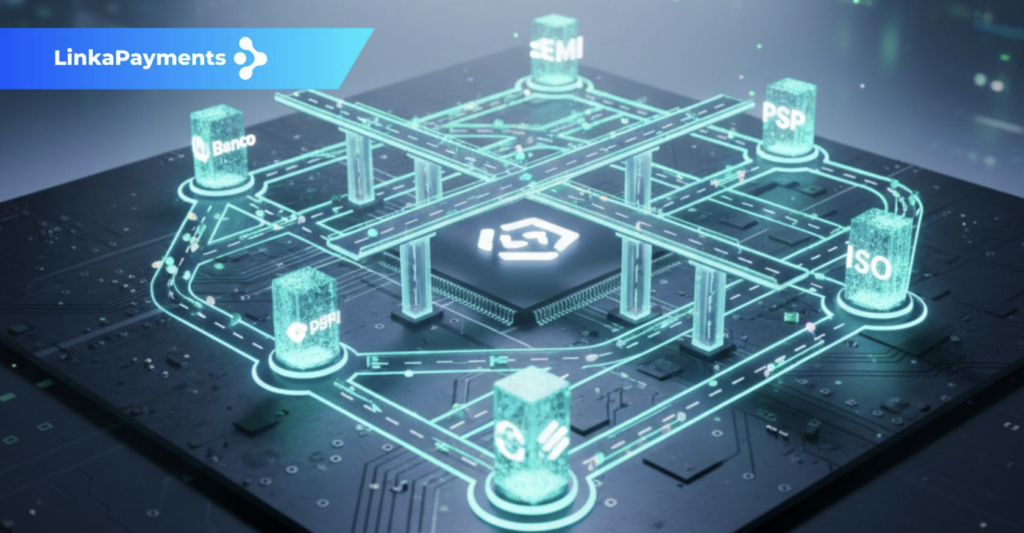
Confusion between regulatory entities is the first step toward an account freeze. Terms like bank, EMI, or PSP are used interchangeably, but they operate under radically different licenses and risk levels.
For a founder in the high-risk sector , not understanding who's who in the processing chain is like walking blindly through a regulatory minefield, something that often leads to the need for crisis management when your PSP gives you 24 hours to get out.
The map of actors: roles and capabilities
The market is no longer a banking monopoly. Specialization has fragmented functions to offer greater agility, but also greater complexity.
| figure | Regulatory | Principal function | Risk Profile |
|---|---|---|---|
| traditional bank | Banking license | Deposit taking and credit granting. | Very conservative |
| EMI (Electronic Money) | EMD2 Directive | Operating accounts and digital currency issuance. | Agile / Technological |
| PI (Payment Institution) | PSD2 Directive | Transaction execution and acquiring services. | Specialized Team |
| PSP (Payment Service Provider) | Service | Technical interface for accepting payments. | Technical intermediary |
| ISO (Independent Sales Org.) | Commercial | Strategic connector between merchant and supplier. | Advisory |
Structure analysis: Which one does your business need?
1. Traditional financial institution: the "fort knox"
These are deposit-taking institutions with full banking licenses. Their main advantage is their stability; their biggest disadvantage is an extremely rigid compliance department that tends to reject high-risk or innovative business models outright.
2. EMI vs. PI: the engine of Fintech
- EMI (Electronic Money Institution): It is the ideal option for managing treasury and international operations. Since it cannot lend its clients' money (unlike banks), the funds are subject to processes of safeguard, offering a superior layer of technical security.
- PI (Payment Institution): If your need is strictly for money to travel from point A to point B (card processing or acquiring), a Payment Institution is usually more efficient in terms of cost and execution.
3. The PSP and ISO pairing
While the PSP provides the technical infrastructure (the payment gateway), the ISO acts as the strategic architect.
ISO has a deep understanding of each entity's "risk appetite" and prevents merchants from "burning" their brand by being systematically rejected for not fitting the supplier profile.
Strategic recommendations for founders
- Multi-entity architecture: Modern financial resilience doesn't depend on a single partner. Diversification is vital: use an EMI for corporate operations and a dedicated PI for the acquiring.
- Redundancy is survival: If your primary supplier experiences a regulatory change or loses its acquiring bank, your business can't stop. Maintaining a diversified structure is your insurance policy.
- Prefilter: Before starting a With an EMI or a bank, make sure their license covers both your geographic jurisdiction and your specific business model.
Is your payments architecture truly robust? At LinkA Payments, we don't just find a provider; we design the regulatory framework your business needs to scale seamlessly.
Frequently asked questions about payment institutions
No. The PSP is the operational and technological facilitator, while the Payment Entity is the legal and regulated entity that holds the license to move the funds.
It depends on your business model. For many digital businesses, an EMI offers all the necessary functionality (IBAN accounts, transfers, payments) with much greater agility than a traditional bank.
We act as a filter and bridge. We analyze your risk, pre-evaluate your documentation, and connect you directly with the entity (EMI, PI, or Bank) that truly accepts your business vertical.